Ecosystems
Ecosystems Overview
Introduction to Ecosystems
- Mr. Andersen introduces the topic of ecosystems, highlighting the proximity of Bozeman to the Greater Yellowstone Ecosystem.
- He explains the ecological hierarchy using the acronym BBECPO: Biosphere, Biome, Ecosystem, Community, Population, Organism.
Defining an Ecosystem
- An ecosystem encompasses all biotic (living) and abiotic (non-living) characteristics in a specific area.
- Yellowstone National Park was established in 1872 primarily to protect geothermal features like Old Faithful but inadvertently preserved a pristine ecosystem.
The Greater Yellowstone Ecosystem
- The concept of an ecosystem around Yellowstone gained attention in the 1970s during studies on grizzly bears.
- There is a conflict between national park land and private land ownership affecting wildlife management.
Primary Productivity and Its Importance
Understanding Primary Productivity
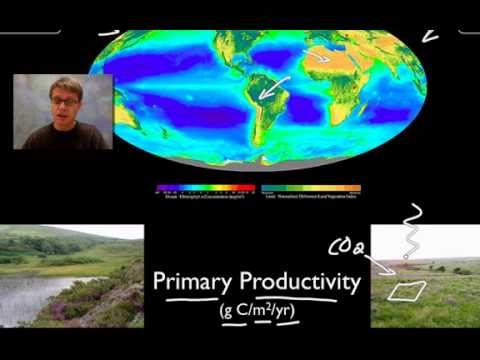
- Primary productivity refers to how much biomass producers create in an area due to energy from sunlight and recycled matter.
- It is measured by assessing carbon production by photosynthetic organisms within ecosystems.
Factors Influencing Primary Productivity
- Various factors can impact ecosystems including biotic (living organisms) and abiotic (environmental conditions), leading to competition for resources.
- Human activities can disrupt natural balances within ecosystems, potentially causing extinctions.
Measuring Primary Productivity
Methods of Measurement
- Primary productivity is quantified as grams of carbon per square meter per year; this indicates how much livable mass is produced by photosynthesis.
Understanding Trophic Levels and Ecosystem Dynamics
Introduction to Trophic Levels
- The concept of trophic levels is introduced, defined as "eating levels" within an ecosystem.
- Trophic level one consists of producers, primarily algae in Lake Ontario, which convert solar energy into organic material.
Consumers in the Food Chain
- Trophic level two includes consumers that cannot produce their own food; they rely on other organisms for sustenance.
- Second-level consumers feed on first-level consumers (e.g., amphipods eat algae, rainbow smelt eat amphipods).
- The fourth trophic level features third-level consumers like chinook salmon, illustrating a linear food chain structure.
Food Web Complexity
- A food web encompasses multiple interconnected food chains, showcasing various interactions among species in Lake Ontario.
- The complexity of ecosystems is highlighted by the numerous connections between different organisms and their adaptations to specific environments.
Population Growth Dynamics
- All populations exhibit exponential growth initially but face limiting factors such as competition and environmental changes.
- Eventually, population growth becomes logistic due to carrying capacity (K), representing the maximum sustainable population size in an ecosystem.
Case Study: Wolves in Yellowstone Park
- The reintroduction of wolves into Yellowstone Park in 1995 serves as a case study for population dynamics and ecological balance.
- Wolf populations have fluctuated over time but are approaching logistic growth patterns with a carrying capacity around 140–150 wolves.
Impact on Elk Population
- The elk population has significantly decreased from approximately 16,000 to about 5,000 due to predation pressure from wolves.
Ecosystem Dynamics and Human Impact
Predator-Prey Relationships
- The wolf population in Yellowstone is affected by food availability, leading to fluctuations in both wolf and elk populations. As the wolf numbers decrease due to limited food, the elk population may rebound.
- This dynamic creates an equilibrium that benefits wolves but poses challenges for elk hunters, as the elk population has significantly decreased from 16,000 to around 5,000.
- The movement of wolves into private areas outside Yellowstone raises human-wildlife conflict issues.
Human Influence on Ecosystems
- Humans can unintentionally cause significant changes in ecosystems; a case study involves the whitebark pine found in Yellowstone Park.
- Whitebark pine trees produce nuts that are crucial for squirrels and grizzly bears. Squirrels create "middens" or stashes of these nuts which are also raided by bears.
Climate Change Effects
- Global warming is impacting the whitebark pine population negatively. Projections indicate that even moderate temperature increases could lead to their decline.
Turn any video into a summary like this
YouTube links, meetings, lectures — with transcripts, search, and chat.