Hooke's Law and Elastic Potential Energy
Introduction to Hooke's Law and Springs
In this section, we will learn about Hooke's Law and the basic idea behind it. We will also understand the proportionality between force and displacement of a spring.
Understanding Hooke's Law
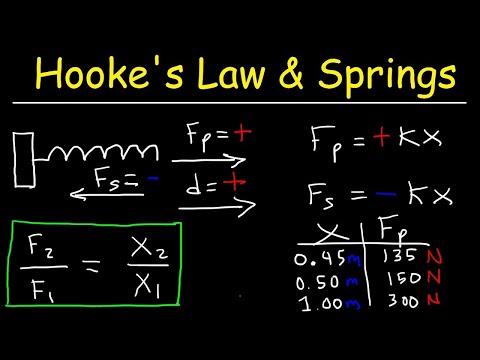
- When a force is applied to stretch a spring, it stretches towards the right.
- The force required to stretch a spring by distance x is proportional to x. This can be represented as Fp = kx, where k is the spring constant.
- The proportionality between Fp and x works up to a limit known as the elasticity region. Beyond that, the spring can elongate without much extra force.
Restoring Force
- Once you apply a force Fp on a spring, it reaches equilibrium. At this point, another force pulls the spring back to its original length. This force is known as restoring force (Fs or Fr).
- Fs is equal in magnitude but opposite in direction to Fp.
- The magnitude of restoring force is proportional to how much you stretch or compress the spring from its natural length.
Solving Problems Related to Hooke's Law
In this section, we will solve problems related to Hooke's law using equations.
Finding Spring Constant
- To find the value of spring constant (k), divide the applied force (Fp) by distance stretched (x).
- For example: If 200 N of force stretches a spring by 4 meters then k = 50 N/m.
Finding Required Force
- To find the force required to stretch a spring by a certain distance, use the equation Fp = kx.
- For example: If k = 300 N/m and we want to stretch the spring by 45 cm, then Fp = (300 N/m) x (0.45 m) = 135 N.
The stiffness of a spring increases as its spring constant increases in value.
Physics Problems
In this section, the speaker solves three physics problems related to force and distance.
Force Required to Move an Object
- A force of 300 newtons is required to move an object at a distance of 1 meter.
- Divide the distance by 2 and divide the force by 2 to get the answer for a distance of 0.45 meters, which is 135 newtons.
- Always check if your answer is reasonable.
Stretching a Spring
- A force of 250 newtons is required to stretch a spring by 24 centimeters.
- Calculate the spring constant k by dividing the force by the distance, which gives us a value of approximately 1041.6 repeating.
- To find out how far it will stretch with a new force of 900 newtons, divide that force by k to get approximately 0.864 meters or 86.4 centimeters.
- Alternatively, use ratios and cross-multiplication to get the same answer.
Work Required to Stretch a Spring
- The speaker discusses how much work is required to stretch a spring by a certain displacement x.
- Work is equal to force times displacement, but since f depends on x in this case (f=kx), we need to make a graph between force and displacement.
- The graph will be linear with slope k, so we can calculate work as area under the line using calculus or geometry.
Calculating Work and Elastic Potential Energy of a Spring
In this section, the speaker explains how to calculate the work required to stretch a spring and the elastic potential energy stored in a spring when it is stretched by a certain force.
Calculating Work Required to Stretch a Spring
- The area of a triangle with base x and height f is 1/2 * f * x. This equation holds true if the force is constant.
- If the force is variable, then the work done by that variable force is the area under the curve, which is 1/2 * f * x.
- The work required to stretch a spring can be calculated using the equation: 1/2 * k * delta_x^2, where k is the spring constant and delta_x is the change in position.
Example Calculation
- Given k = 250 N/m and delta_x = 0.75 m, we can calculate that the work required to stretch the spring is 70.3 J of energy.
Calculating Elastic Potential Energy Stored in a Spring
- The elastic potential energy stored in a spring can be calculated using the equation: 1/2 * k * x^2, where k is the spring constant and x is relative to the natural length of the spring.
- The work done by an applied force on a spring equals its change in potential energy if acceleration is zero.
- Therefore, W = final potential energy - initial potential energy
- For elastic potential energy specifically: U = 1/2kx^2
Example Calculation
- Given k = 450 N/m and delta_x = 0.25 m, we can calculate that elastic potential energy stored in a spring when it's stretched by this amount of force equals (1/2)450(0.25)^2 J or approximately 7.03 J of energy.
Spring Constant and Potential Energy
In this section, the speaker explains how to calculate the spring constant and potential energy of a spring.
Calculating Spring Constant
- The spring constant is calculated by dividing the force applied to the spring by its displacement from its natural position.
- As the spring constant increases, so does the stiffness of the spring.
- The work required to stretch a spring is directly proportional to its spring constant.
Calculating Potential Energy
- The potential energy of a stretched spring can be calculated using the formula 1/2 * k * x^2, where k is the spring constant and x is the displacement from its natural position.
- The speaker provides an example calculation for finding potential energy.
Work Required to Stretch a Spring
In this section, the speaker explains how to calculate the work required to stretch a spring from one position to another.
Example Problem
- The problem involves calculating how much work is required to stretch a given spring from one position (position A) to another (position B).
- To solve this problem, we need to use the equation 1/2 * k * delta x^2, where delta x is equal to x final - x initial.
- It's important not to confuse delta x with x final - x initial. Delta x should be calculated as described in step 2.
- The answer for this problem is 0.352 joules.
Verifying Answer
- The speaker provides an alternative method for verifying the answer by calculating the potential energy at positions A and B.
- The work required to stretch the spring is equal to the difference in potential energy between positions A and B.
Additional Details
In this section, the speaker provides additional details about calculating work required to pull a spring.
Pulling Force
- Fp is defined as the pulling force or force used to stretch a spring.
- When drawn to the right, Fp is considered a positive force.
Work Done by a Spring
In this section, we learn about the work done by a spring and how it relates to the force and displacement vectors.
Work Required to Stretch a Spring
- The work required to stretch a spring is positive.
Work Done by the Elastic Force
- The work done by the elastic force is negative.
- This work is equal to -1/2 k delta x squared as the spring is being pulled to the right.
Change in Potential Energy
- The change in potential energy for conservative forces like gravity, electric force, or elastic force is negative times the change in potential energy.
- The expression for change in potential energy for an elastic force is 1/2 k delta x squared.
Positive vs Negative Sign of Work
- Whether the sign of work done by a force is positive or negative depends on which force you're talking about and where the spring is being stretched or compressed.
- If the force and displacement vectors are in the same direction, then work is positive; if they're in opposite directions, then work is negative.