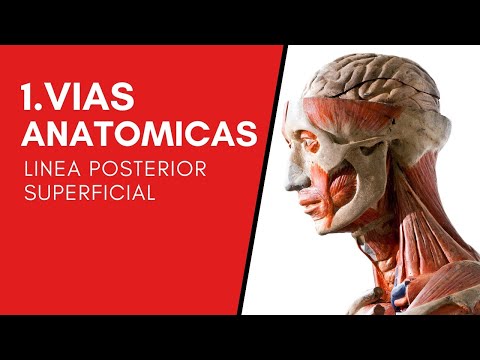
1/12. Vías anatómicas. Línea posterior superficial del Anatomy Trains.
Anatomical Pathways: Understanding the Superficial Back Line
Introduction to Anatomical Pathways
- The concept of anatomical pathways, also referred to as chains or meridians, is introduced. These include terms like neo-facial chains and myofascial meridians, which connect muscles and fascia in the body.
- The categorization emphasizes continuities between facial muscles, bones, and fascia that help explain movement and posture. This discussion is based on Meyer's book "Anatomy Trains."
Overview of the Superficial Back Line (SBL)
- The superficial back line refers to the posterior surface of the body, starting from the supra-orbital area down to the feet. It includes various anatomical components that will be explored in detail.
- Key structures involved in this pathway include muscles such as frontalis and occipitalis, along with connective tissues like the epicranial aponeurosis.
Components of the Superficial Back Line
- The SBL consists of several key anatomical features:
- Frontal Area: Involves frontalis muscle and epicranial aponeurosis connecting it to occipital muscle.
- Spinal Erectors: Includes extensor musculature located in the posterior region along with sacral fascia and ligaments connecting sacrum to ischial tuberosity where hamstrings attach.
- Hamstring Group: Comprises biceps femoris among others; these muscles establish continuity from sacrum through to lower leg structures including Achilles tendon and plantar fascia.
Reverse Route Analysis
- A reverse route analysis illustrates how all components connect from foot back up through calf muscles (gastrocnemius), hamstrings, sacrotuberous ligament, spinal erectors, neck extensors up to supra-orbital area. This highlights interconnectedness within SBL anatomy.
Detailed Examination of Neck Extensors
- Focus shifts towards specific neck extensors:
- Rectus Muscles: Rectus posterior minor/major run from atlas/axis vertebrae to occipital bone; oblique muscles connect similarly but differ in attachment points.
- Complex Minor & Longissimus: These extend from cervical/dorsal vertebrae towards mastoid process indicating their role in maintaining head position relative to spine structure.
Final Review of Superficial Back Line
- Recap emphasizes understanding SBL's comprehensive nature involving muscle groups (hamstrings), ligaments (sacrotuberous), bones (calcaneus), and fascia (plantar). Each component plays a crucial role in overall body mechanics affecting everything from foot movements up through cranial structures.
- Importance for training methodologies and manual therapies is highlighted; any dysfunction at one point can influence distant areas due to this interconnected chain system within human anatomy.
This concludes an overview of the superficial back line as part of broader anatomical pathways essential for understanding human movement dynamics.