Damped Oscillations
Introduction to Drag Force in Simple Harmonic Motion
In this section, we will discuss the addition of a drag force to simple harmonic motion and how it affects the system.
Drag Force Model
- The drag force is proportional to velocity and opposes the velocity vector.
- It is represented by a constant value B.
Differential Equation Form
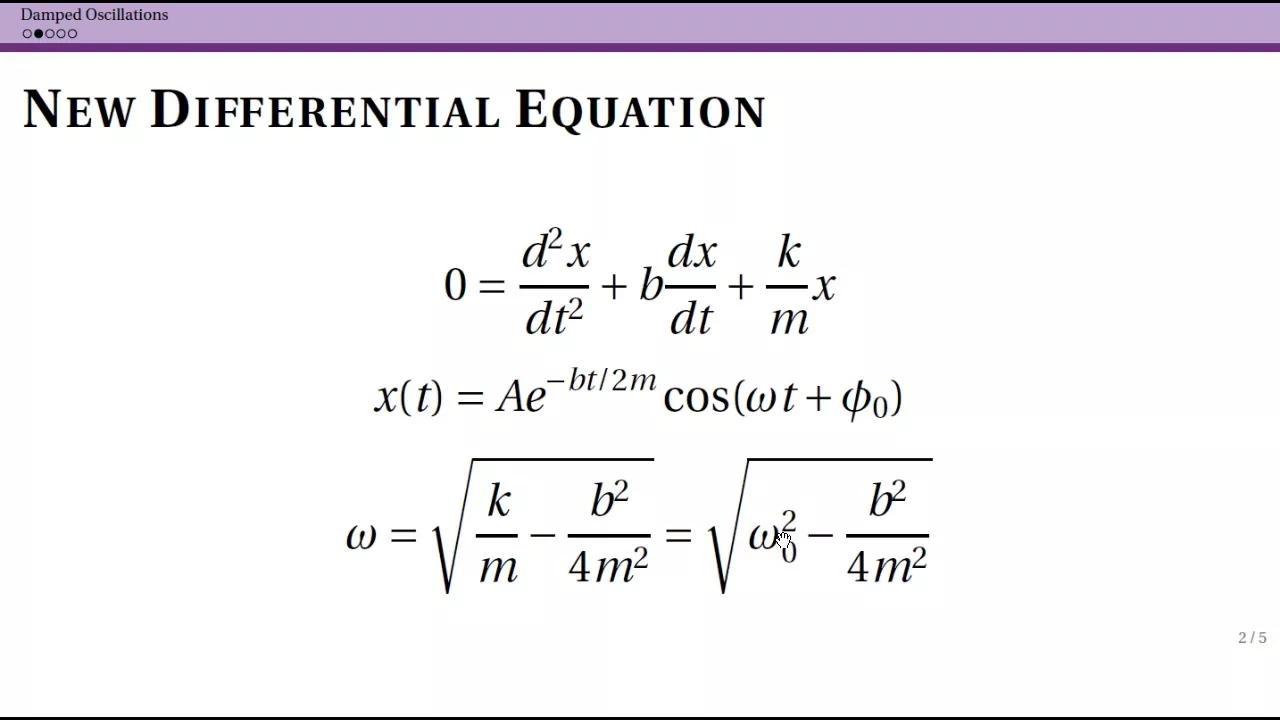
- The equation of motion for a mass on a horizontal spring with drag force can be written as:
- (Equation)
- This differential equation cannot be easily solved without further analysis.
Solution for the Differential Equation
- The solution to the differential equation involves an exponential term and cosine function.
- Omega (Ω) is determined by taking derivatives and plugging them back into the equation.
- Omega has two components: Omega naught (Ω₀) and a correction term due to damping.
Lightly Damped Approximation
- In lightly damped situations, where B/2m is small compared to Ω₀, Omega can be approximated as Ω₀.
- This approximation holds when B/2m << sqrt(K/m).
Amplitude Decay and Envelope
- In the presence of damping, the amplitude of oscillations gradually decreases over time.
- The decrease follows an exponential decay given by an envelope function.
- Energy is conserved when there is no damping (B = 0), but it decreases with increasing damping.
Comparing Damping Ratio with Angular Frequency
Here we explore how the damping ratio compares with angular frequency in determining the behavior of damped oscillations.
Comparison between B/2m and Ω₀
- The behavior of damped oscillations depends on comparing B/2m with Ω₀.
- If B/2m is much smaller than sqrt(K/m), then Omega is approximately equal to Omega naught.
Energy Conservation and Damping
- Increasing damping (larger B) leads to faster decrease in amplitude.
- The shape of the decay remains exponential regardless of the damping ratio.
Exponential Decay and Energy Conservation
In this section, we discuss the relationship between exponential decay, amplitude, and energy conservation in damped oscillations.
Exponential Decay of Amplitude
- The amplitude of damped oscillations decreases with time following an exponential function.
- The exponential term has a negative sign, indicating a decrease from maximum amplitude over time.
Energy Conservation
- When there is no damping (B = 0), the amplitude remains constant, and energy is conserved.
- Increasing damping (larger B) leads to faster decrease in amplitude and decreasing energy over time.
New Section
This section discusses the position and energy of a system, which is exponentially decreasing over time. The concept of a time constant is introduced to measure the rate of decay.
Position and Energy Decay
- The position of a system is given by an equation that shows exponential decay.
- The maximum value of x occurs when the exponential term reaches its maximum.
- The energy of the system is also exponentially decreasing over time.
- In physics, equations like this are often put into a standardized form using a time constant.
- The time constant for this system is calculated as 2M/B, where M represents mass and B represents another variable.
New Section
This section further explains the concept of a time constant and its significance in measuring decay rates. It draws parallels with other fields such as chemistry and biology.
Understanding Time Constant
- The time constant, represented by 2M/B, determines how quickly the system decays.
- By using the same mathematical relationship, various processes can be described in terms of their respective time constants.
- Examples include radioactive decay in chemistry and certain biological processes.
- Although damped oscillations may not be the main focus in this chapter, understanding exponential decay behavior is important.
New Section
This section emphasizes that exponential decay behavior can be observed in various fields beyond physics.
Exponential Decay Behavior
- Exponential decay behavior is not limited to physics but can also be found in chemistry and biology.
- While damped oscillations may not be extensively covered in this chapter, it serves as an example to illustrate exponential decay behavior.