Transporte pasivo y permeabilidad selectiva | Biología | Khan Academy en Español
How Do Molecules Cross Cell Membranes?
Introduction to Molecular Transport
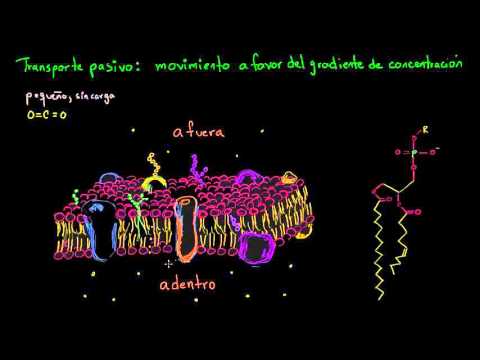
- The video discusses how molecules can cross a cell membrane, either from outside to inside or vice versa.
- The first type of transport introduced is passive transport, which does not require energy and involves the movement of molecules along their concentration gradient.
Understanding Passive Transport
- A semi-permeable membrane's permeability depends on the type of molecule attempting to pass through it.
- Small molecules can diffuse through the spaces between phospholipid heads and hydrophobic tails in the membrane, facilitating easier passage.
Examples of Diffusion
- Carbon dioxide (CO2), being small and uncharged, diffuses easily across membranes. Higher concentrations inside cells lead to more CO2 exiting than entering.
- Uncharged molecules like CO2 are not attracted or repelled by hydrophilic heads of phospholipids, aiding their movement through the membrane.
Oxygen Diffusion
- Molecular oxygen (O2), similar to CO2, also diffuses well due to its size and lack of charge.
- With higher concentrations outside cells compared to inside, there will be a net flow of O2 into the cell as random movements favor this direction.
Challenges for Charged Particles
- Charged particles such as sodium ions (Na+) face difficulties crossing membranes due to attraction towards hydrophilic heads that prevent their passage.
- These charged ions accumulate near hydrophilic regions but cannot migrate across due to electrostatic interactions with the membrane components.
Water as an Intermediate Molecule
- Water is highlighted as an important intermediate molecule; while it has partial charges due to its structure (one oxygen and two hydrogen atoms), it can still navigate through membranes under certain conditions.
Understanding Hydrophilic Heads and Membrane Permeability
The Role of Hydrophilic Heads
- The discussion begins with the concept of hydrophilic heads in phospholipids, which are attracted to water due to their affinity for it.
- Water molecules, despite having a weaker charge, can interact with these hydrophilic heads, allowing some to pass through the membrane after several interactions.
Water Molecules and Membrane Diffusion
- Water molecules are small enough to diffuse across membranes, although not as easily as carbon dioxide or oxygen molecules due to their polar nature.
- Future discussions will explore how diffusion can be facilitated for water molecules.
Aquaporins: Facilitating Water Movement
- Aquaporins are introduced as channels that traverse membranes, enabling water to move more efficiently without interacting with the membrane's hydrophobic regions.
Limitations of Larger Molecules