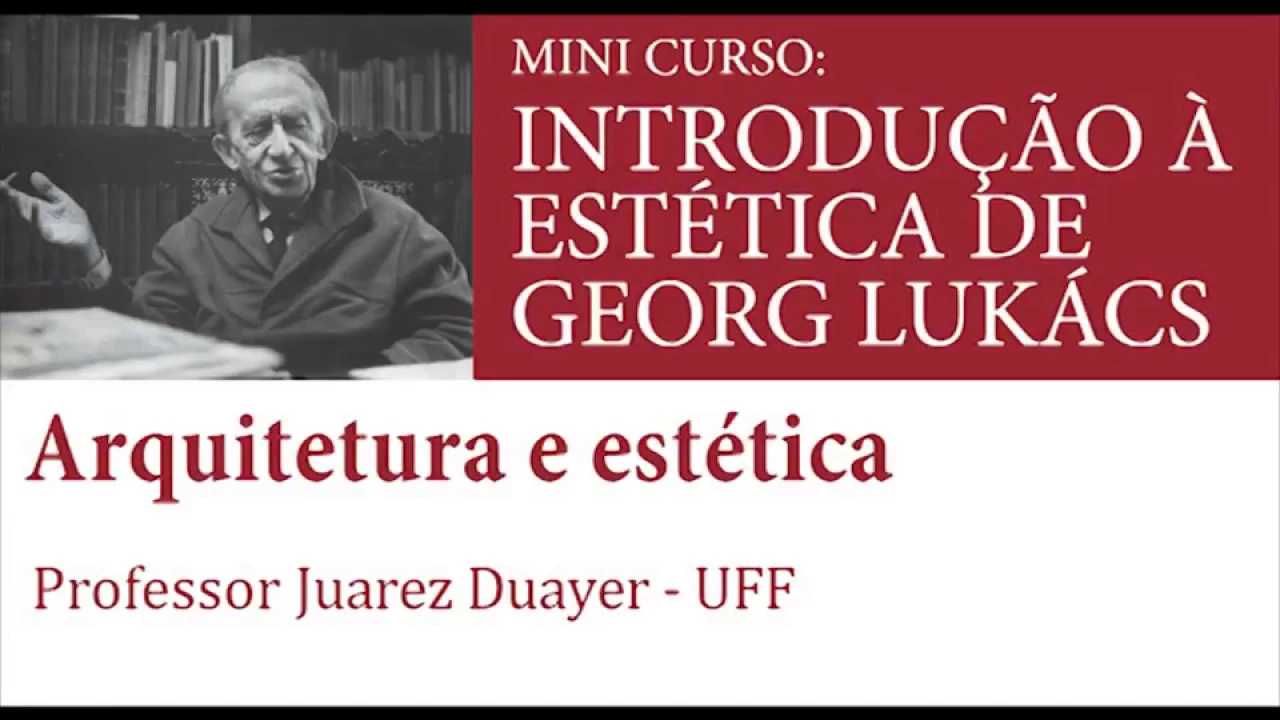
MiniCurso: Introdução à Estética de Georg Lukács - 08 12 - Juarez Duayer
Introduction to Georg Lukács' Aesthetics
The speaker introduces the mini-course on Georg Lukács' aesthetics, highlighting the upcoming lecture by a professor from UFF focusing on Marxist aesthetics, architecture, art history, and philosophy.
Architecture Aesthetics
- The presenter discusses the block titled "Architecture Aesthetics" and mentions that certificates will be sent via email to participants. There will be a test but not graded harshly.
- Reflection on the significance of an event related to Max's exile at a Brazilian university, emphasizing its importance beyond just current circumstances.
- Noteworthy participation in discussions about art within Marxist circles and Lukács studies, highlighting both quantity and quality of interventions.
- Comparison between attendance at recent events in Hungary and Brazil concerning Lukács studies, noting differences in audience size.
- Acknowledgment of attendees' presence and gratitude expressed towards students for their cultural engagement within the critical perspective of architectural education.
Lukács Studies Insights
- Discussion on shifts within architectural education towards conservatism and challenges faced due to faculty changes.
- Reference to previous presentations by different speakers with positive feedback given; emphasis on diverse perspectives enriching discussions.
- Preparation for discussing Lukács' work amidst challenges faced by scholars concentrating more on social sciences than aesthetics within academic settings.
Lukács' Works Analysis
- Recognition of scholars delving into Lukács' works despite limited focus on aesthetics within academic circles; challenges posed by language barriers in accessing original texts.
- Anticipation of exploring Lukács' monumental works spanning multiple volumes and complexities encountered in studying his aesthetic theories amidst contemporary academic trends.
Historical Context & Edition Analysis
- Introduction to Lukács' extensive writings with references to editions available in different languages; discussion on challenges faced due to limited scholarly focus on aesthetics.
- Mention of valuable editions of Lukács' works available in various languages including German, French, Italian, reflecting historical contexts during which these were written post-war periods.
Esthetic Peculiarities & Influences
- Delving into the peculiarities of Lukács’ aesthetic theories across volumes published over time; reference made to influences such as Rego's esthetic model shaping architectural discourse.
- Exploration of early editions of Lukács’ works dating back to 1962 with insights into his evolving aesthetic concepts influenced by wartime experiences.
Conclusion & Symbolism Discussion
- Reflection on the monumental nature of Lukács’ multi-volume works encompassing diverse aesthetic dimensions; pondering influences like Rego’s esthetic model shaping architectural ideologies.
New Section
In this section, the speaker discusses the extensive work of a particular individual and their shift from an aesthetic project to a Marxist ethics focus.
Detailed Discussion on Work and Shift
- The individual's work spans nearly two thousand pages, with sixteen chapters across four volumes.
- There was a transition from working on an aesthetic project to delving into Marxist ethics.
Reception of Aesthetics
This part explores the reception of aesthetics, particularly in the country, highlighting challenges in accessibility and confinement.
Reception Challenges
- Accessibility issues hinder understanding and study of aesthetics.
- The confinement of aesthetics poses difficulties for individuals studying the subject.
Encounter with Chassi
The speaker recounts an encounter with Chassi during a period when he was returning from exile.
Noteworthy Encounter
- During his return from exile, Chassi was encountered in João Pessoa, showcasing his involvement in reediting essays.
Legacy and Aesthetic Thought
This segment delves into the legacy and significance of aesthetic thought within Lukács' works.
Legacy Insights
- Lukács' writings serve as a crucial legacy for understanding aesthetics.
- His notes provide valuable insights for beginners entering the field.
Musical Pursuits
Here, Lukács' interest in music is discussed alongside its importance within his broader intellectual pursuits.
Musical Engagement
- Lukács' engagement with music presents a significant challenge and interest beyond architecture.
Interview Insights
The discussion centers on Lukács' interviews, shedding light on key themes explored during these conversations.
Interview Revelations
- Lukács' interviews offer profound insights into various intellectual realms such as art and science.
Discussion on Lukács' Work and Ideology
The discussion delves into the life and work of Lukács, focusing on his ideological perspectives and influences.
Lukács' Ideological Evolution
- Lukács' early desire to change his name was influenced by Marxist ideologies.
- His militant character is highlighted through his dedication to the Communist Party.
- The concept of social mission in Lukács' work carries an emancipatory dimension related to humanity.
Emancipatory Themes in Lukács' Works
- The notion of belonging to the human genre is central in Lukács' writings.
- Lukács' aesthetic trajectory reflects a commitment to themes of abandonment and emancipation.
Influence of Historical Context on Lukács
This segment explores how historical events shaped Lukács' literary contributions and ideological stance.
Impact of Historical Events
- Lukács remained true to his aesthetic principles despite external pressures during periods like Stalinism.
- His texts during challenging times paved the way for his later works, particularly concerning Stalinist influence.
Lukács' Experiences in Soviet Union
Discusses Lukács' experiences during his time in the Soviet Union and their impact on his artistic development.
Soviet Influence on Artistic Development
- Despite facing imprisonment, Lukács maintained a critical stance towards certain literary forms.
- Interaction with figures like Michael Engels influenced his exploration of various art forms, enriching his perspective.
Debate on Realism vs. Proletarian Art
Explores the debate surrounding realism versus proletarian art within the context of Lukács' career.
Realism vs. Proletarian Art
- The period marked a consolidation of ideas around realism, diverging from notions of proletarian art.
- Discussion highlights the evolution of Lukác's views over 15 years, emphasizing a departure from earlier dilemmas.
Contemporary Relevance of Ideological Debates
Examines how debates around ideology remain pertinent today, drawing parallels with past discussions.
Modern Relevance
- Ongoing debates echo historical tensions, as seen in contemporary discussions at conferences like Locas Congress.
Reception of Lukács' Work in Brazil and Europe
The discussion revolves around the reception of Lukács' work, particularly in Brazil and Europe, highlighting instances where his ideas were influential and how they were perceived.
Reception of Lukács' Work
- Lukács' work was well-received not only in Brazil but also in Europe.
- Comparisons are drawn between how Lukács helped in the field of music akin to Adorno assisting Thomas Mann with Faust.
- After escaping from Hungary to the Soviet Union, efforts were made internationally to protect him.
- Lukács had a dedicated chapter on music within his works, including a letter related to Thomas Mann.
- Critiques suggest that current writings on aesthetics lack depth and insight.
Influence and Translation Efforts
This section delves into the influence of Lukács' work on individuals and the translation efforts surrounding his texts.
Influence and Translation
- Individuals like José Chaves took up translating Lukács' works posthumously.
- Various scholars engaged with translating and studying Lukács' works, such as Paulo Arantes and Sérgio Lessa.
- Different regions in Brazil have groups dedicated to studying Lukács, showcasing varied levels of engagement.
Diverse Engagement with Lukács' Ideas
This part explores the diverse engagement with Lukács’ ideas across different regions and academic circles.
Diverse Engagement
- Regions like Alagoas, Niterói, João Pessoa show active interest in studying Lukács’ philosophy.
- Mention of clandestine groups around Buenos Aires linked to Miguel Vedda's circle engaging with his ideas.
Exploring Aesthetics through Artistic Modes
The discussion shifts towards exploring aesthetics through artistic modes as influenced by Lukács’ theories.
Exploring Aesthetics
- Bernardo Rezende’s focus on Russian authors aligning with certain aspects of Lukács’ theories is highlighted.
Reflection on Artistic Modes
Reflecting on artistic modes as per Max Weber’s concepts is discussed within the context of reflecting the world artistically.
Reflection on Artistic Modes
New Section
In this section, the speaker discusses the interplay between regular and particular elements in art, emphasizing the importance of understanding the dialectic between universal and individual aspects.
Regular vs. Particular in Art
- The speaker highlights the significance of navigating the dialectic between regular and particular elements to grasp art's essence.
- Reference is made to a book discussing complexity in aesthetics, focusing on the interplay between regularity and uniqueness.
- The concept of particularity in art is explored, emphasizing its connection to artistic reflection and immanence.
- Students are encouraged to engage with anthropomorphism and mobilization in art classes to understand reflective processes better.
- Art is portrayed as a reflection of human existence, showcasing a deep-rooted connection between art and humanity.
New Section
This segment delves into the enduring nature of art throughout history, drawing parallels between mythological narratives and contemporary emotional responses to ancient artifacts.
Endurance of Art through Time
- The discussion centers on Max's exploration of Greek mythology's emotional impact on individuals across different eras.
- Emphasis is placed on how ancient artifacts evoke emotions due to their historical significance and cultural resonance.
- The notion of catharsis is introduced concerning emotional purging through engagement with art forms like literature.
- A comparison is drawn between modern perceptions of Greek contributions to knowledge and creativity with historical perspectives.
New Section
This part focuses on evolving human inquiries over time, particularly regarding significant questions about humanity's essence and artistic expression.
Evolution of Human Inquiry
- The evolution of human questioning over time is highlighted, indicating shifts in fundamental inquiries about human existence.
- Discussions touch upon students' progression from introductory topics towards more complex analyses within educational settings.
- References are made to works exploring uneven historical developments as exemplified by architectural advancements compared to other arts.
New Section
This section delves into architecture as a unique form of artistic expression that reflects societal structures and historical contexts.
Architecture as Reflective Art
Architecture and Artistic Sensibility
In this section, the speaker discusses the relationship between architecture and artistic sensibility, emphasizing the importance of a deep understanding of art in architectural practice.
Architecture and Education
- The speaker highlights the significance of literature in architecture, drawing attention to the insights gained from thinkers who have a background in literature.
Artistic Sensibility in Architecture
- Reference is made to Hitler's failed attempt at entering an architectural school due to his lack of inclination towards architecture, underscoring the need for genuine artistic sensibility in this field.
Aesthetic Peculiarities
- Exploring the uniqueness of aesthetic expressions across different art forms that require dedicated study and understanding beyond mere technical skills.
Art, Taxonomy, and Human Experience
This segment delves into the intersection of art, taxonomy, and human experience within architectural discourse.
Universal Themes in Art
- Discussion on how taxonomy aids in categorizing elements of the world, reflecting commonalities among diverse fields such as music, dance, and architecture.
Aesthetics and Natural Order
- Exploring the fundamental role of natural laws and material properties in shaping architectural design through control systems like gravity resistance.
Mimesis and Architectural Expression
The conversation shifts towards mimesis as a concept influencing architectural expression and human perception.
Mimetic Processes
- Delving into mimesis as a tool for creating spaces that resonate with human emotions while addressing both aesthetic and strategic needs within architecture.
Architecture: Historical Context and Development
This part focuses on tracing the historical evolution of architecture within societal contexts.
Evolution of Architecture
Desatualização e Sensibilidade Humana na Arquitetura
The discussion delves into the evolution of human sensitivity and its reflection in architecture, emphasizing the role of architecture in intensifying human experiences.
Evolution of Human Sensitivity
- Architecture evolves beyond mere shelter production to spaces that intensify human experiences.
- Lukács emphasizes collective needs over individual mimicking in architecture to enhance human experiences.
- Exploration extends to various art forms like music, crafts, and gardening to understand how sensitivities are incorporated progressively.
Life's Daily Activities and Aesthetics
Life's daily activities serve as a foundation for aesthetics, shaping artistic reflections and societal realities.
Significance of Daily Life
- Analogies drawn between daily life and rivers like Sapucaí or Danube highlight aspirations and local contexts' influence.
- Aesthetic concepts stem from daily life needs, bridging social realities with artistic expressions.
- Development in arts reflects societal progress through unique structures based on communal necessities.
Artistic Reflections of Daily Life
Understanding how artistic reflections capture nuances of daily life and transform them into aesthetic expressions.
Artistic Interpretation
- Challenges in linking historical architectural sensitivities due to varied forms necessitate a nuanced approach.
- Artistic reflections go beyond catharsis, requiring emotional engagement for profound aesthetic appreciation.
New Section
In this section, the speaker reflects on a period where they were away from a particular location. They recall instances of individuals engaging with books and literature, highlighting the importance of exploring various texts.
Reflections on Literature and Engagement
- During a time when the speaker was absent from a place, they reminisce about people gathering in a room or library to delve into books.
- The speaker mentions scenes from cinema involving children and Bolshevik elders, discussing elements of Cuban cinema and intellectual perspectives.
- Reference is made to authors attempting to explore aesthetics through Kantian principles, emphasizing different viewpoints in artistic endeavors.
- The significance of biographies and revolutionary figures like Max and Rosa Luxemburg is highlighted for their contributions to ideological discussions.
- Aesthetic considerations are discussed in relation to Marxist thought, touching upon the concept of an engaged art form against societal norms.
New Section
This segment delves into the role of artistry within political contexts, emphasizing the importance of artistic expression as a means of social commentary and critique.
Artistic Expression and Social Commentary
- The speaker discusses how artists like Melo Kaká embraced communism while challenging traditional aesthetic norms.
- There is mention of students' generosity towards creating protest architecture as a form of societal resistance within creative fields.
- Architecture's unique reflection on society's needs is explored, focusing on its role in shaping urban spaces based on societal reflections.
- The assertion that dominant class ideologies influence architectural designs is discussed alongside the notion that built environments reflect societal contradictions.
New Section
This part emphasizes Lukács' views on human emancipation through artistry and his efforts to merge revolution with comprehensive humanism in his works.
Lukács' Ideals and Human Emancipation
- Lukács' commitment to intertwining revolution with humanism in his writings is highlighted as pivotal for renewing Marxist ideologies.
- The speaker reflects on Lukács' struggles against collective ideals prevalent during his time, particularly addressing issues related to socialist realism versus individual artistic expressions.
New Section
This section focuses on Ana Lukács' textual interventions regarding revolution and integral humanism within specific historical contexts.
Ana Lukács' Textual Interventions
- Ana Lukács' writings are examined concerning historical events such as communal living experiences and massacres, shedding light on her narrative style.
Detailed Discussion on Various Topics
In this section, the speaker delves into various topics related to books, memories, and art, providing insights into different aspects of literature and painting.
Ronaldo's Last Book and Artistic Influences
- : Discusses Ronaldo's latest book cover inspired by a Renaissance painter named Jordano.
- : Mentions a memoir book by Ronaldo detailing his journey and interactions with artists like Beethoven.
Artistic Interpretations and Discussions
- : Talks about discussions with Paulo regarding art in Ronaldo's office.
- : Reflects on a painting in Ronaldo's office triggering memories for the speaker.
Architectural Insights and Book References
- : Mentions an architecture book related to the speaker's thesis.
- : Introduces a chapter structure discussing Lukács' aesthetics in architecture.
Critique on Philosophical Authors
- : Analyzes authors' views on architecture, focusing on Schopenhauer's perspective.
- : Explores how modern thinkers interpret architectural aesthetics differently from classical Greeks.
Evolution of Architectural Sensibilities
- : Traces the origins of architectural theory back to ancient Greek concepts of space.
- : Discusses the development of architectural forms from ornaments to complete structures.
Aesthetic Reflections in Architecture
- : Examines the dual nature of architectural reflections - scientific and aesthetic.
- : Explores how buildings express both technological advancements and aesthetic sensibilities.
Challenges in Architectural Authenticity
- : Questions whether architecture has evolved authentically compared to other art forms.
Individual vs. Collective Architectural Needs
- : Contrasts individual artistic needs with collective societal requirements shaping architectural design.
Urban Revolutions Impacting Architecture
Discussion on Transformations and Revolutions
The discussion delves into the concept of transformations and revolutions, particularly focusing on a book by an American author that touches on capitalism and internal aspects.
Transformations and Revolutions
- The period of "golpe é produzi los" signifies fundamental transformations akin to a revolution, altering societal relations significantly.
- In the context of the Renaissance, capitalism was not initially prevalent, highlighting shifts in societal structures over time.
- During the Renaissance era, there existed a social pact animating individuals towards certain ideals and possibilities beyond mere material concerns.
Exploration of Historical Periods
This segment explores contrasting views on historical periods such as the Middle Ages, emphasizing their significance in shaping societal ideologies.
Historical Perspectives
- The Middle Ages are depicted as a period often misunderstood or misrepresented due to regressive perceptions compared to classical antiquity.
- Insights into historical events like wars in Guinea and Hungary shed light on ideological shifts and political dynamics during those times.
Critique of Architecture and Ideology
A critical analysis is presented regarding architecture's role in reflecting ideological decay and societal conventions.
Architectural Critique
- Architecture is scrutinized for embodying ideological decadence through superficial facades that mask underlying societal issues.
- The discussion extends to how architectural critique influences various fields like philosophy, literature, art, and modern aesthetics.
Evolution of Artistic Expressions
The conversation transitions towards exploring Lukács' evolving perspectives on everyday life within his intellectual development.
Lukács' Evolution
- Lukács' shifting views on everyday life underscore his progression from dichotomous frameworks towards nuanced mediations within aesthetic analyses.
New Section
In this section, the discussion revolves around the limitations of architecture in creating a counter-hegemonic architectural design and the potential for critical realism in cinema.
Limitations of Architecture and Critical Realism
- The conversation delves into the constraints faced by architecture in constructing a counter-hegemonic architectural style that challenges existing norms.
- There is a query regarding why architecture struggles to break barriers despite its ancient roots, contrasting with the potential for critical realism in cinema.
- The dialogue explores the relationship between cinema and technology, highlighting how technological advancements have influenced cinematic expression and questioning if Brazil can establish a unique cinematic structure distinct from Hollywood's influence.
- It touches upon the aesthetic connection between architecture and cinema, pondering on how both fields can potentially intersect to create innovative designs and narratives.
- The discussion extends to the possibility of reimagining Brazilian cinema through a distinct approach that diverges from traditional Hollywood paradigms, emphasizing technological evolution as a catalyst for creative exploration.
Exploring Artistic Expression
This segment focuses on linking aesthetics in architecture with everyday life and delving into social work practices related to daily routines.
Aesthetics in Architecture and Social Work Practices
- The discourse contemplates establishing connections between architectural aesthetics and everyday structures like favelas, exploring how these spaces embody unique architectural forms despite societal perceptions.
- There is an inquiry about integrating daily life experiences into architectural projects, particularly emphasizing social work perspectives on routine activities within communities.
- The conversation shifts towards discussing professional practices within social work frameworks, referencing key theorists such as Agnelli de Dodô while seeking insights on specific categories like particularity.
- Reflecting on art's role in portraying societal elements shaped by human labor, there is an exploration of artistic expressions mirroring reality within different cultural contexts.
Artistic Realism and Cultural Reflection
This part delves into artistic realism's portrayal of societal elements influenced by labor and reflects on cultural expressions through local perspectives.
Artistic Realism and Cultural Interpretation
- The discussion navigates through reflections on artistic realism capturing societal nuances shaped by labor efforts, prompting considerations about analyzing popular culture from localized viewpoints.
- There is an attempt to connect cinematic artistry with cultural interpretations, emphasizing film's intrinsic link with technology while distinguishing between aesthetic interventions for artistic intent versus mere documentation of reality.
New Section
In this section, the speaker discusses the human dimension and dramatic aspects of each character in a film, highlighting their struggles and desires within the context of everyday life.
Human Dimension in Characters
- The protagonists in the film possess a human dimension that reflects common life experiences and struggles.
- Each character embodies a mix of human and dramatic elements, resonating with viewers through relatable actions and emotions.
Struggles and Desires
- Characters living in modest conditions face challenges related to work and personal aspirations.
- The narrative follows a young man caring for his childhood friend while working as a dishwasher, showcasing themes of loyalty and ambition.
New Section
In this section, the speaker discusses the impact of architecture on society and the connection between architecture and human behavior.
The Influence of Architecture
- The speaker mentions Neymar and questions if he has read "A Estética," highlighting a critical view of Lukács' aesthetics.
- There is a discussion about architects not fully grasping the affirmative nature Locais points out in architecture, referencing criticism of Soviet architecture by Lukács.
- Lukács criticizes Soviet architecture during Stalin's era, expressing disillusionment with socialist realism in Hungary.
- Neymar emphasizes the transformative power of architecture on religious life, linking it to an affirmative characteristic unique to architecture.
- The conversation delves into how architecture can impact life significantly, contrasting with other arts' ability to evoke negativity.
New Section
This section explores the role of negativity in art and how it contrasts with the affirmative nature specific to architecture according to Lukács.
Negativity in Art vs. Affirmative Architecture
- Lukács highlights art's capacity for expressing a wide range of emotions and ideologies through negativity, contrasting it with the positive nature inherent in architecture.
- The limitations of architectural expression are discussed as being distinct from deprivation but rather as shaping a world suitable for humanity based on social needs and historical contexts.
- Architecture is seen as uniquely capable of revealing societal determinations directly through its affirmative character, emphasizing its role in reflecting social conditions.
- The concept of architectural positivity is explained as essential for revealing broader social realities during specific periods, showcasing how architecture differs from other art forms.
New Section
This part focuses on the significance of an affirmative approach in architecture according to Lukács and its implications for societal transformation.
Affirmative Nature of Architecture
- Emphasizing that only through an alternative society can buildings reflect a more humane environment, suggesting a profound link between societal progress and architectural form.
- Critique is directed towards architectural shortcomings labeled as "architectural garbage," advocating for ethical considerations beyond mere technical solutions within the profession.
Bourgeoisie and Architecture Discussions
The conversation delves into the bourgeoisie's political maneuvers and transitions to discussing architecture, emphasizing the relationship between architecture and capitalism.
Bourgeoisie Political Maneuvers
- The bourgeoisie is depicted as abruptly ending political agreements, reflecting a pattern of self-interest over political alliances.
Architecture and Capitalism
- Architectural discussions center on creating structures that mirror contemporary society, with a focus on Brazilian architecture.
- Standardized architecture emerges from capitalist development stages, excluding certain elements while shaping new architectural norms.
Debates on Artistic Expression and Urban Planning
The dialogue shifts towards debates surrounding artistic expression, urban planning, and the role of eclecticism in aesthetics during transitional periods.
Artistic Expression Debates
- Discussions touch upon the affirmation of artistic styles, contrasting eclecticism with modern approaches in art and design.
Urban Planning Controversies
- Economic considerations influence architectural decisions, highlighting limitations in expressing humanity through standardized designs.
Challenges in Architectural Education
The discourse navigates challenges within architectural education systems, particularly focusing on resistance to change and departmental restructuring.
Educational Challenges
- Resistance within architectural academia leads to struggles for autonomy within departments like urban planning.
- Efforts to establish distinct departments reflect desires for ownership over specific areas of study within architecture education.
Architectural Identity and Influence
Conversations delve into defining architectural identity amidst debates on urbanism's pace versus architects' roles.
Architectural Identity Formation
- Notions of "slow" urbanism challenge traditional architect roles, prompting reflections on establishing unique architectural identities.
Historical Perspectives on Architecture
Historical insights are shared regarding art history's impact on architectural evolution and societal experiences.
Historical Contextualization
New Section
In this section, the speaker discusses the historical placement of social needs in personal and aesthetic contexts, emphasizing the importance of addressing these needs in everyday life.
Historical Placement of Social Needs
- Social needs are historically situated in personal and aesthetic realms.
- The discussion shifts to the significance of addressing social needs in daily life for societal organization and humanization.
- Emphasizes that social needs originate from everyday life experiences, impacting societal resolutions and scientific advancements.
- Highlights the complexities individuals face in daily life, navigating theological and technological positions that can lead to failure if not managed effectively.
- Explores the concept of totality concerning issues related to architecture, dance, music, and health within various contexts.
New Section
This segment delves into the notion of totality as it relates to understanding societal dynamics through mediations and explores key concepts such as modern jazz and reactionary stances.
Understanding Totality
- Discusses how grasping totality involves comprehending societal dynamics through mediations.
- Reflects on the significance of modern jazz's relationship with reactionary ideologies within cultural contexts.
- Considers the differentiation between progressive and regressive positions in societal structures like art and dance.
New Section
The conversation transitions towards discussing literary works, including a mention of a recent article on Dodô Tertuliano's book.
Literary Discourse
- Mentions an article on Dodô Tertuliano's book regarding fatigue and exhaustion.
New Section
Expresses gratitude towards professors, audience engagement, event organization, and plans for future interactions among participants.
Gratitude and Future Interactions
- Acknowledges professors' contributions, audience participation, event organization by Cristina Nasstico, expressing exhaustion but satisfaction with the event.