Integracion metabolica AYUNO
New Section
In this section, the instructor introduces the topic of short fasting and discusses the hormonal changes that occur during this period.
Short Fasting and Hormonal Changes
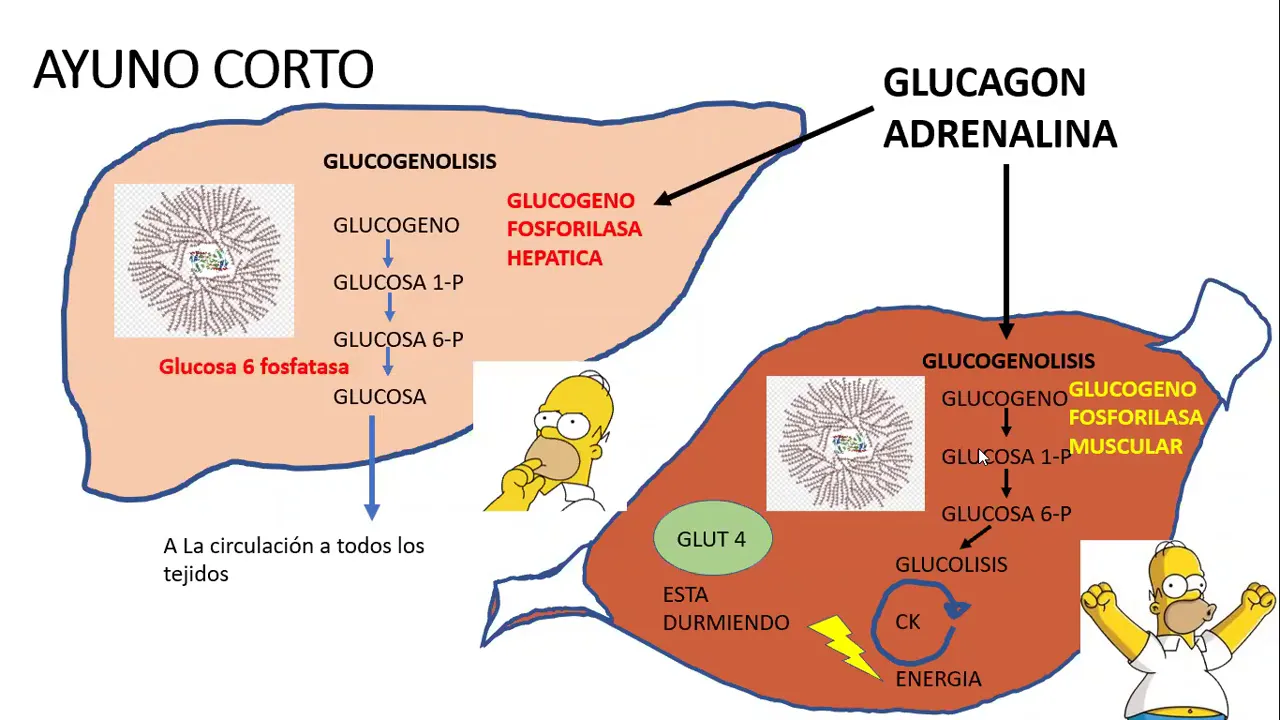
- Hormonal changes during short fasting involve hormones other than insulin, such as glucagon and adrenaline.
- Short fasting typically lasts less than 12 hours but actually begins around 4 hours after eating.
- After about 4 hours of fasting, glucagon and adrenaline are released, with glucagon acting in the liver and adrenaline in muscle tissue.
- Glucagon cannot act on muscle tissue due to the absence of specific receptors for it, unlike adrenaline which does have receptors in muscles.
Liver's Role in Fasting
This part delves into the liver's crucial role during fasting periods and how it provides glucose to various tissues.
Liver Function During Fasting
- The liver plays a key role in providing glucose to all tissues even when no food is consumed.
- During fasting, the liver breaks down stored glycogen through glycogenolysis to release glucose for energy production.
- The enzyme glycogen phosphorylase hepatic is pivotal in initiating glycogen breakdown under the influence of glucagon.
Glucose Regulation and Muscle Uptake
This segment focuses on how glucose regulation occurs during fasting and addresses muscle glucose uptake challenges.
Glucose Regulation and Muscle Uptake
- Glucose released from glycogen breakdown is converted to glucose-6-phosphate by an enzyme called glucose 6-phosphatase before being released into circulation.
- Glucose 6-phosphatase facilitates the release of glucose into circulation by cleaving phosphate from carbon 6 of glucose molecules.
Muscle Glucose Uptake Challenges
Here, strategies for overcoming muscle glucose uptake challenges during short fasting periods are discussed.
Overcoming Muscle Glucose Uptake Challenges
New Section
In this section, the discussion revolves around the activation of muscular glycogen phosphorylase by adrenaline in the absence of glucagon receptors.
Activation of Muscular Glycogen Phosphorylase
- The activation of muscular glycogen phosphorylase occurs through adrenaline in the absence of glucagon receptors.
- During short fasting periods, muscle energy primarily comes from glycogenolysis.
- Muscular glycogen phosphorylase is activated not only by adrenaline but also by molecules with low energy charge.
- Exercise, particularly anaerobic exercise, increases AMP levels, activating muscular glycogen phosphorylase for rapid energy release.
- In anaerobic exercise, muscle utilizes stored glycogen for quick energy production due to increased AMP levels.
New Section
This segment delves into the process of converting glycogen to glucose and subsequent utilization in various tissues.
Glycogen Conversion and Tissue Utilization
- Glycogen converts to glucose 1-phosphate during fasting, leading to glucose 6-phosphate formation and continuation through glycolysis.
- All tissues undergo glycolysis when supplied with glucose from the liver except for muscles during fasting.
- Citrate remains within muscle mitochondria during fasting as muscle lacks fatty acid synthesis capability.
- Muscle cannot regulate blood sugar like the liver due to lacking glucose 6-phosphatase enzyme present only in hepatic tissues.
New Section
The focus here is on enzyme regulation and differences between tissues in terms of regulatory mechanisms.
Enzyme Regulation and Tissue Differences
- Glucose 6-phosphatase induction solely by glucagon highlights tissue-specific regulatory mechanisms.
- Some enzymes exhibit only positive regulation without negative feedback mechanisms.
Glucose Metabolism Overview
In this section, the discussion revolves around the metabolism of glucose in the body, focusing on various tissues' roles and interactions during different metabolic states.
Glucose Neogenesis Pathway
- When glycogen stores are depleted, tissues still require glucose for energy. The liver plays a crucial role in providing glucose to organs through gluconeogenesis.
Collaboration of Tissues in Gluconeogenesis
- Different tissues collaborate with the liver by providing substrates for gluconeogenesis. This process involves synthesizing glucose from non-carbohydrate compounds through pathways like gluconeogenesis.
Contributions from Red Blood Cells and Cortisol
- Red blood cells contribute to gluconeogenesis by converting lactate to pyruvate. Cortisol activates muscle proteolysis, breaking down proteins into amino acids that can be used as substrates for glucose synthesis.
Role of Aminotransferases and Hormones
- Aminotransferases facilitate the conversion of amino acids like alanine into pyruvate, contributing to gluconeogenesis. Hormones like glucagon and adrenaline can activate lipolysis in adipose tissue through phosphorylation.
Glycerol Contribution and Gluconeogenic Pathway
- Glycerol released from triglyceride breakdown enters the bloodstream, reaching the liver as a substrate for gluconeogenesis. It can be converted into intermediates like dihydroxyacetone phosphate or glyceraldehyde 3-phosphate.
Gluconeogenic Enzymes Regulation
- Enzymes like phosphoenolpyruvate carboxykinase (PEPCK), induced by cortisol, play a vital role in regulating key steps of gluconeogenesis. These enzymes are essential for maintaining glucose homeostasis during fasting states.
Fructose Metabolism and Energy Production
In this section, the discussion revolves around fructose metabolism, enzyme inhibition, and energy production pathways in the body.
Fructose 2-6 Phosphate Inhibition
- The conversation starts with a query about inhibiting the enzyme fructosa 1,6-bisfosfatasa.
Regulation of Fructose 2-6 Phosphate
- Fructose 2-6 phosphate is discussed as an inhibitor of the enzyme.
- The synthesis of fructose 2-6 phosphate is mentioned.
Role of PFK-2 in Energy Production
- PFK-2 (phosphofructokinase 2) is highlighted for its role in inhibiting certain enzymes during satiety.
Glucose Production Pathway
- The pathway from glucose to glucose 6-phosphate is detailed.
Energy Source for Different Tissues
- The importance of glucose for energy supply to tissues like the brain is emphasized.
Energy Sources in Fasting
This segment delves into energy sources during fasting periods and how different tissues derive energy.
Muscle Energy Source in Fasting
- Discussion on muscle energy source depletion after glycogen stores are exhausted.
Utilization of Glycerol and Fatty Acids
- Explanation on how muscles utilize glycerol and fatty acids for energy production.
Fatty Acid Metabolism
Focus shifts to fatty acid metabolism, transport, activation, and utilization within the body.
Fatty Acid Transport and Activation
- Details on fatty acid transport via albumin and entry into mitochondria through carnitine system.
Liver's Role in Fatty Acid Metabolism
- Activation process of fatty acids upon reaching the liver is explained.
Regulation of Carnitine Palmitoyltransferase I (CPT-I)
Discussion centers around the regulation mechanism of CPT-I enzyme crucial for fatty acid metabolism.
Regulation Mechanism of CPT-I
- Regulation of CPT-I by malonyl-CoA levels is elaborated upon.
Ketone Body Formation
Ketone body formation as an alternative fuel source during fasting periods is explored.
Ketone Body Generation Pathway
Acetone and Ketone Bodies in Metabolism
The discussion delves into the role of acetone, acetoacetate, and beta-hydroxybutyrate in metabolism, highlighting their energy-providing properties and the brain's dependence on glucose.
Acetone and Ketone Bodies
- Acetone is a volatile molecule eliminated via respiration, leaving behind beta-hydroxybutyrate and acetoacetate.
- These ketone bodies offer significant energy to cells by producing two molecules of acetyl-CoA.
Metabolic Pathways Involving Acetyl-CoA
Exploring how acetyl-CoA enters the citric acid cycle to provide cellular energy, emphasizing the significance of lysine in this process.
Citric Acid Cycle and Energy Production
- Acetyl-CoA enters the citric acid cycle in cells to generate energy.
- Prior to contributing acetyl-CoA, lysine must undergo solysis for degradation.
Brain Dependency on Glucose vs. Ketone Bodies
Discussing the brain's reliance on glucose for energy and its transition to utilizing ketone bodies during prolonged fasting or starvation.
Brain Energy Source
- The brain is reliant on glucose for energy production.
- During extended periods without food intake (e.g., over 24 hours), the brain shifts to using ketone bodies for energy due to depleted glucose levels.
Neurological Symptoms from Ketosis
Explaining neurological symptoms arising from prolonged fasting-induced ketosis due to decreased glucose availability.
Effects of Prolonged Fasting
- Extended fasting leads to reliance on ketone bodies for energy.
- Neurological symptoms such as dizziness, drowsiness, tremors, and cognitive impairment manifest due to reduced glucose availability.
Stimuli for Ketone Body Synthesis
Detailing the conditions necessary for synthesizing ketone bodies through beta oxidation and highlighting hormonal influences on this metabolic pathway.
Factors Influencing Ketogenesis
- Ketone bodies are produced from beta oxidation or directly from acetyl-CoA.