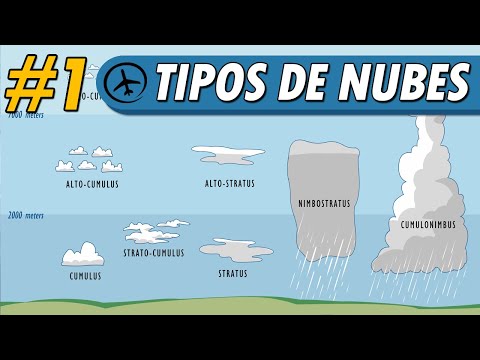
Clasificación de Nubes (Parte 1) - Meteorología
What Are Clouds and How Are They Classified?
Introduction to Clouds
- The video introduces the topic of cloud classification, stating that it will be divided into two parts. The first part covers basic concepts about clouds, their formation, and relevance in aviation.
- The second part will focus on different types of clouds based on height and shape, as well as special conditions for cloud formation.
Definition and Formation of Clouds
- A cloud is defined as a visible collection of tiny water droplets or ice crystals suspended in the atmosphere, categorized as a hydrometeor.
- Despite appearing weightless, clouds are not made of water vapor; they consist of liquid water or solid ice particles that can remain airborne due to their small size.
- Clouds form when water vapor condenses or sublimates onto condensation nuclei in the atmosphere, creating visible clusters.
Conditions for Cloud Formation
- The state (liquid or solid) of the particles in a cloud depends on temperature: above 0°C results in liquid droplets while below leads to ice crystals.
- Various mechanisms contribute to cloud formation but all require three common components: presence of water vapor (humidity), cooling air mass (to reach saturation), and condensation nuclei for phase change.
Importance of Clouds in Aviation
- Understanding clouds is crucial for aviation since their characteristics indicate atmospheric stability and humidity levels at any given time.
- Identifying different types of clouds helps predict weather phenomena such as turbulence, reduced visibility, precipitation, icing conditions, and electrical discharges.
How Are Clouds Classified?
Classification Criteria
- Clouds can be classified based on various criteria including height (low, medium, high), shape (stratiform vs. cumuliform), and coverage (scattered vs. overcast).
Height-Based Classification
- According to base height:
- Low clouds: 0 - 6,500 feet
- Medium clouds: 6,500 - 20,000 feet
- High clouds: above 20,000 feet
- Vertical development clouds typically have bases within low cloud range.
Variability by Latitude
- While low clouds consistently fall between 0 - 6,500 feet globally, medium and high cloud classifications vary with latitude due to differences in tropopause altitude near the equator versus poles.
Determining Cloud Height
Understanding Cloud Measurement and Classification
Measuring Cloud Height
- Clouds are measured relative to the ground rather than sea level, with two key levels: the base and the top of the cloud. The height reported is based on the distance from the base.
- An example illustrates three weather stations at different elevations: Station A at sea level, Station B at 2,000 feet, and Station C at 8,000 feet. Each station measures cloud height differently due to their elevation.
- For Station A (8,000 feet), clouds are classified as mid-level; for Station B (6,000 feet), they are low-level; while for Station C (at ground level), it’s categorized as fog instead of a cloud.
- This highlights that cloud classification by height is relative and depends on the observer's elevation.
Practical Methods for Measuring Cloud Height
- Various methods exist to measure cloud height practically. One method involves timing how long a balloon takes to reach the base of a cloud since it ascends at a known speed.
- A more modern approach uses a ceilometer, which employs lasers or light beams to determine cloud height accurately both day and night.
Classification of Clouds by Shape
Types of Clouds Based on Form
- Clouds can be classified into three main groups based on their shape: cumulus (uniform), stratus (layered), and cirrus (wispy).
Cumulus Clouds
- Cumulus clouds develop vertically resembling cotton or cauliflower tops. They exhibit significant vertical development but limited horizontal spread and form in unstable atmospheric conditions due to ascending air currents.
Stratus Clouds
- Stratus clouds appear diffuse without well-defined shapes, extending horizontally in layers. They have minimal vertical development and typically form under stable atmospheric conditions where vertical air movement is restricted.
Cirrus Clouds
- Cirrus clouds are thin and fibrous, found only at high altitudes. Their appearance resembles hair-like filaments with reduced thickness.
Grouping Clouds by Height and Shape
Families and Genera of Clouds
- By applying criteria based on both height and shape, clouds can be organized into various families, genera, species, and varieties according to physical characteristics.
Low-Level Cloud Families
- Low-level clouds include stratus, cumulus, stratocumulus, and nimbostratus. These can sometimes overlap with mid-level classifications depending on specific characteristics.
Characteristics of Stratus Clouds
- Stratus clouds are low-layered formations that appear grayish with uniform bases. They may consist of water droplets or ice crystals depending on temperature conditions.
Overview of Cloud Types and Their Characteristics
Moderate to Severe Freezing Conditions
- Clouds can produce light precipitation in the form of drizzle or snow under moderate to severe freezing conditions when temperatures are low.
Cumulus Clouds: Definition and Characteristics
- Cumulus clouds, derived from Latin "cumulus," are low, individual clouds with well-defined shapes resembling cotton or cauliflower. Their bases are nearly horizontal with some vertical development.
- These clouds can be composed of water droplets or ice crystals depending on temperature and indicate unstable atmospheric conditions that favor vertical air movements, suggesting potential turbulence during flight.
Development Stages of Cumulus Clouds
- Smaller cumulus clouds (cumulus humilis) can develop into larger forms (cumulus mediocris) and eventually into towering cumulus (cumulus congestus), which may lead to cumulonimbus clouds associated with storms.
Stratocumulus Clouds: Features and Formation
- Stratocumulus clouds, abbreviated as "sc," mix characteristics of stratiform and cumulus types, appearing as grayish-white bands or layers with considerable horizontal extent. They are common globally.
- Composed of liquid water droplets or solid ice crystals based on temperature, these clouds typically indicate stable atmospheric conditions but may still present slight instability at certain levels. Turbulence is expected when flying through them.
Nimbostratus Clouds: Precipitation Characteristics
- Nimbostratus clouds ("ns") are dark, thick stratiform clouds that produce continuous precipitation in the form of rain or snow; they do not have distinct species or varieties due to their consistent characteristics.
- These clouds often contain supercooled large water droplets leading to moderate to severe icing conditions during flight; they also associate with warm front passages and exhibit light turbulence when traversed.
Conclusion on Cloud Classification