Melting Temperature of DNA (Tm)
Understanding the Factors Affecting DNA Melting Temperature
Overview of DNA Denaturation
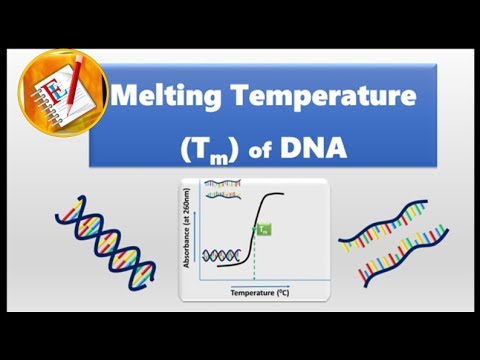
- The previous lecture covered DNA denaturation, defining melting temperature as the point where half of the DNA molecules are denatured, located at the midpoint of the melting curve.
Key Factors Influencing Melting Temperature
- Three main factors affect the melting temperature of DNA:
- Nucleotide content
- Length of the DNA molecule
- Ionic strength of the DNA solution
Nucleotide Content and Melting Temperature
- In a double helix, adenine pairs with thymine via two hydrogen bonds, while guanine pairs with cytosine through three hydrogen bonds. This difference in bonding affects stability.
- A GC-rich DNA molecule has a higher melting temperature due to more heat energy required to disrupt stable base stacking interactions compared to AT-rich molecules.
- Graphical representation shows that higher GC content correlates with increased melting temperatures; for example, a GC-rich sequence exhibits a higher melting temperature than an AT-rich one.
Length of the DNA Molecule
- Longer double-stranded DNA requires more energy to disrupt than shorter strands because greater stabilizing forces exist between longer strands, leading to higher melting temperatures.
Ionic Strength and Stability
- The sugar-phosphate backbone carries negative charges that repel each other. Proteins like histones in eukaryotic cells help neutralize these charges.
- In laboratory settings, adding positively charged ions (e.g., sodium ions) stabilizes DNA by neutralizing negative charges on phosphate groups.
- Ionic strength refers to total ion concentration in a solution; for instance, comparing solutions with different sodium chloride concentrations illustrates how ionic strength impacts stability.
- Higher ionic strength leads to greater stability in DNA molecules; thus, more heat is needed for denaturation. Conversely, lower ionic strength results in less stable molecules requiring less energy for disruption.
This structured summary provides insights into how various factors influence the melting temperature of DNA and highlights critical concepts discussed throughout the transcript.