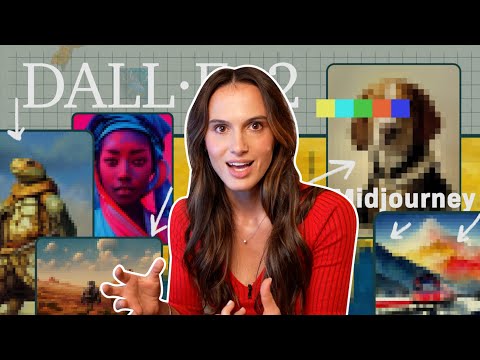
The REAL Fight Over AI Art
The Power of AI in Art
In this video, the speaker explores the use of artificial intelligence (AI) in creating art. He discusses how AI tools like DALL-E 2 can be used to generate images and unlock human creativity.
Introduction to DALL-E 2
- DALL-E 2 is an image-generating artificial intelligence tool that creates new images instead of collaging existing ones.
- These tools are fun to play with and have become controversial among artists who fear they will replace traditional artistry.
Using AI for Artistic Creation
- The speaker noticed that his friend, who was already an artist, created better art using AI than he did without it.
- To test this theory, the speaker and his friend set up a competition where they each created a digital art piece of the New York City skyline - one without AI and one with AI.
- They discovered that using AI as a tool could help them create more complex and interesting pieces within a short amount of time.
How to Use DALL-E 2
- Users can input specific prompts such as "a photo of a yellow astronaut riding a skateboard" or "a blue banana riding a banana skateboard painted by Van Gogh."
- Users can also specify aspects such as lighting, colors, and style to get more specific results.
- A community member has even created an Excel spreadsheet that generates prompts based on user inputs.
Conclusion
- This video is not about how AI will replace artists but rather how it can unlock more human creativity.
- AI can be a powerful tool for artists of all skill levels to create new and interesting pieces.
Introduction
The video introduces the topic of AI-assisted art and sets the stage for a discussion on how these tools work.
Justin and Mayuko's Round 1
- Justin and Mayuko discuss their Round 1 creations, which were both collages made using existing images.
- They reflect on the limitations of this approach and how it relates to people's perceptions of what AI tools do.
How AI Tools Work
- Aditya Ramesh explains how DALL-E 2 works, using CLIP and unCLIP technologies to generate images based on text prompts.
- He describes how CLIP learns from both image and language data to understand aesthetics, style, and other elements that go into generating an image.
Justin and Mayuko's Round 2
- Justin shows his Round 2 creations, which include a stained glass window-style New York skyline.
- Mayuko shows her Round 2 creations, including a Botticelli-style New York skyline.
How AI is Trained to Recognize Art Styles
In this section, the speaker explains how CLIP is trained on a large dataset of images collected from the internet. They also discuss how DALLE retains information about style and colors.
CLIP Training
- CLIP is trained broadly on a large dataset of images collected from the internet.
- Most images on the internet have some kind of alt text or caption associated with them.
- This training allows CLIP to recognize different art styles.
DALLE Retains Information About Style and Colors
- DALLE retains information about style, colors, and other features for later use.
- It does not work like collaging but rather uses inspiration from previous works.
The Controversy Surrounding AI in Art
In this section, the speaker discusses the controversy surrounding AI in art and raises questions about job loss and access to technology.
Job Loss Concerns
- There are concerns that AI tools could lead to job loss in industries such as design.
- The risk is that because these tools are so fast, one person could do what previously took 20 people to do.
Access to Technology
- Not everyone can afford expensive software tools used by digital artists.
- However, technology can unlock abundance from scarcity when used correctly.
The Future of AI in Art
In this section, the speaker discusses where they see DALL-E going in terms of future development.
Moving Beyond Images
- The speaker is excited about moving beyond just images to audio and video.
- Photorealistic images are already possible, and the technology is advancing rapidly.
The Implications of Photorealism
In this section, the speaker discusses the implications of photorealism in AI-generated art.
Concerns About Misinformation
- Deepfakes and misinformation are already a concern with AI-generated content.
- Photorealism takes this to a whole new level.
Refining How AI Tools Are Used
- We don't need to blindly accept technology as an all-or-nothing solution.
- We can help refine how these tools are used to avoid negative consequences.
The Results of the Competition
In this section, the results of a competition between two individuals using AI tools are revealed.
Public Voting Results
- 3,000 people voted on their favorite AI-generated art pieces.
- Justin's piece with AI was voted as the most popular, followed by his piece without AI and then the speaker's piece with AI.
Conclusion: The Power of Technology in Art
In this section, the speaker reflects on how technology has impacted creativity and access to powerful creative tools.
Increasing Access to Creative Tools
- Increasing access to powerful creative tools has given us so much.
The Importance of Inclusivity in Art
This section discusses the importance of inclusivity in art and how it allows anyone to create cool art.
Inclusivity Leads to Cool Art
- The speaker notes that inclusivity has allowed for more people to create art.
- The speaker asks what the listener will make, implying that anyone can create cool art with inclusivity.