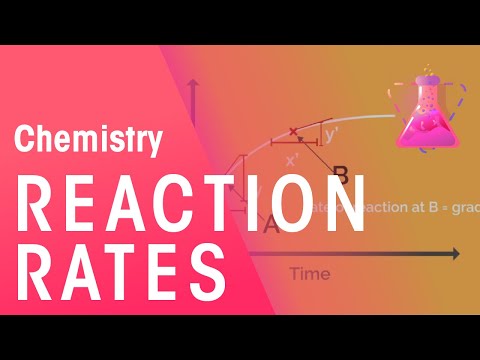
Rates of Reactions - Part 1 | Reactions | Chemistry | FuseSchool
What is Reaction Rate and How to Measure It?
Understanding Reaction Rate
Reaction rate measures how quickly reactants transform into products during a chemical reaction.
There are two primary methods for measuring reaction rate:
Measuring the decrease in mass of reactants.
Measuring the increase in volume of products.
Method 1: Measuring Reactant Decrease
Example: The reaction between marble chips (calcium carbonate) and hydrochloric acid produces calcium chloride, water, and carbon dioxide.
As the reaction occurs, the mass of reactants decreases due to carbon dioxide gas being released.
The rate of reaction at any point can be determined by calculating the gradient (Y/X) on a graph plotting mass against time.
Observations on Reaction Rate
As the reaction proceeds, it is observed that the rate of reaction slows down over time.
Method 2: Measuring Product Increase
Instead of measuring reactant loss, one can measure the gain in volume of carbon dioxide produced using appropriate apparatus.
A graph plotting volume of gas produced against time also shows that as time progresses, the rate of reaction decreases similarly to method one.
Recap on Reaction Rate Measurement
To summarize:
The rate of reaction indicates how fast reactants convert into products.
It can be measured by observing either the decrease in reactants or the increase in products.
Video description
Rates of Reactions - Part 1 | Reactions | Chemistry | FuseSchool
In this video you are going to learn what the reaction rate is and some ways of measuring reaction rate.
Reaction rate is a measure of how quickly the reactants in a reaction change into the products of the reaction.
The rate of a chemical reaction can be measured in two ways:
1) The first way is to measure how quickly the reactants (the substances on the left of the arrow in the equation) decrease.
2) The second way is to measure how quickly the products (the substances on the right of the arrow in the equation) increase.
Example for 1: Measuring how quickly reactants decrease.
We will look at the reaction between marble chips (calcium carbonate) and hydrochloric acid.
As the reaction proceeds, the reactants lose mass because carbon dioxide gas is given off. We can measure the decrease in mass of reactants by using this type of apparatus with a conical flask stopwatch, cotton wool plug and balance.
Based on our measurements, we plot a graph of ‘mass of reactants against time’.
The rate of reaction at point A is given by the gradient at A which is y/x and the rate of reaction at point B is given by the gradient at point B which is y’/x’ .
Example for 2:
Instead of measuring the loss of mass of the reactant we can also measure the gain in volume of the product carbon dioxide.
Watch part 2 to learn more: https://www.youtube.com/watch?v=ExHV_cFWYSM
SUPPORT US ON PATREON
https://www.patreon.com/fuseschool
SUBSCRIBE to the FuseSchool YouTube channel for many more educational videos. Our teachers and animators come together to make fun & easy-to-understand videos in Chemistry, Biology, Physics, Maths & ICT.
VISIT us at www.fuseschool.org, where all of our videos are carefully organised into topics and specific orders, and to see what else we have on offer. Comment, like and share with other learners. You can both ask and answer questions, and teachers will get back to you.
These videos can be used in a flipped classroom model or as a revision aid.
Find all of our Chemistry videos here: https://www.youtube.com/playlist?list=PLW0gavSzhMlReKGMVfUt6YuNQsO0bqSMV
Find all of our Biology videos here: https://www.youtube.com/playlist?list=PLW0gavSzhMlQYSpKryVcEr3ERup5SxHl0
Find all of our Physics videos here: https://www.youtube.com/playlist?list=PLW0gavSzhMlTWm6Sr5uN2Uv5TXHiZUq8b
Find all of our Maths videos here: https://www.youtube.com/playlist?list=PLW0gavSzhMlTKBNbHH5u1SNnsrOaacKLu
Instagram: https://www.instagram.com/fuseschool/
Facebook: https://www.facebook.com/fuseschool/
Twitter: https://twitter.com/fuseSchool
Access a deeper Learning Experience in the FuseSchool platform and app: www.fuseschool.org
Follow us: http://www.youtube.com/fuseschool
Befriend us: http://www.facebook.com/fuseschool
This is an Open Educational Resource. If you would like to use the video, please contact us: info@fuseschool.org