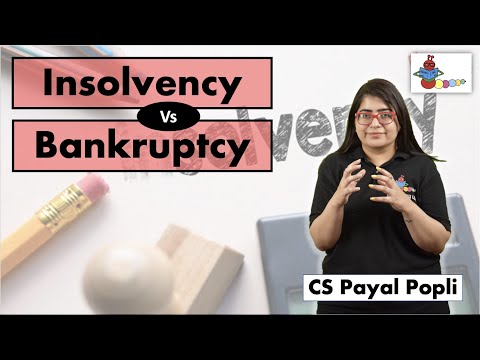
How Insolvency is different from Bankruptcy? | Insolvency vs Bankruptcy
Introduction
In this video, the speaker discusses the differences between insolvency and bankruptcy.
- Insolvency refers to a state of economic distress where an individual or company is unable to pay off their liabilities.
- Bankruptcy is a court order that decides how an insolvent debtor will deal with unpaid obligations.
Differences Between Insolvency and Bankruptcy
The speaker explains the differences between insolvency and bankruptcy.
- Insolvency is a state of economic distress where one cannot pay off their liabilities, while bankruptcy is a court order that decides how an insolvent debtor will deal with unpaid obligations.
- Insolvency can lead to bankruptcy if the insolvent person is unable to successfully address their financial condition.
- An insolvent company can reverse course by cutting costs, selling assets, borrowing money, renegotiating debt, or allowing themselves to be acquired by a larger corporation.
Liabilities in Insolvency and Bankruptcy
The speaker discusses liabilities in insolvency and bankruptcy.
- In insolvency, one has liabilities they are not able to pay off. In contrast, in bankruptcy, there are legal proceedings that decide how an insolvent debtor will deal with unpaid obligations.
- A bankrupt person may have some assets analyzed for any liability. Creditors may also come forward with claims against them.
Steps Involved in Bankruptcy and Insolvency
The speaker outlines the steps involved in both bankruptcy and insolvency.
- Bankruptcy is followed by insolvency. It's considered as the last step whereas insolvency is considered as the initial step.
- An insolvent person can try to rectify their situation by cutting costs, selling assets, borrowing money or renegotiating debt before it leads to bankruptcy.
Insolvency and Bankruptcy in Education
The speaker discusses how insolvency and bankruptcy are taught in education.
- Insolvency is taught in the first year of high school, while bankruptcy is taught in the second year.
- In high school, students learn about the differences between insolvency and bankruptcy, as well as the steps involved in each process.
Conclusion
The speaker concludes by summarizing the key points discussed in the video.
- Insolvency refers to a state of economic distress where one cannot pay off their liabilities, while bankruptcy is a court order that decides how an insolvent debtor will deal with unpaid obligations.
- An insolvent person can try to rectify their situation by cutting costs, selling assets, borrowing money or renegotiating debt before it leads to bankruptcy.
- In high school, students learn about the differences between insolvency and bankruptcy, as well as the steps involved in each process.
Understanding Insolvency and Bankruptcy
In this section, the speaker explains the difference between insolvency and bankruptcy.
Insolvency vs. Bankruptcy
- Insolvency is a financial state where an individual or company is unable to pay off their debts.
- Bankruptcy is a legal process that allows individuals or companies to declare themselves unable to pay off their debts and seek protection from creditors.
- The terms "insolvency" and "bankruptcy" are often used interchangeably, but there is a difference between them.
- It's important to understand the difference between insolvency and bankruptcy in order to make informed decisions about financial situations.
Conclusion
In this section, the speaker concludes the video by encouraging viewers to stay tuned for upcoming content and follow his social media accounts.
Final Thoughts
- Viewers are encouraged to stay tuned for upcoming content on the channel.
- The speaker also encourages viewers to follow his social media accounts for more information.
Turn any video into a summary like this
YouTube links, meetings, lectures. With transcripts, search, and chat.