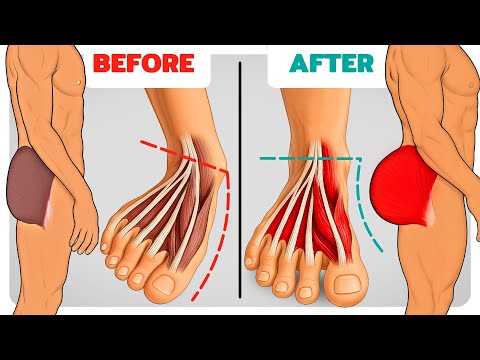
How Strong Glutes Fix Flat Feet & Weak Ankles (Science-Based)
Why Do Flat Feet and Weak Ankles Struggle for Improvement?
Understanding the Problem
- People with flat feet and weak ankles often see little improvement despite using supportive shoes, insoles, and braces because these methods do not address the root causes of their issues.
- A new approach is necessary to tackle the underlying problems directly, which will be discussed in this video.
Step 1: Strengthen Your Weak Glutes
- The glutes are crucial not only for hip extension but also serve as powerful external rotators that stabilize the leg from hips to feet. This stability is essential for proper foot function.
- When glutes are inactive or weak, it leads to instability in the legs, similar to a loosely held dishcloth; strong glutes create tension and stability.
Testing Glute Activation
- To test glute activation, stand naturally and let your knees drift inward; then squeeze your glutes to observe immediate changes in knee position and arch height. This demonstrates how active glutes can stabilize lower limbs.
Addressing Issues Affecting Glute Function
- Tight Hips: Restricted hip mobility prevents effective glute activation due to altered reciprocal inhibition; improving hip mobility can enhance glute function significantly. A study showed a 17.1% increase in glute activity after focused hip mobility work over five days.
- Weak Core: A stable core is vital for pelvic stability; without it, the pelvis becomes unstable, hindering glute performance—similar to firing a cannon from an unstable base like a canoe. Research indicates that core stability training improves foot conditions significantly when combined with strengthening routines for flat feet.
Training Your Glutes Effectively
- Once hips are mobile and core strength is established, direct training of the glutes can begin through exercises such as single-leg balancing which enhances core engagement while stabilizing the pelvis effectively during movement patterns that prevent knee collapse and overpronation of the foot.
Progression of Single-Leg Balance Training
Steps for Effective Balance Training
- Start by standing on one leg barefoot while engaging your core; maintain level pelvis alignment for at least one minute before progressing further into movements like gentle hip hinging while keeping your spine neutral to engage your glutes more effectively.
- Introduce hip rotation challenges once basic balance feels easy; this forces additional stabilization from multiple planes of movement enhancing overall strength and control of both feet and ankles as well as improving balance under dynamic conditions by using slightly unstable surfaces like balance beams later on in training sessions.
Step 2: Fix Your Tight Ankles
Importance of Ankle Mobility
- Tight ankles restrict dorsiflexion—the ability of the ankle to bend properly—which affects functional movements such as walking or squatting leading to compensatory patterns that compromise structural integrity across both ankle joints and arches if left unaddressed.
Understanding Ankle Mobility and Foot Strength
Importance of Ankle Dorsiflexion
- Restricted dorsiflexion can lead to increased injury risk for the ankle, as it may not move properly under load or during dynamic tasks. Research indicates that 76.6% of individuals with flat feet experience these restrictions.
- A study involving 1,093 army recruits revealed that those with limited ankle dorsiflexion had up to five times the risk of ankle sprains compared to those with average flexibility.
Improving Ankle Mobility
- To enhance ankle mobility, avoid shoes with raised heels which keep the ankle in a plantar flexed position, leading to tightness in calf muscles and Achilles tendon over time.
- Transitioning to flat, zero-drop shoes is recommended as they maintain the natural foot slope and promote proper dorsiflexion.
Exercises for Enhancing Dorsiflexion
- The deep squat is an effective exercise for assessing and improving ankle mobility; if weight shifts backward onto heels or toes lift during squats, this indicates restricted dorsiflexion.
- The counterbalance squat involves using an upright support while squatting deeply, focusing on pushing knees over toes to maximize dorsiflexion.
Strengthening Foot Muscles
- The human foot comprises 29 muscles that work together like tension cables supporting arches; weak foot muscles can destabilize this structure under stress.
- Strengthening these muscles restores necessary tension for arch support and overall stability of both feet and ankles.
Choosing Appropriate Footwear
- Selecting the right shoes is crucial; rigid footwear can weaken foot muscles similar to how a cast restricts movement. Minimalist shoes encourage natural movement and muscle engagement.
- A study showed participants increased their foot strength by 57.4% within six months simply by wearing minimalist shoes without additional exercises.
Training Foot Muscles Effectively
- Gradual adaptation to minimalist footwear is essential for those with weak feet; programs like the Barefoot Shoe Transition Plan help facilitate this process safely over six months.
- Dedicated exercises are vital for strengthening feet; neglecting them undermines overall body function despite strong upper body muscles.
This structured overview captures key insights from the transcript regarding ankle mobility and foot strength while providing timestamps for easy reference.
Fixing Toe Alignment for Better Foot Health
Importance of Toe Alignment
- Proper toe alignment is crucial as it forms a stable, tripod-like foundation that supports the entire body. It enhances the function of intrinsic foot muscles.
- The great toe has the most intrinsic muscles and is vital for arch support; weak muscles can lead to flat feet, especially in individuals with bunions.
- A study found all participants with bunions also had flat feet, indicating a strong link between toe misalignment and collapsed arches.
Impact of Misalignment on Strength and Mobility
- An experiment showed that poor toe alignment reduced big toe strength by 20%, demonstrating how deviations weaken foot functionality.
- Misalignment limited big toe mobility by 30 degrees, affecting hip extension during walking or running, which in turn restricts glute activation.
- This interconnectedness illustrates regional interdependency: issues in one area can disrupt others, emphasizing the body's integrated system.
Functional Movement Tests and Solutions
- As a sports scientist, understanding these principles led to developing functional movement tests at Barefoot Strength Academy to identify root causes of dysfunction.
- Addressing root issues often improves not just the affected area but other interconnected systems as well.
Approaches to Fix Toe Misalignment
Exercises and Tools
- The Toe Spread-Out exercise targets key muscles (abductor hallucis and abductor digiti minimi), essential for maintaining proper toe alignment and supporting foot arches.
- Newborn reflexively perform similar movements to activate foot muscles before weight-bearing; this exercise promotes natural intrinsic strength development.
Use of Spacers and Footwear
- Silicone spacers have shown significant improvements in toe alignment over 12 months; they also enhance glute function during exercises.
- Wearing shoes that match the natural shape of feet is critical; narrow toe boxes force unnatural positioning leading to misalignment.
Integrated Approach for Improvement
- Combining active exercises, use of spacers, and appropriate footwear provides an effective strategy for enhancing toe splay, foot function, and ankle stability.
Enhancing Ground Feel for Stronger Feet
Importance of Ground Sensation
- To achieve strong feet and stable ankles, it's essential to feel ground textures clearly. Quick sensory feedback helps stabilize during uneven terrain navigation.
Mechanoreceptors Role
- Specialized nerve endings (mechanoreceptors), similar to those in hands, collect environmental data through touch. This information adjusts muscle tension dynamically based on real-time conditions.
The Importance of Sensory Feedback in Footwear
The Impact of Shoe Design on Sensory Input
- Common training shoes with thick EVA foam hinder accurate sensory input, dampening signals from mechanoreceptors and disrupting natural stabilization.
- Gymnasts train barefoot to maximize sensory data for stability; similarly, surgeons use thin gloves to maintain tactile feedback during intricate procedures.
- A study revealed reduced muscle activation when walking on soft EVA foam compared to hard surfaces, indicating that soft barriers impair muscle function and weaken foot stability over time.
Solutions for Enhanced Ground Feel
- The solution lies in minimalist, barefoot-style shoes with soles less than 1 cm thick, which protect against cuts while preserving sensory feedback.
- Barefoot shoes activate intrinsic foot muscles, allowing the body to fine-tune shock absorption and balance naturally as it interacts with the ground.