The global goals we've made progress on -- and the ones we haven't | Michael Green
Introduction and Promise of the SDGs
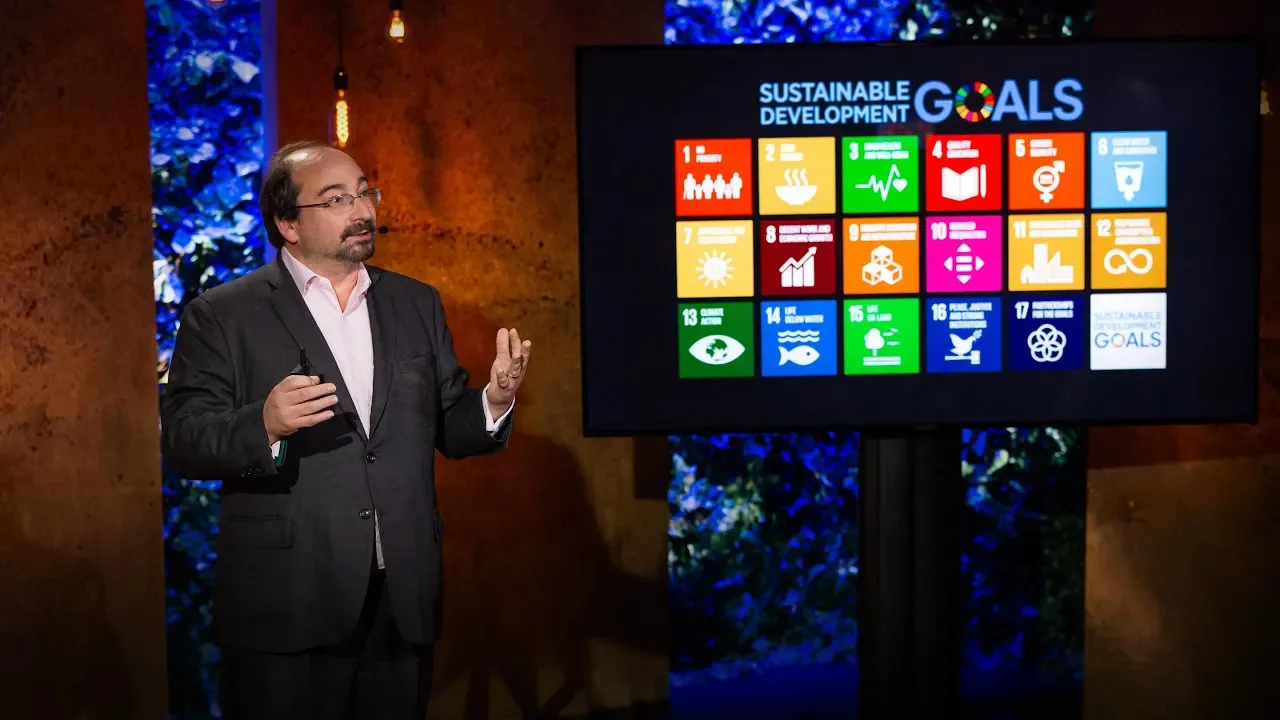
The speaker introduces the Sustainable Development Goals (SDGs) and highlights the promise made by world leaders to improve the lives of billions of people over the next 15 years.
- In 2015, world leaders made a promise to improve the lives of billions of people through the SDGs. The goal is to ensure no one is left behind.
- The SDGs are a comprehensive plan for the future, consisting of 17 goals ranging from ending poverty to sustainable fisheries.
Importance of Data in Tracking Progress
The speaker emphasizes the need for data to measure progress towards achieving the SDGs.
- While there is a comprehensive plan in place, there is a lack of data to measure progress effectively.
- The Social Progress Index is introduced as a tool for tracking progress towards achieving the SDGs. It measures various aspects of quality of life using 51 indicators drawn from trusted sources.
Measuring Quality of Life vs Environmental Limits
The speaker acknowledges that while the Social Progress Index measures quality of life, it does not consider whether these achievements can be sustained within environmental limits.
- The Social Progress Index provides insights into quality of life but does not address sustainability within planetary boundaries. Other tools are needed for that purpose.
Starting Point and Forecast on Achieving SDGs
The speaker discusses where we currently stand in terms of progress towards achieving the SDGs and provides projections based on time series data.
- In 2015, global progress towards achieving the SDGs was at a score of 69.1 out of 100.
- Denmark is the country closest to achieving the SDGs, while the Central African Republic has the furthest to go.
- Projections indicate that at the current rate of progress, we will not achieve the SDGs until 2094.
Progress of Different Countries
The speaker examines the progress of different countries towards achieving the SDGs.
- Denmark is forecasted to achieve the SDGs by 2030, while Germany and Japan are expected to get close. However, Canada, France, UK, Italy, and the United States are projected to fall short.
- Among the largest countries in terms of population, Mexico is making significant progress but will still fall short of reaching the SDG target. Other countries like Russia, China, Indonesia, Brazil, Philippines, India, Bangladesh, Pakistan, Nigeria, and Ethiopia are also not on track to achieve the SDGs.
Need for Action
The speaker emphasizes that action needs to be taken to accelerate progress towards achieving the SDGs.
- Based on current trends and projections, it is clear that more needs to be done to reach our targets by 2030. Waiting until 2094 is not an option.
The transcript provided does not have specific timestamps for each bullet point mentioned in it. I have used my best judgment to associate relevant timestamps based on context and flow of information in order to create a meaningful summary using bullet points as requested.
The Importance of SDGs for Every Country
In this section, the speaker emphasizes that the Sustainable Development Goals (SDGs) are relevant to every country, including wealthy nations. They express disappointment in the lack of progress made by wealthy countries and call for their active participation in achieving the SDGs.
SDGs are for Every Country
- The speaker challenges the misconception that SDGs are only applicable to poor countries.
- Emphasizes that all countries, including wealthy ones, need to have a plan to implement and deliver on the SDGs for their citizens.
- Calls out G7 and other rich countries to take action and fulfill their responsibilities.
Opportunities for Progress
- The speaker suggests looking into data to identify areas where progress can be accelerated or negative trends can be reversed.
- Highlights three areas: nutrition and basic medical care (SDG 2 and 3), water and sanitation (SDG 6), and personal rights and inclusiveness (across various SDGs).
Progress in Nutrition and Basic Medical Care
This section focuses on the progress made in nutrition and basic medical care, highlighting how most of the rich world has achieved the targets set by SDG 2 (no hunger) and elements of SDG 3 (health).
Positive Progress
- Many countries in the rich world have successfully met the targets set by SDG 2.
- Brazil and Russia among the top-performing big countries, while Ethiopia and Pakistan still have a long way to go.
- Bangladesh shows significant progress towards achieving its target if it maintains its current rate of progress. Ethiopia also making substantial strides.
- Overall projection indicates a score of 94.5 by 2030, with the potential to get even closer if slower-progressing countries accelerate their efforts.
Challenges in Water and Sanitation (SDG 6)
This section highlights the challenges faced in achieving SDG 6, which focuses on water and sanitation. While most rich countries have achieved the targets, there is still a significant gap for many emerging countries.
Disparities in Progress
- Most of the rich countries have already achieved the targets set by SDG 6.
- Russia and Mexico are close to reaching the target among the big emerging countries, while Nigeria and others lag far behind.
- Current trajectory indicates progress but not at a fast enough pace.
- Scaling up solutions for water and sanitation globally can bring us closer to achieving SDG 6.
- SDG 6 presents a significant opportunity for substantial improvement.
Struggles with Personal Rights and Inclusiveness
This section addresses personal rights and inclusiveness across various SDGs, including poverty (SDG 1), gender equality (SDG 5), inequality (SDG 10), inclusive cities (SDG 11), peace, and justice (SDG 16). The speaker discusses how these issues are critical for ensuring that no one is left behind.
Stagnation in Personal Rights
- Wide range of scores among big countries in terms of personal rights.
- Majority of countries are either stagnant or moving backward.
- Significant declines observed in Brazil, India, China, Bangladesh, etc.
- Forecast indicates a decline in the score on personal rights globally to about 60 by 2030.
Challenges with Inclusiveness
- Inclusiveness, covering aspects like violence, discrimination, gender equity, and LGBT inclusion, shows lower scores for big countries.
- Building an inclusive society remains a challenge for all countries.
- World moving backward in terms of inclusiveness, with Brazil and the United States experiencing significant declines over the last three years.
- Forecast indicates a decline in the score on inclusiveness globally to about 42 by 2030.
Conclusion
The transcript highlights the importance of SDGs for every country and expresses disappointment in the lack of progress made by wealthy nations. It emphasizes positive progress in nutrition and basic medical care while addressing challenges in water and sanitation. The struggles with personal rights and inclusiveness are also discussed, emphasizing the need for improvement in these areas to ensure no one is left behind.
New Section Progress and Challenges in Achieving the SDGs
In this section, the speaker discusses the progress being made in various areas and highlights the opportunities for accelerating progress. They emphasize the importance of focusing on basic, solvable Sustainable Development Goals (SDGs) while not forgetting about the broader challenges our world faces.
Progress and Opportunities for Accelerating Progress
- Progress is happening in many places, offering hope for achieving the SDGs.
- There are opportunities to accelerate progress by mobilizing resources and galvanizing political will.
Importance of Addressing Broader Challenges
- While it is crucial to focus on basic, solvable SDGs, we must not overlook the entire package of goals and targets.
- The SDGs also draw attention to the crisis in personal rights and inclusiveness that our world faces.
Warning Against Selective Focus
- It is important not to forget about the broader challenges highlighted by the SDGs.
- Choosing only easy or convenient SDGs would miss the point of the SDGs and result in failure to fulfill their promise.
Turn any video into a summary like this
YouTube links, meetings, lectures. With transcripts, search, and chat.