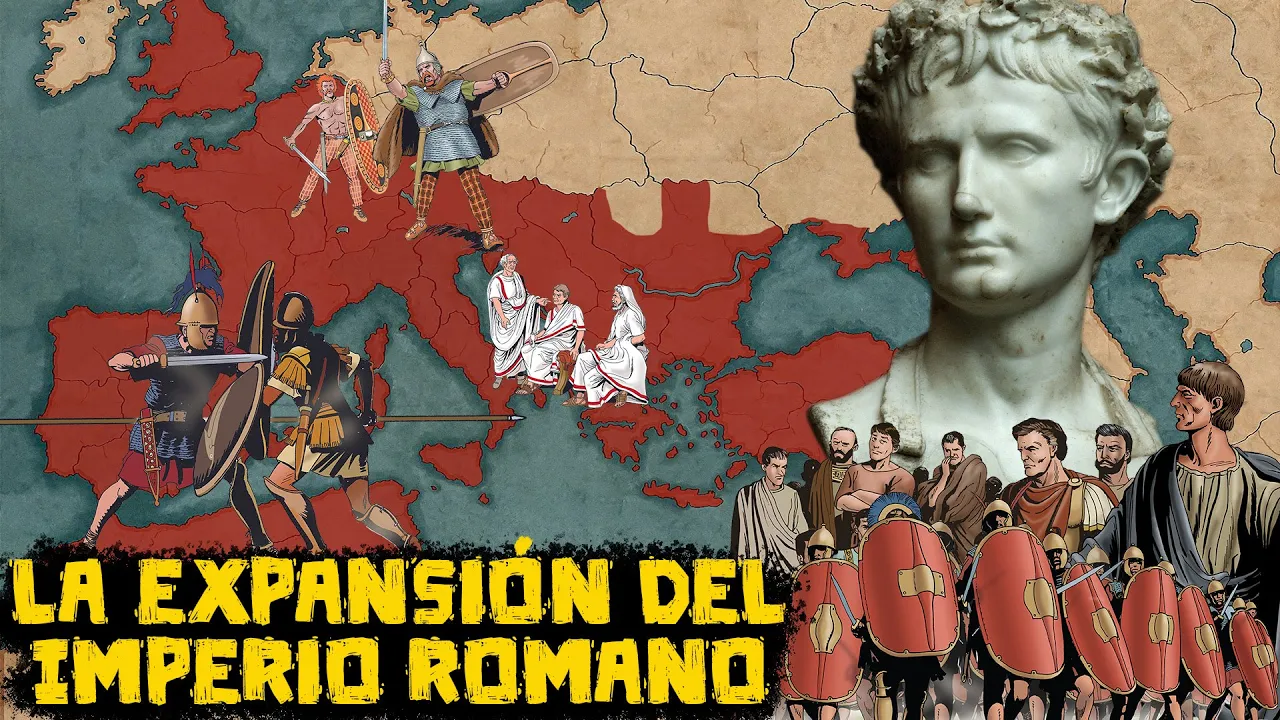
¿Cómo se hizo tan GRANDE el Imperio Romano? - La Historia de la Expansión del Imperio Romano
The Rise of the Roman Empire
The rise of the Roman Empire from a small city-state to a dominant power in the ancient world, encompassing key events such as the transition from monarchy to republic, expansion through wars, and internal political struggles.
The Early Roman Republic
- Rome transitioned from a monarchy to a republic in 509 BCE, replacing the king with two consuls elected annually.
- As Rome expanded its influence, its political power centralized in the Senate, initially comprising wealthy patrician and plebeian families.
- Through battles against neighboring tribes like the Etruscans and Greeks, Rome gradually conquered the Italian peninsula by 272 BCE.
Wars of Conquest
- Rome engaged in the Punic Wars against Carthage, culminating in victory in 241 BCE after developing naval prowess and strategic alliances.
- The Second Punic War saw Rome defeat Hannibal Barca, solidifying control over Sicily and Spain by 201 BCE.
Expansion and Turmoil
- Rome's conquest extended to Greece during the Macedonian Wars and culminated in destroying Carthage after the Third Punic War in 146 BCE.
- By constructing roads for connectivity and engaging in trade, Rome became an intellectual, political, and financial hub during this period.
Challenges within the Roman Republic
Internal challenges within the Roman Republic emerged as it expanded its territories leading to social inequalities, power struggles among generals like Marius and Sulla, culminating in civil war.
Social Unrest and Inequality
- Rapid expansion brought instability to conquered regions with growing disparities between rich landowners and poor farmers.
Rise of Military Leaders
- Gaius Marius' military achievements elevated him to consulship but sparked conflict with Lucius Cornelius Sulla leading to a civil war from 83 to 81 BCE.
Political Shifts
Julius Caesar and the Roman Empire
This section delves into the rise of Julius Caesar in the Roman Empire, his military conquests, political maneuvers, and the subsequent transition to imperial rule under Augustus.
Julius Caesar's Ascendancy
- Julius Caesar amassed wealth by selling slaves and looted goods from Gaul, overshadowing Pompey's authority in Rome.
- Caesar crossed the Rubicon into Italy, sparking a civil war that led to his dictatorship in 45 BC.
- After Caesar's assassination in 44 BC, Octavian (Augustus) allied with Mark Antony to defeat Brutus and Cassius, forming the Second Triumvirate.
Augustus' Rule and Legacy
- Octavian consolidated power as Rome's sole leader, becoming Augustus in 27 BC and initiating an era of peace known as Pax Romana.
- The Augustan government brought stability, social reforms, military victories, and cultural flourishing but also paved the way for inept or cruel emperors like Tiberius and Caligula.
Roman Emperors: Trajan to Constantine
This segment covers key emperors from Trajan to Constantine, highlighting their reigns' impact on Rome's expansion, governance, religion, and eventual division.
Trajan's Reign and Succession
- Emperor Trajan expanded Rome's territories through conquests like Britain but faced financial ruin under Nero leading to his suicide.
- The Roman Empire reached its peak under Trajan with peace and prosperity until incompetent successors like Commodus disrupted this golden age.
Constantine's Era and Division
- Lucius Septimius Severus emerged victorious after a period of civil wars during the 3rd century.
Turn any video into a summary like this
YouTube links, meetings, lectures. With transcripts, search, and chat.