Signal Transduction Pathways (G-Protein, Receptor Tyrosine Kinase, cGMP)
Signal Transduction Overview
In this section, the speaker introduces the topic of signal transduction and emphasizes its significance in biochemistry and immunology.
G Protein-Coupled Receptors
- G protein-coupled receptors play a crucial role in signal transduction.
- These receptors are embedded within the plasma membrane and consist of seven transmembrane domains.
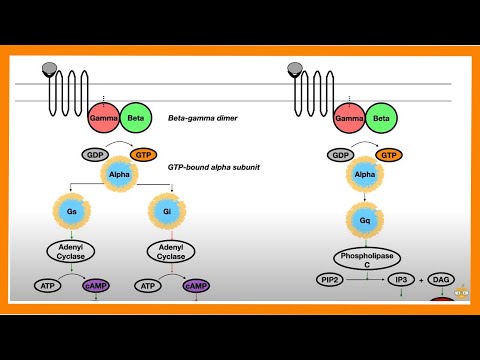
- The receptor is associated with a heterotrimeric G protein network comprising gamma, alpha, and beta subunits.
- Activation Mechanism of G Proteins
- Signal binding induces conformational changes in the trimeric protein.
- The alpha subunit undergoes conversion from GDP to GTP upon activation by the signal.
- Functions of Alpha Subunit
- Alpha subunit can stimulate (G sub S) or inhibit (G sub I) adenylyl cyclase.
- Another function involves working through GQ to activate phospholipase C, leading to unique downstream effects like calcium release and protein kinase activation.
- Significance of Different Pathways
Receptor Signaling Pathways
In this section, the discussion revolves around receptor signaling pathways, focusing on G-protein-coupled receptors and receptor tyrosine kinases.
G-Protein-Coupled Receptors
- G-protein-coupled receptors can activate protein kinase A, inhibit protein kinase A, or activate both calcium and protein kinase C based on the intended effect through the secondary messenger system.
- Mnemonic for remembering the pathway: "G protein turns on adenylyl cyclase which turns on cAMP which turns on PKA."
- Endocrine hormones under the control of cAMP pathway include FSH, LH, ACTH, TSH, CRH, HCG, ADH among others.
- Endocrine hormones under the control of IP3 pathway include GNRH, oxytocin, ADH (V1 receptor), TRH among others.
Receptor Tyrosine Kinases
- Receptor tyrosine kinases are unique as they have inherent enzyme activity in addition to being receptors.
- Growth factors bind to receptor tyrosine kinases leading to dimerization and cross-phosphorylation.
- Cross-phosphorylation results in an SH2 domain formation for complex signal transduction initiation.
- Activation of Ras occurs after GDP is exchanged for GTP leading to a cascade involving Raf, MEK, and ERK.
Receptor Tyrosine Kinase Pathway Mnemonic
This part focuses on a mnemonic to remember the receptor tyrosine kinase pathway.
Detailed Pathway Explanation
In this section, the speaker explains the pathway involving three kinases and receptor tyrosine kinases, simplifying the process by dropping a kinase at each step for easier understanding.
Three Kinase Pathway
- The pathway after ROS starts with MAP kinase kinase kinase.
- As you progress down the pathway, drop a kinase at each step.
- Example: RTK (Receptor Tyrosine Kinase) - R for ROS, T for three K for kinase.
- Simplifies understanding by eliminating a kinase as you move along the pathway.
CGMP Pathway Overview
The CGMP pathway is discussed as the final signal transduction pathway due to its simplicity and memorization ease. Nitric oxide's role in activating guanylate cyclase to convert GTP into CGMP is highlighted.
Nitric Oxide and CGMP Pathway
- Nitric oxide interacts with guanylate cyclase inside the membrane.
- Guanylate cyclase converts GTP into CGMP.
- CGMP activates protein kinase G in the pathway.
- Notable feature: Most components in this pathway contain the letter 'G'.
Endocrine Hormones and Effects of CGMP Pathway
The endocrine hormones BNP and EDRF are controlled within the CGMP pathway. Understanding this pathway is crucial due to its profound effects on smooth muscles.
Endocrine Hormones and Smooth Muscle Effects
- Endocrine hormones controlled in this pathway: BNP and EDRF.