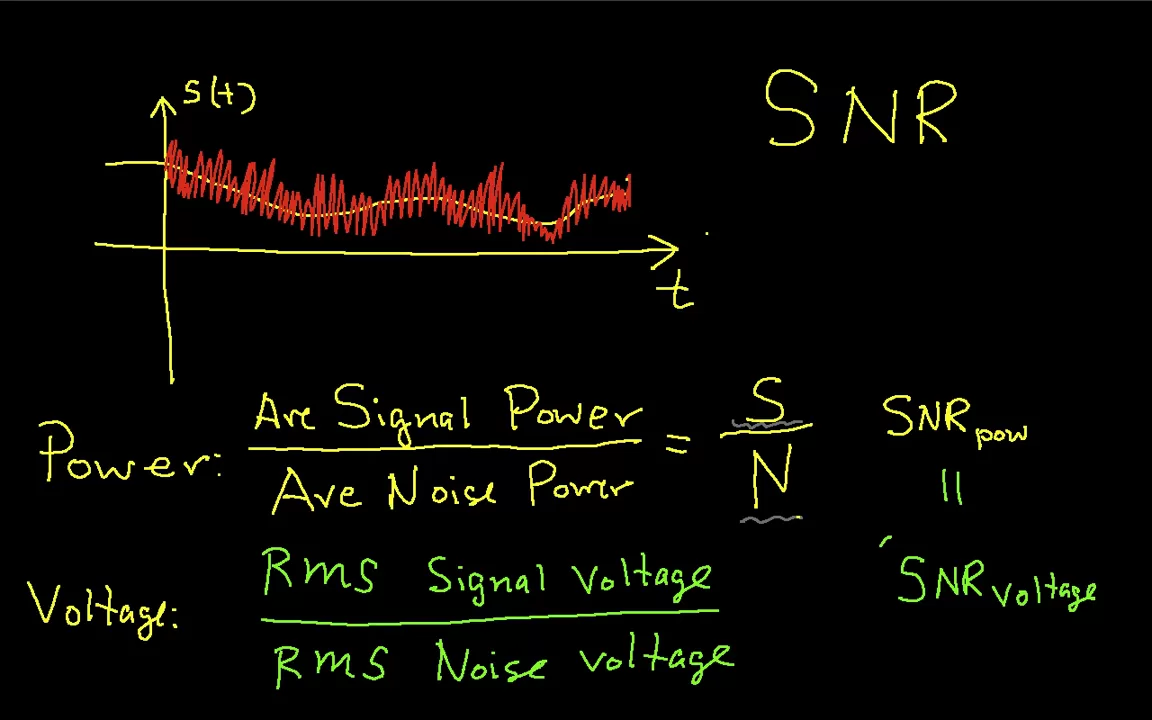
Signal-to-Noise Ratio
Introduction to Signal-to-Noise Ratio
In this video, the concept of signal-to-noise ratio is introduced. The importance of signal-to-noise ratio is discussed, and how it can be defined.
Definition of Signal-to-Noise Ratio
- A signal is a function that changes over time.
- Noise can interfere with the signal and make it difficult to measure or understand.
- Noise is one of the limiting factors in communication systems.
- Signal-to-noise ratio (SNR) characterizes the relative strength of the signal and noise.
- SNR can be expressed as power or voltage ratios.
Power and Voltage Ratios
Power Signal-to-Noise Ratio
- Power SNR is given by average signal power divided by average noise power.
- Power SNR can be expressed in terms of voltage SNR using a square relationship.
Voltage Signal-to-Noise Ratio
- Voltage SNR is given by RMS signal voltage divided by RMS noise voltage.
- Average signal power and average noise power can be computed from RMS values.
Decibels
- Decibels (dB) are a logarithmic scale used to express SNR.
- dB can be calculated from power or voltage ratios.
Manipulating Signal-to-Noise Ratios
Example 1 - Low SNR
- An SNR of 1 means that noise power equals signal power, which is not ideal.
Example 2 - High SNR
- An SNR of 100 means that signal power is much greater than noise power, which is desirable.
Signal-to-Noise Ratios
This section explains how to calculate signal-to-noise ratios and express them in decibels (dB).
Calculating Signal-to-Noise Ratios
- A power signal-to-noise ratio of 100 is equivalent to a voltage signal-to-noise ratio of 10.
- The dB expression for a voltage or power signal-to-noise ratio is the same: 20 log to the base 10 of the ratio.
- For example, a power signal-to-noise ratio of 100 is equal to 20 dB.
- The log base 10 of a number can be multiplied by 10 to get its dB value.
Using Signal-to-Noise Ratios
- A gain or attenuation expressed in dB corresponds to a ratio that is either twice or half the value of something else, respectively.
- For example, a gain of 3 dB corresponds to a ratio that is twice the value of something else, while an attenuation of -3 dB means that something is half the value of something else.
- Filters are often discussed in terms of their bandwidth at frequencies where they have attenuated signals by three DB or by a factor of two.
Overall, this section provides an introduction to calculating and using signal-to-noise ratios and expressing them in decibels.