If I Could Go Back & Tell Myself What I Know Now... Part 3 of 4
Introduction and Purpose
The video is part three of a series where the speaker imagines having a conversation with their younger self to provide insights on what to focus on when starting out in trading.
Focus on Learning from Past Mistakes
- The speaker hopes that by sharing their experiences, they can help others avoid painful lessons and losses.
- Emphasizes the importance of practicing and backtesting daily setups before entering trades.
Importance of Practice and Backtesting
The speaker discusses different platforms for practicing and backtesting trading strategies.
Utilizing Demo Accounts
- Recommends using broker demo platforms, which are trial versions of trading platforms offered by brokers.
- Forex brokers often offer demo accounts that don't expire, allowing traders to test strategies without risking real money.
- Advises treating demo accounts seriously, simulating realistic trading conditions and avoiding overtrading or falling into bad habits.
Third-party Apps for Backtesting
- Mentions forex tester as a third-party app for backtesting strategies.
- Suggests visiting forextester.com for more information on this tool.
- Highlights the importance of building good habits and removing the temptation to take excessive trades every day.
TradingView Platform
- Introduces TradingView as a platform that offers various features similar to MetaStock Super Charts or TradeStation.
- Encourages focusing primarily on open, high, low, and close price levels rather than relying heavily on indicators.
- Advises stripping charts of unnecessary indicators to gain clarity in understanding price action.
Importance of Price Levels in Trading
The speaker explains why focusing on open, high, low, and close price levels is crucial for consistent setups.
Stripping Down Charts
- Urges removing all overlays and indicators from charts.
- Emphasizes the significance of open, high, low, and close price levels.
- Mentions that understanding previous day's highs and lows, as well as those from previous weeks and months, can provide valuable setups.
Practicing with TradingView
The speaker demonstrates how to practice using the TradingView platform.
Setting Up Charts
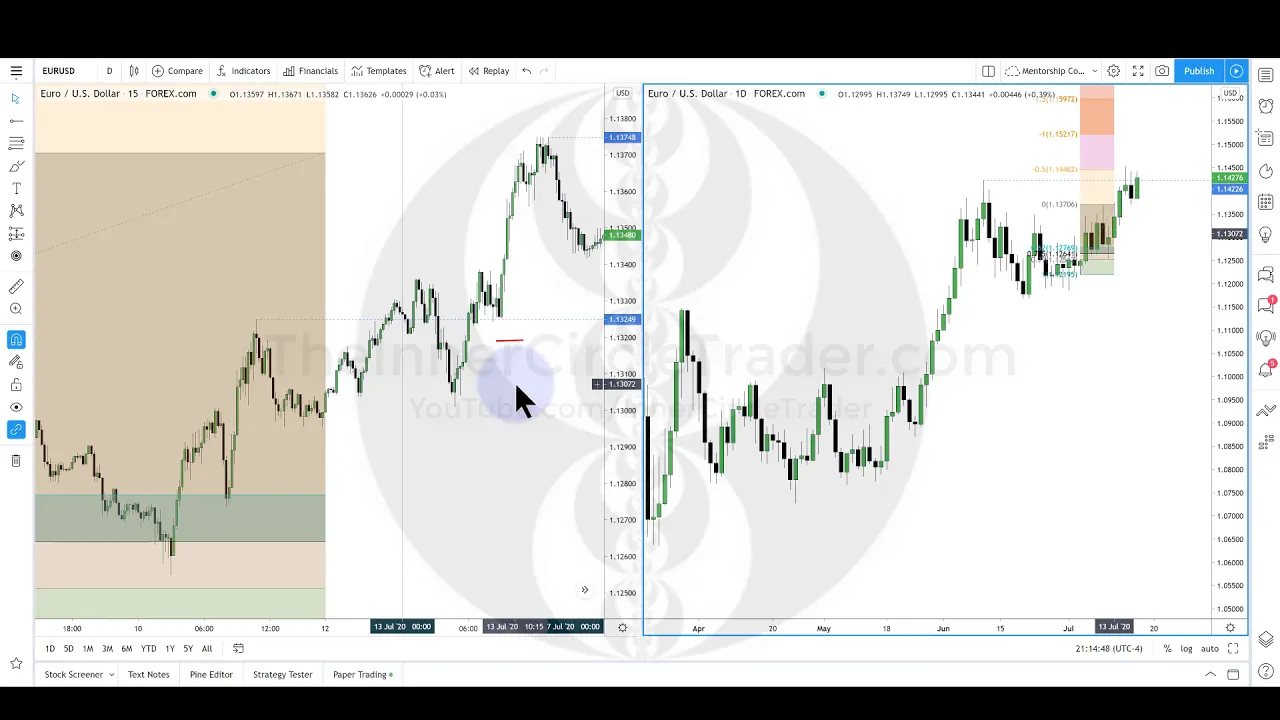
- Shows a chart of the EUR/USD currency pair on a 15-minute time frame on the left side and a daily chart on the right side.
- Focuses on optimal trade entry patterns on higher time frames until they reach key levels.
Using Fibonacci Retracement
- Demonstrates drawing Fibonacci retracement levels to identify potential retracements within price ranges.
- Anchors the Fibonacci tool from swing lows to successive higher highs for capturing retracements.
Identifying Optimal Trade Entry Levels
- Points out specific levels such as 60% to 70% retracement level and 70.5 sweet spot as potential trade entry points.
- Recommends primarily using the 62% retracement level for most trades.
Conclusion
The video provides insights into practicing, backtesting, and focusing on price levels for consistent trading setups. It emphasizes the importance of demo accounts, third-party apps like Forex Tester, and utilizing platforms like TradingView. Stripping down charts and focusing on open, high, low, and close price levels is highlighted as crucial for understanding market dynamics. The demonstration in TradingView showcases how to use Fibonacci retracement for identifying optimal trade entry points.
Opportunity between 62% and trade zone
The speaker discusses the opportunity that lies between the 62% retracement level and the trade zone. They emphasize the importance of focusing on daily candle movements and aiming for higher price levels.
Ideal entry at 62% retracement level
- The speaker suggests that an ideal entry point is at the 62% retracement level.
- Price movement starting from this level can indicate a potential upward trend.
- Daily candles opening near the low and closing near the high are considered favorable.
"To it and through it" slogan for optimal trades
The speaker introduces the concept of finding optimal trades by using the "to it and through it" approach. They explain how this strategy can be applied to various markets.
Optimal trade entry until reaching a high
- The speaker mentions that an optimal trade entry will continue to deliver profits until reaching a high price level.
- They emphasize using the "to it and through it" approach when encountering resistance at a high price point.
- This strategy can be applied across different market asset classes.
Targeting above previous highs with Fibonacci levels
The speaker explains how Fibonacci levels can be used to set targets above previous highs. They provide an example of targeting slightly above a specific price point.
Using Fibonacci levels for target setting
- A target slightly above a specific price point can be set using Fibonacci levels.
- In this example, they mention targeting 1.1446 with one pipette above the actual high of 1.1452.
- Fibonacci levels, such as one standard deviation or half a standard deviation, can also be used for target setting.
Focusing on New York setup for optimal trades
The speaker advises focusing on the New York setup for optimal trade opportunities. They suggest studying the price structure during specific timeframes to identify retracements and accumulation.
Studying the New York setup
- The speaker recommends concentrating on the price structure between 8:30 AM and 11:00 AM in the New York session.
- By studying this timeframe, one can observe retracements and accumulation patterns.
- Each day is expected to have accumulation, manipulation, and distribution phases.
Delineating daily timeframes for optimal trade entries
The speaker explains how to delineate daily timeframes on a chart to identify optimal trade entries. They discuss the concept of accumulation near the low of the day.
Delineating daily timeframes
- A line segment or rectangle can be used to delineate each day's timeframe from 8:30 AM to 11:00 AM in New York time.
- Accumulation of long positions typically occurs near the low of the day during this timeframe.
- Retracements lower within this consolidation period provide opportunities for optimal trade entries.
Optimal trade entry at 62% retracement level
The speaker emphasizes using a 62% retracement level as an optimal trade entry point. They explain how to identify low swing highs within consolidations for potential trades.
Optimal trade entry at 62% retracement level
- Optimal trade entries can be found by identifying low swing highs within consolidations during the specified timeframe.
- Going long at the 62% retracement level with a stop below the previous swing low is suggested.
- Targets can be set at previous day's highs or using standard deviations on the Fibonacci tool.
Backtesting and analyzing trade performance
The speaker discusses the importance of backtesting and analyzing trade performance. They highlight factors to consider, such as risk, drawdown, and trade duration.
Analyzing trade performance
- Backtesting is recommended to study the performance of trades using the 62% retracement level.
- Factors to consider include the number of pips gained or lost, time taken from entry to target, and drawdown experienced.
- Analyzing a sample set of data helps in setting realistic expectations and understanding trade outcomes.
Dealing with trades that don't perform as expected
The speaker addresses trades that do not perform as expected. They discuss the importance of managing expectations and learning from mistakes.
Trades not performing as expected
- Trades may not always react immediately at the 62% retracement level.
- It is important to manage expectations and not be discouraged by initial non-performance.
- Learning from mistakes, such as holding onto losing trades or being offside, is crucial for growth.
Identifying optimal trade entries in London session
The speaker explains how to identify optimal trade entries during the London session. They mention targeting previous day's highs using the 62% retracement level.
Optimal trade entries in London session
- During the London session, one should look for price structures created by runs followed by retracements between 8:30 AM and 11:00 AM.
- Optimal trade entries can be found using the 62% retracement level.
- Targets can be set at previous day's highs or using standard deviations on Fibonacci tools.
Building a backlog for studying trade outcomes
The speaker emphasizes the importance of building a backlog to study trade outcomes. They discuss the benefits of analyzing profitability, drawdown, and trade duration.
Building a backlog for studying trades
- Building a backlog involves recording and analyzing trade outcomes.
- Factors to consider include profitability, drawdown experienced, and time taken to reach targets.
- Studying the backlog helps in gaining perspective and understanding optimal trade performance.
Not all optimal trades perform as expected
The speaker acknowledges that not all optimal trades will perform as expected. They highlight the importance of managing expectations and learning from hindsight experiences.
Managing expectations with optimal trades
- Even with an optimal trade entry, there is no guarantee of success.
- It is important to learn from hindsight experiences and understand that not every trade will be profitable.
- Analyzing factors such as stop-outs, adverse price movements, and overall trade performance provides valuable insights.
Wrestling with the idea of being right in trading
The speaker discusses the common struggle traders face when trying to be right. They emphasize focusing on growth rather than being fixated on being correct.
Struggling with the need to be right
- Traders often struggle with wanting to be right in their trades.
- The focus should shift towards personal growth and learning from mistakes.
- Being fixated on being correct can hinder progress in trading.
New Section
The importance of accepting one's humanity and avoiding unnecessary struggles.
Accepting One's Humanity
- It is important to accept that you are human and prone to mistakes.
- Struggling unnecessarily can be avoided by acknowledging one's limitations.
- By accepting our humanity, we can avoid painful experiences in the future.
New Section
Learning from both good and bad examples without torturing oneself.
Learning from Examples
- Use bad examples for learning purposes without torturing oneself.
- Avoid toxic thinking and negative self-criticism when journaling trading experiences.
- Frame annotations in a journal with no emotions but focus on extracting salient information for constructive criticism.
New Section
Using a trading journal to study mistakes objectively and avoid repetitive problems.
Studying Mistakes Objectively
- Journaling helps identify problematic patterns in trading decisions.
- Study mistakes with a sober mind to understand why they occurred.
- Avoid reliving painful moments by using the journal constructively for positive criticism.
New Section
Framing annotations in a trading journal without emotions but focusing on lessons learned.
Constructive Annotations in a Journal
- Frame annotations in the trading journal without emotions.
- Study what led to being wrong to identify problematic behaviors or decisions.
- Use the journal as a tool for positive criticism and learning from mistakes.
New Section
The importance of studying mistakes objectively to avoid frustration and losses.
Objective Study of Mistakes
- Studying mistakes objectively helps identify recurring issues.
- Falling victim to repeated problems can be avoided through objective analysis.
- Avoid losing money and experiencing unnecessary frustration by understanding the reasons behind mistakes.
New Section
The significance of staying consistent with a trading narrative.
Consistency in Trading Narrative
- Not every day will be a winning trade, but consistency is key.
- Focus on the overall trading narrative rather than individual daily outcomes.
- Even when a swing high occurs, it does not mean there won't be future buying opportunities.
New Section
Analyzing trade entries and studying their characteristics.
Analyzing Trade Entries
- Study the characteristics of trade entries, such as time taken to cover spread and move to target.
- Assess the number of pips offered by a trade and whether it reached the previous day's high.
- Scale profits based on short-term highs instead of solely relying on reaching previous day's high.
New Section
Taking profits at different levels and assessing trade duration.
Scaling Profits and Trade Duration
- Take profits at different levels, including short-term highs.
- Assess how long you stayed in a trade before realizing it was wrong.
- Be honest about expectations during backtesting to avoid unrealistic results.
New Section
Building a backlog of ideas for weekend study sessions.
Weekend Study Sessions
- Build a backlog of trades, analyzing factors such as pip count, time taken, and drawdown.
- Study how each trading day sets up the situation for the next day.
- Gain an understanding of institutional order flow through hourly and daily perspectives.
New Section
Training oneself to recognize setups and understand repeating characteristics.
Training for Setup Recognition
- Practicing consistently helps train oneself to recognize specific setups.
- Develop an understanding of how characteristics repeat over time.
Turn any video into a summary like this
YouTube links, meetings, lectures. With transcripts, search, and chat.