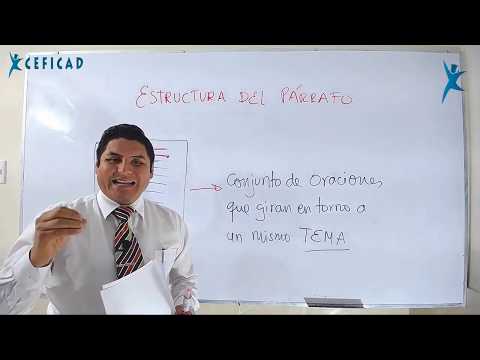
🟡ESTRUCTURA DEL PÁRRAFO👩🏻🏫👨🏻🏫
Understanding the Structure of a Paragraph
Introduction to Paragraph Structure
- The course on text comprehension is introduced by Professor David de Rengifo Ortega, focusing on the structure of paragraphs.
- The session aims to explore what a paragraph is, how it is organized, its structure, and how to recognize it for examination purposes.
Definition and Composition of a Paragraph
- A paragraph is defined as a significant unit composed of multiple sentences that revolve around a single theme.
- It consists of interconnected ideas or sentences that collectively focus on one main topic.
Main and Secondary Ideas in Paragraphs
- Each paragraph contains a main idea (highlighted in red) supported by secondary ideas that reinforce this central concept.
- Understanding the distinction between primary and secondary ideas is crucial for analyzing texts effectively.
Identifying Main Ideas
- To analyze a text, one must identify the main idea within each paragraph and extract these to formulate an overarching central idea from the entire text.
- Recognizing where one idea ends and another begins can be indicated by punctuation marks like periods.
Characteristics of Paragraph Formatting
- A new paragraph typically starts with an indentation (known as "sangría"), signaling the beginning of a new idea.
- Secondary ideas may be separated by punctuation such as commas or semicolons, contributing to the overall coherence of the paragraph.
Hierarchical Structure in Text Construction
- The relationship between words, sentences, paragraphs, and texts is explained; paragraphs are essential components that contribute to forming complete texts.
- The hierarchy indicates that words form sentences, sentences form paragraphs, and multiple paragraphs create a cohesive text.
Macrostructure vs. Microstructure
- The discussion emphasizes understanding macrostructure—how individual elements like paragraphs contribute to the overall structure of texts.
- It clarifies that texts are not merely divided into paragraphs but rather consist of interconnected units that together create meaning.
Understanding the Structure of a Paragraph
Characteristics of a Paragraph
- A paragraph is defined by specific characteristics that make it recognizable, including its syntactic structure and organization.
- The syntactic structure refers to how the paragraph is organized, emphasizing the importance of syntax in understanding its form.
- Semantically, a paragraph conveys meaning through its main idea and theme, establishing itself as a unit of thought.
- It serves as a unit of thought by connecting a main idea with secondary ideas that support or elaborate on it.
- All elements within the paragraph must align with the central theme to avoid incoherence.
Visual and Textual Properties
- A paragraph also has visual unity, which can be observed through indentation and punctuation that separate ideas clearly.
- Key textual properties include coherence, cohesion, and adequacy; these ensure that the text conveys a clear message effectively.
- These characteristics work together to create meaningful text that meets conditions for clarity and comprehension.
Example Analysis
- An example paragraph illustrates these concepts: "La argumentación forma parte de nuestra vida cotidiana..." highlights how argumentation appears in daily communication contexts.
- The discussion includes various scenarios where argumentation is present, such as debates among friends or public discussions on controversial topics.
- Observing this example helps identify key features like thematic focus and supporting details within the text structure.
Identifying Main Ideas
- The analysis emphasizes recognizing the main idea within paragraphs; here, "la argumentación forma parte de nuestra vida cotidiana" serves as an overarching thesis statement.
- Following this thesis are supporting statements that elaborate on how frequently argumentation occurs in everyday life situations.
- Each point made after the main idea builds upon it while maintaining clarity through proper punctuation to differentiate between primary and secondary ideas.
Understanding Paragraph Structure
Key Concepts in Paragraph Composition
- The discussion begins with the connection of primary needs through a linking point, illustrating how ideas are interrelated within a paragraph.
- It highlights the emergence of advertising texts in public debates on controversial topics, emphasizing their role in media and legal discussions.
- The importance of identifying paragraph characteristics is stressed, aiding in distinguishing between main and secondary ideas during text analysis.
Visual Aspects of Paragraphs
- A visual example is presented to illustrate the components and rules that make paragraphs identifiable, including spacing and capitalization.
- Key elements such as indentation, starting with a capital letter, and sentence structure are discussed as foundational aspects of paragraph formation.
Identifying Main Ideas and Supporting Details
- The theme of a paragraph is identified as its characteristics; understanding these helps recognize structural elements effectively.
- Each paragraph must start with a capital letter following a period from the previous one, establishing clear boundaries for new thoughts.
Properties of Textual Coherence
- Cohesion and coherence are defined as essential properties that connect ideas within paragraphs, ensuring clarity in communication.
- The relationship between main ideas (thematic sentences) and supporting details (secondary ideas) is explored to enhance comprehension.
Exploring Structural Levels of Paragraphs
Deep vs. Superficial Structures
- Paragraph structure can be analyzed at two levels: deep (meaning-based) and superficial (form-based), each serving distinct analytical purposes.
Deep Structure Analysis
- The deep structure focuses on meaning; it involves identifying thematic sentences which encapsulate the main idea alongside supporting details.
Superficial Structure Analysis
- In contrast, superficial structure pertains to formal aspects like themes and subthemes that contribute to overall content organization.
Conclusion on Structural Understanding
- Recognizing both deep meanings and superficial forms allows for comprehensive analysis of paragraphs, enhancing writing skills by clarifying how content is structured.
Understanding Paragraph Structure and Classification
Analyzing Paragraph Themes and Structures
- The analysis of a paragraph involves identifying its main theme and subtopics, focusing on both superficial and deep structures. This dual approach helps in understanding the overall content better.
- Questions posed by educators often relate to the superficial structure (theme identification) or the deep structure (main ideas, secondary ideas). Understanding these layers is crucial for effective text analysis.
Levels of Paragraph Structuring
- A paragraph consists of two levels:
- Superficial Structure: Refers to the framework or skeleton of the paragraph.
- Deep Structure: Involves the internal content and connections within the paragraph. Both are essential for comprehensive analysis.
Classifications of Paragraphs
Function-Based Classification
- Paragraphs can be classified based on their function within a text:
- Introductory Paragraph: Serves as the opening section that introduces the topic. It sets up what follows in the text.
- Informative Paragraph: Focuses on conveying information about a specific subject matter, distinct from merely being part of an informative text type. It develops core ideas related to a topic.
Connecting Ideas Through Linking Paragraphs
- Linking Paragraph: Acts as a bridge between preceding and following paragraphs, facilitating smooth transitions in thought processes throughout the text. These paragraphs help maintain coherence in writing.
Conclusion-Based Classification
- Conclusion Paragraph: Marks the end of a text, summarizing key points discussed earlier while often using specific connectors like "to conclude" or "in summary." Recognizing these connectors can help identify this type effectively.
Importance of Connectors in Text Analysis
- Connectors play a vital role in concluding paragraphs; they signal important summaries or conclusions drawn from previous discussions, making it easier to pinpoint critical insights within texts. Examples include phrases like "therefore," "in conclusion," etc., which indicate significant takeaways from prior content.
Summary Insights on Text Analysis Techniques
- When analyzing texts, start by examining structural elements such as introductory and concluding paragraphs to quickly grasp main themes and supporting details without needing to read every section thoroughly.
- Understanding how different types of paragraphs function aids not only in writing but also enhances comprehension when reading complex materials, allowing for efficient extraction of key messages throughout any given text.
Classification of Paragraphs
Types of Paragraphs Based on Structure
- The analytical paragraph is defined by having the main idea presented at the beginning, allowing readers to grasp the primary concept immediately.
- This type of paragraph is also referred to as a deductive paragraph, where secondary ideas are derived from the main idea introduced at the start.
- In contrast, a synthetic paragraph places the main idea at the end, summarizing or concluding after presenting supporting details.
- The inductive paragraph leads with secondary ideas and culminates in a general conclusion, emphasizing how specific points build up to an overarching theme.
- A framed paragraph starts and ends with the same main idea but rephrased, creating a cohesive structure that reinforces its central message.
Additional Paragraph Structures
- A parallel paragraph contains multiple important ideas that hold equal weight; no single point overshadows another, requiring inference for understanding its main idea.
- The discussion includes various types of paragraphs such as analytical, synthetic, framed, and parallel based on their structural characteristics and placement of key ideas.
Understanding Introductory Paragraphs
Characteristics and Functions
- An introductory paragraph serves to introduce readers to the text's subject matter while capturing their interest in what follows.
- It typically presents both the topic and main idea clearly, setting expectations for what will be discussed throughout the text.
- Recognizing this introductory section is crucial as it often contains essential information about themes and intentions behind the writing.
- The introductory paragraph may also outline objectives or context for understanding subsequent content within the text.
- It can provide insights into how the text will be organized, indicating which topics will be covered in detail later on.
Understanding the Structure of Texts
The Importance of Introductory Paragraphs
- The introductory paragraph serves a crucial purpose by providing context, details, and objectives for understanding the text. It contains valuable information essential for reading comprehension.
- An example illustrates that an introductory paragraph outlines how people communicate, focusing on communication goals, influencing factors, and the role of language in human behavior.
- This paragraph also discusses behaviors and relationships between communicators (e.g., speaker-listener dynamics), emphasizing the complexity of communication processes.
- Key elements highlighted include the main idea regarding communication's scope and objectives, as well as additional subtopics that will be explored in the text.
- The introductory section sets up expectations for analyzing various aspects of communication while avoiding oversimplifications or distortions.
Transitioning to Informative Paragraphs
- Unlike introductory paragraphs, informative paragraphs are used to develop the body of a text with central information and key ideas related to the main topic. They elaborate on themes introduced earlier.
- These paragraphs contain relevant structured information derived from central ideas, supporting them with detailed insights that explore different aspects of the subject matter.
- Informative paragraphs can take various forms depending on their content type—narrative, comparison/contrast, cause-effect relationships—tailoring to specific writing styles or purposes within texts.
- An example is provided where an informative paragraph contrasts fresh produce with processed foods, highlighting nutritional benefits while addressing common misconceptions about convenience foods.
- This structure allows readers to engage deeply with content while facilitating better understanding through organized presentation of ideas and arguments throughout the text development process.
Effects of Food Choices on Health
The Cost of Healthy Eating
- The discussion begins with the idea that unhealthy food choices lead to increased visits to healthcare professionals, suggesting a long-term financial burden despite lower immediate costs.
- It highlights how packaged foods often come with attractive packaging, leading consumers to prioritize brand over nutritional content, which can mislead purchasing decisions.
Comparison of Food Types
- A comparison is made between junk food and healthier options like fresh fruits, emphasizing that while junk food may seem cheaper initially, it has detrimental health effects.
- The author argues that the initial savings from buying junk food are outweighed by future healthcare costs associated with poor nutrition.
Long-Term Financial Implications
- The text contrasts short-term savings against long-term health expenses, reinforcing the notion that "cheap" food can ultimately be more expensive due to health issues.
- An argument is presented stating that investing in organic foods leads to fewer medical visits and better overall health outcomes.
Informative Paragraph Structure
- The author effectively uses a comparison and contrast structure in their writing to convey the negative impacts of processed foods versus natural options.
- This section serves as an example of informative writing where central ideas are developed through comparative arguments.
Causal Relationships in Personal Experience
Reflection on Education Choices
- A personal anecdote illustrates how ignoring advice about education led to regrettable financial consequences later in life.
- The narrative shifts from a condition (not listening to teachers) leading to an effect (poor financial situation), showcasing cause-and-effect reasoning.
Consequences of Short-Term Thinking
- The speaker reflects on their initial feelings of success when leaving university but later realizes this decision was misguided compared to peers who pursued higher education.
Realization and Change
- Over time, the speaker acknowledges their incomplete education as a significant factor affecting their career prospects and decides to return for further studies at age 25.
Summary of Cause and Effect
- Throughout this narrative, the author emphasizes how each decision has cascading effects on future opportunities and well-being.
Understanding Informative Paragraphs and Their Functions
Structure of Informative Paragraphs
- The action-reaction structure is fundamental in analyzing texts; informative paragraphs often follow this format, which can include various types such as contrast, problem-solution, or narration.
- Different forms of informative paragraphs include exemplification and argumentation, showcasing how authors can elaborate on their ideas effectively.
- Narrative paragraphs develop events and facts, while normative paragraphs present the author's arguments. Descriptive paragraphs explain characteristics and qualities.
- Expository paragraphs introduce subtopics, contributing to the overall development of the text's theme.
The Role of Linking Paragraphs
- Linking paragraphs serve as connectors between previous and subsequent content, enhancing cohesion within the text.
- These linking elements are crucial for maintaining coherence throughout a piece by relating prior information to new ideas presented later.
- A linking paragraph acts like a staircase that bridges different levels of discussion within the text, ensuring smooth transitions between concepts.
Examples of Linking Paragraph Usage
- An example phrase like "considering what was previously stated" illustrates how linking phrases draw from earlier content to introduce new topics.
- This technique is known as concatenation; it allows authors to connect past discussions with current points seamlessly.
Conclusion Paragraph Characteristics
- Conclusion paragraphs are essential for summarizing key themes and reiterating main ideas presented throughout the text.
- They provide a paraphrase of significant points made earlier while establishing a final connection with readers through summary statements.
- The conclusion serves as an opportunity for readers to grasp the central message clearly before finishing the text.
Understanding the Purpose of Texts
The Role of Introductory and Concluding Paragraphs
- The introductory paragraph outlines the purpose of the text, reiterating the main idea. It serves as a summary of what has been discussed.
- The concluding paragraph encapsulates all previous discussions, summarizing key points but not all texts include detailed evolution paragraphs.
- Not every text features a conclusion; some may only provide informative paragraphs without summarization.
- A well-crafted conclusion saves readers time by consolidating information, making it easier to grasp essential ideas.
- An example illustrates how conclusions can summarize complex issues like global warming, emphasizing its urgency for government action.
Identifying Main Ideas and Themes
- To find the main idea or theme in a text, look for concluding paragraphs that often highlight critical insights.
- Paragraph structure is crucial; each paragraph should connect through a single theme with specific textual properties and classifications based on function and location.
- Understanding superficial structures helps in analyzing deeper meanings within texts.
Analyzing Language and Purpose
- Distinguishing between scientific language and literary language requires understanding their respective purposes—this involves inference rather than direct statements from the text.
- Inferring meaning means constructing ideas based on context rather than explicit content; recognizing themes is vital for comprehension.
- Key terms such as "distinguish" indicate significant concepts that help clarify differences between literary and scientific discourse.
Clarifying Authorial Intent
- The author’s intent revolves around comparing literary versus scientific language, which shapes how we interpret their purpose within the text.
- Recognizing distinctions aids in understanding broader themes related to emotion versus thought in literature versus science.
Conclusion on Text Structure
- Introductory paragraphs set up expectations for subsequent informative sections while also establishing thematic relevance throughout the text.
- Correctly identifying these elements leads to better comprehension of an author's comparative analysis between different types of language.
Analysis of Text Structure and Language
Understanding Paragraph Functions
- The discussion begins with analyzing the function of paragraphs within a text, focusing on their classification based on roles such as informative, introductory, linking, or concluding.
- The speaker emphasizes the importance of identifying whether a paragraph introduces new ideas or develops existing ones, highlighting its role in setting up the main theme.
- A distinction is made between introductory paragraphs and headings; while both serve to introduce content, they are not synonymous.
Characteristics of Scientific vs. Literary Language
- The speaker compares scientific language to literary language, noting that the former can be ambiguous and filled with historical accidents that affect meaning.
- Literary language is described as expressive and capable of influencing reader attitudes through various techniques like meter and alliteration.
Analyzing Specific Paragraphs
- The analysis shifts to specific paragraphs where one focuses solely on characteristics of literary language without comparing it to scientific language.
- It is noted that subsequent paragraphs will likely address scientific language characteristics, indicating a structured approach to developing themes throughout the text.
Central Ideas in Text Analysis
- The speaker stresses the need for readers to focus solely on what each paragraph presents without assuming prior knowledge from previous sections.
- Emphasis is placed on identifying central ideas within paragraphs; for instance, one paragraph discusses distinctive features of literary language without mentioning scientific comparisons.
Conclusion on Language Efficiency
- The conclusion drawn highlights that while literary language may have certain deficiencies compared to scientific language, these aspects are explored further in subsequent discussions.
- Overall efficiency in communication is underscored as a key difference between literary and scientific languages.
Literary vs. Scientific Language: A Comparative Analysis
Deficiencies in Literary Language
- The discussion begins with a comparison of literary and scientific language, highlighting that the text paraphrases the idea that literary language has many deficiencies compared to scientific language.
- It is asserted that while the text does not explicitly state that scientific language is more efficient, it implies that literary language is deficient when contrasted with scientific discourse.
Understanding Textual Interpretation
- The speaker emphasizes the need to find ideas literally stated in the text rather than inferred, indicating a focus on textual evidence for claims about efficiency.
- There’s a distinction made between identifying differences and finding main ideas as presented in the text; this affects how one interprets responses based on literal meanings.
Paragraph Structure and Function
- The analysis continues by categorizing paragraphs based on their function, noting that certain paragraphs are informative rather than introductory.
- An informative paragraph develops specific themes rather than introducing them, which leads to discussions about descriptive forms within these texts.
Mixed Paragraph Types
- The conversation shifts to mixed paragraph types, where elements of introduction, information, and conclusion coexist within a single paragraph structure.
- This blending creates complexity in understanding how different parts of a paragraph contribute to its overall message.
The Invention of the Phonograph
Historical Context and Functionality
- The transcript transitions into discussing Thomas Edison’s invention of the phonograph in 1877, detailing its mechanical recording system which transformed sound waves into mechanical vibrations.
- It concludes by explaining how these vibrations allowed for sound reproduction, emphasizing the phonograph's significance as an early device for recording sounds.
How Does the Phonograph Work?
Understanding Text Structure and Development
- The phonograph is discussed as a tool for recording and reproducing sounds, emphasizing its role in text synthesis.
- Different writing strategies are highlighted based on the text's intention, such as starting with a main idea or focusing on secondary details.
- The importance of structuring paragraphs is noted, where secondary ideas may precede the main conclusion to enhance clarity.
- Connectors like "in conclusion" help identify paragraph types and their functions within the text structure.
- The use of connectors indicates whether a paragraph is expository or argumentative, guiding readers through the text's logic.
Factors Influencing Skin Cancer Mortality Rates
Analyzing UV Light Intensity and Health Outcomes
- UV light intensity is questioned as the primary factor in skin cancer mortality rates; Colorado has low rates despite high UV exposure.
- Contrasting data shows that England has higher skin cancer mortality despite lower UV levels, suggesting other influencing factors.
- Regions with high UV exposure but low mortality rates (like Mauritius and Nicaragua) challenge assumptions about UV light's impact on health.
- Genetic factors, diet, behavior, and healthcare access are identified as significant contributors to skin cancer outcomes beyond just UV exposure.
Classifying Paragraph Types Based on Function
Evaluating Content Structure in Text Analysis
- The first paragraph introduces key themes regarding skin cancer mortality related to UV intensity; it serves an introductory function.
- The second paragraph develops these ideas further by providing specific examples from U.S. regions with varying cancer rates linked to environmental factors.
- Classification of paragraphs according to their content type (argumentative vs. informative), highlighting how they serve different purposes in conveying information.
- The correct classification emphasizes that while the second paragraph argues against common beliefs about UV light’s effects, it also informs readers about relevant statistics.
This structured approach provides a comprehensive overview of key discussions from the transcript while maintaining clarity and focus on essential insights.
Discussion on Skin Cancer and UV Exposure
Key Insights on Skin Cancer Factors
- The text emphasizes that the intensity of light is not the most critical factor in skin cancer, suggesting a nuanced view on UVB exposure.
- While acknowledging that UVB rays influence skin cancer, the author argues there are other significant factors at play beyond just UV exposure.
- The discussion highlights alternative protective measures against skin cancer, such as wearing hats and using sunscreen, which contradict the notion that UV intensity is solely responsible for skin cancer deaths.
- The author asserts that ultraviolet light does not decisively contribute to mortality from skin cancer, challenging common perceptions about its role.
Understanding Products: Tangible vs. Intangible
Classification of Products
- The text defines a product as a set of attributes identifiable by consumers, distinguishing between tangible (e.g., computers, cars) and intangible products (e.g., services like cleaning).
- It explains that tangible products can be physically touched while intangible products represent services or experiences that cannot be physically handled.
- The purpose of the text is to classify products into tangible and intangible categories rather than merely stating what they are; it aims to explain their characteristics.
Author's Intent
- The author's intent is clarified as an effort to categorize products based on their tangible and intangible aspects, emphasizing this classification as central to understanding consumer goods.
- Conclusively, the main idea revolves around recognizing both types of products' existence and their implications for consumer behavior.