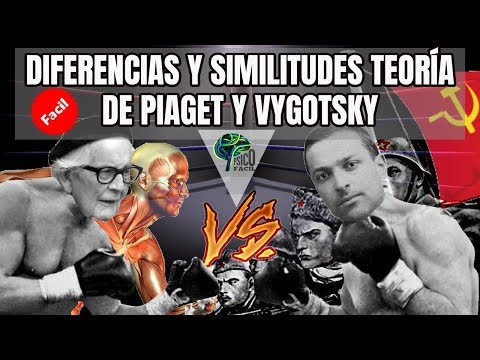
TEORÍAS DE JEAN PIAGET Y VYGOTSKY. DIFERENCIAS Y SIMILITUDES | FACIL Y CON EJEMPLOS!
Differences and Similarities Between Piaget and Vygotsky's Theories
Introduction to Cognitive Development Theories
- The episode introduces the differences and similarities between the cognitive development theories of Jean Piaget and Lev Vygotsky, emphasizing their influence on childhood education.
- It highlights that both theorists provide crucial insights into cognitive development influenced by biological and social factors.
Piaget's Theory of Cognitive Development
- Piaget describes four stages of cognitive development based on maturation and experience, focusing on how children interact with their environment.
- Key principles include:
- Children as active learners constructing knowledge from their surroundings.
- Learning through assimilation and accommodation leading to equilibrium in understanding.
- Physical interactions are essential for cognitive growth.
- Development occurs in specific age-related stages.
Vygotsky's Historical-Cultural Theory
- Vygotsky emphasizes culture and social interaction in cognitive development, viewing speech as a vital psychological tool for thought evolution.
- His theory is characterized by:
- Development through informal/formal conversations with adults.
- Critical early years where thinking becomes independent from language.
- Complex mental activities starting as basic social tasks.
Similarities Between Piaget and Vygotsky
- Both theorists focus on constructivism, where new knowledge builds upon prior understanding, valuing the environment as a developmental factor.
- They agree that early life is crucial for learning acquisition, highlighting an active role of children in knowledge acquisition rather than being passive recipients.
- Learning arises from conflicts with the environment; when faced with challenges, children seek new solutions through exploration or assistance.
Differences Between Piaget and Vygotsky
- For Piaget, learning stems more from environmental interaction; for Vygotsky, it is rooted in social interaction.
- Intelligence according to Piaget relies on biological factors necessary for adaptation; conversely, Vygotsky prioritizes social factors in development.
- While Piaget presents universal developmental stages, Vygotsky does not define distinct stages but offers a more linear view of growth.
- In terms of language's role: for Piaget it's less central compared to Vygotsky who sees it as fundamental to cognitive development.
Conclusion
Turn any video into a summary like this
YouTube links, meetings, lectures. With transcripts, search, and chat.