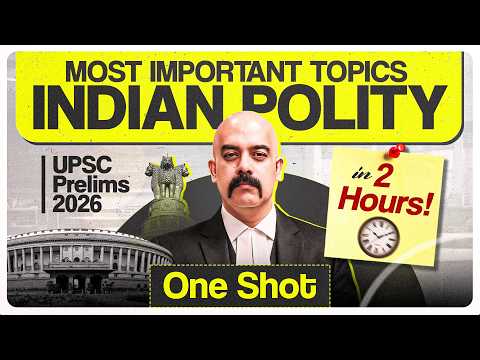
Most Important Polity Topics in 2 Hours! | One Shot | UPSC Prelims 2026 | Dr Sidharth Arora
Introduction to Exam Preparation
Overview of Topics
- The speaker introduces the urgency of preparing for an upcoming tough exam, emphasizing the importance of covering critical topics.
- Four main topics will be discussed: Emergency Provisions, Election Commission, President, Governor, and Bills in Parliament.
- Students who have already studied these topics are encouraged to leave the video; others can use it for quick revision.
Study Approach
- The speaker suggests watching at 2x speed for those familiar with the content and at normal speed for beginners.
- An offer from Unacademy is mentioned, promoting a crash course for UPSC CSE Prelims 2026 at a nominal fee.
Emergency Provisions
Types of Emergencies
- There are three types of emergencies: National Emergency (Article 352), President's Rule (Article 356), and Financial Emergency (Article 360).
National Emergency
- Article 352 allows declaration during war, external aggression, or armed rebellion.
- The term "armed rebellion" replaced "internal disturbance" due to the 44th Constitutional Amendment Act of 1978.
Declaration Process
- Only the President can proclaim a National Emergency based on written advice from the Cabinet.
- A historical instance is cited where Indira Gandhi declared an internal emergency without prior Cabinet advice.
Parliamentary Approval
Approval Requirements
- After proclamation, parliamentary approval must be obtained within one month through a special majority vote.
Special Majority Definition
- Special majority requires two-thirds of members present and voting plus absolute majority in both Houses.
Effects of National Emergency
Centralization of Power
- During a National Emergency, power centralizes under the Union government as per Article 355 responsibilities.
Fundamental Rights Impact
- Article 19 rights are suspended during external emergencies but automatically reinstated afterward; Articles 20 and 21 remain unaffected in any emergency.
Judicial Independence
Judiciary's Role During Emergencies
- The judiciary remains unaffected by any type of emergency declared under Articles 352 or 356.
President's Rule (Article 356)
Conditions for Imposition
- President’s Rule can be imposed if state governance fails to operate according to constitutional provisions based on reports from governors or other sources.
Duration and Approval Process
- Initially lasts two months without consultation; thereafter requires parliamentary approval via simple majority for extensions up to three years.
Financial Emergency (Article 360)
Declaration Criteria
- A financial emergency is declared when there is a threat to India's financial stability.
Implications on Governance
- It allows central directives over state finances including salary cuts across all levels including Supreme Court judges.
Conclusion
Historical Context
- Notably, India has never experienced a financial emergency since independence despite multiple instances of national emergencies being declared.
Understanding Internal Disturbances and Constitutional Amendments
Changes in Terminology Post-44th Amendment
- The term "internal disturbances" has been replaced with "armed rebellion" following the 44th Constitutional Amendment Act of 1978, indicating a significant shift in legal terminology.
- The amendment introduced the term "armed rebellion" to clarify grounds for declaring a national emergency, emphasizing the need for precise language in constitutional law.
- The speaker highlights that this change reflects an evolution in understanding internal conflicts within the country.
Matching Articles with Emergencies
- A question is posed regarding which articles correspond correctly to different types of emergencies: National Emergency (Article 352), President's Rule (Article 356), Financial Emergency (Article 360), and Suspension of Fundamental Rights (Article 358).
- Clarification is provided that Article 358 specifically deals with the suspension of Article 19 rights, not all fundamental rights as previously stated.
Election Commission of India: Structure and Function
Overview of the Election Commission
- The Election Commission of India is established as a constitutional body under Article 324, responsible for overseeing elections in India.
- It is crucial to note that appointments made by the President are subject to parliamentary law, ensuring checks and balances within this process.
Composition and Appointment Process
- According to Article 324, there must be one Chief Election Commissioner; however, additional commissioners can be appointed at the President's discretion based on parliamentary laws.
- From its inception until recent amendments, the structure has evolved from a single-member commission to a three-member commission since 1993.
Tenure and Removal Procedures
Terms of Office for Commissioners
- Members serve either six years or until they reach age sixty-five, whichever comes first. This ensures accountability while providing stability within their roles.
Removal Processes Differentiated
- The removal process varies between Chief Election Commissioners and other commissioners; only Parliament can remove the Chief Election Commissioner through special majority votes based on proven misconduct or incapacity.
Powers and Responsibilities of the Election Commission
Key Functions Defined
- Important functions include superintendence, direction, control over elections, and preparation of electoral rolls for various levels including Parliament and State Legislatures.
Limitations on Jurisdiction
- The Election Commission does not oversee municipal or panchayat elections; these are managed by state election commissions instead.
Judicial Powers Related to Elections
Dispute Resolution Authority
- While it holds quasi-judicial powers concerning disputes related to elections, it should not be confused with regular court proceedings or election petitions filed post-election results.
Legislative Framework
- The Representation of People’s Acts governs many aspects related to elections but detailed discussions may arise during advanced studies rather than preliminary examinations.
Comparative Analysis: President vs. Governor
Constitutional Basis
- The position of President is defined under Article 52 while that of Governor falls under Article 153. Both play critical roles in their respective governments.
Headship Roles Explained
- Understanding distinctions between de jure (by law - President as head of state at union level), versus de facto (in reality - Prime Minister as head at union level).
Oath-Taking Procedures
The oath for Presidents is administered by the Chief Justice while Governors take theirs from High Court Chief Justices. This distinction emphasizes their respective roles within state governance structures.
Understanding the Roles of President and Governor in India
The Resignation Process
- The President resigns by writing to the Vice President, who then communicates this to the Speaker of the Lok Sabha. This process is straightforward compared to that of a Governor.
- A Governor, being an appointed authority, also resigns in writing to the President, making their position relatively dependent on the President.
Removal Processes
- The removal of a President occurs through impeachment as outlined in Article 61 of the Constitution, which is a significant point for understanding presidential accountability.
- While impeachment is commonly discussed regarding judges' removal from courts, it specifically applies only to Presidents under Article 61; judges are removed based on proven misbehavior or incapacity.
Grounds for Impeachment
- The grounds for impeaching a President are violations of the Constitution of India. This differs from other officials where misbehavior or incapacity may be cited.
- UPSC often asks about these grounds; it's essential to remember that for Presidents, it’s strictly constitutional violations.
Comparison with Governors
- Unlike Presidents who can be removed by Parliament, Governors can only be removed by the President at any time due to their unique position within state governance.
- This highlights a quasi-federal structure where Governors operate independently from state legislative assemblies.
Judicial Review and Grounds for Removal
- Although Governors can be removed at any time without specified grounds, this does not exempt them from limited judicial review concerning their actions.
- For Presidents, Article 61 clearly states that they can only be removed for constitutional violations; no such explicit grounds exist for Governors.
Relationship Between President and Prime Minister
Advisory Role
- The Prime Minister and Council of Ministers advise the President according to Article 74. This advisory role has been made binding through amendments.
Constitutional Amendments Impacting Advice
- The 42nd Amendment (1976), added binding advice requirements for ministers when advising the President.
- Following this amendment, if advice is returned once by the President for reconsideration under the 44th Amendment (1978), it becomes binding upon resubmission.
Clemency Powers: Differences Between Governor and President
Scope of Clemency Powers
- The clemency powers allow Presidents extensive authority over pardons including death sentences while Governors cannot pardon death sentences or deal with military affairs due to lack of command over armed forces.
Legal Implications
- If a Governor acts outside their prescribed powers or fails to act according to ministerial advice, it could lead to legal challenges but lacks direct implications like those faced by Presidents.
Legislative Processes Involving Bills
Structure of Parliament
- Parliament consists of Lok Sabha, Rajya Sabha, and the President. No bill can become law without Presidential assent after passing both houses.
Presidential Options Regarding Bills
- Upon receiving bills passed by both houses, Presidents have three options: grant assent (making it law), withhold assent (pocket veto), or return it once for reconsideration.
Types of Bills in Indian Parliament
Ordinary vs Money Bills
- Ordinary bills do not require prior recommendation from the President while Money bills must originate in Lok Sabha and need certification from its Speaker before introduction.
Financial Bill Characteristics
- Financial bills include provisions related primarily to taxation but differ slightly from Money bills regarding procedural aspects during passage through Parliament.
Constitutional Amendment Process
Overview
- Constitutional amendments are solely within parliamentary jurisdiction; states have no role in amending constitution which emphasizes central authority over federal structures.
Key Features
- Amendments require Presidential assent post-parliamentary approval without room for questioning or returning them unlike regular legislation processes.
Turn any video into a summary like this
YouTube links, meetings, lectures. With transcripts, search, and chat.