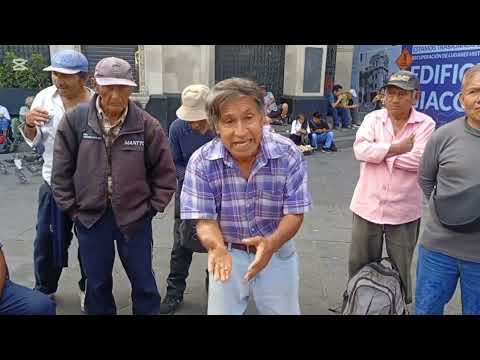
¡GRAN DEBATE CON EL MEJOR ALUMNO DE HAYA DE LA TORRE!
Understanding Economic Ideologies: Are They Truly Opposed?
The Nature of Economic Models
- The speaker argues that while North American and other economies may appear ideologically opposed, they are not fundamentally different in their financial practices.
- Ideology is defined as a system of ideas reflecting material existence and social development goals; the speaker emphasizes that capitalism and communism represent opposing ideologies but share similarities in practice.
Capitalism vs. Communism: A Closer Look
- The speaker claims that both North American capitalism and Chinese communism operate similarly in terms of economic exploitation, despite ideological differences.
- Examples are provided to illustrate how both systems engage in resource extraction and environmental degradation, questioning the notion of their opposition.
Philosophical Underpinnings
- The discussion shifts to the philosophical beliefs of leaders like Donald Trump and Vladimir Putin, suggesting they share common goals despite differing ideologies.
- The speaker introduces key communist concepts such as planned collective economy, historical materialism, and class struggle as foundational elements that challenge the existence of purely capitalist or communist states today.
Class Struggle and Social Dynamics
- It is posited that contemporary societies consist of two main classes—communist (or socialist) versus capitalist—rather than strictly adhering to one ideology.
- The conversation touches on dialectical materialism, emphasizing the need for understanding thesis-antithesis-synthesis dynamics when discussing economic models.
Dialectics in Marxist Theory
- A debate arises regarding the validity of antithesis within dialectical reasoning; the speaker insists on its importance for understanding societal evolution.
- Clarification is sought on Hegel's influence on Marx's interpretation of dialectics, highlighting a shift from idealistic to materialistic perspectives.
Collective Productive Work: A Global Perspective
- The speaker challenges the idea that collective productive work is non-existent globally, asserting it exists across all nations as a method for social production.
- Emphasis is placed on clarity when discussing these complex theories; understanding Marx’s dialectic framework is deemed essential for meaningful discourse about economic systems.
Existence and Consciousness: A Marxist Perspective
The Relationship Between Being and Consciousness
- The speaker emphasizes that existence determines consciousness, arguing against the notion that consciousness can shape existence. This foundational idea is rooted in Marxist philosophy.
- The discussion introduces the concept of collective productive work as essential for a functioning society, linking it to communism and critiquing capitalism's lack of such work.
Class Struggle and Dialectical Materialism
- The speaker asserts that class struggle is central to societal dynamics, highlighting two opposing classes in constant conflict. They argue that dialectical materialism lacks definitive beginnings or ends.
- Four laws of dialectics are presented:
- Change and movement are inherent in all things.
- Nothing exists in isolation; everything is interconnected.
- Opposing forces are always at play, suggesting perpetual conflict rather than peace.
- All entities undergo transformation over time.
Historical Context of Imperialism
- The speaker connects historical developments to class struggles, asserting that the majority seeks to reclaim resources from a capitalist minority exploiting them. This dynamic drives historical progress.
- They argue that imperialism was established through revolution, indicating that current power structures were built on past conflicts.
Revolution vs. Class Struggle
- To overthrow imperialism, the speaker posits that a broader people's struggle is necessary rather than just class-based actions. They emphasize unity among oppressed groups against powerful entities like capitalism.
- The argument suggests individual efforts are insufficient against systemic oppression; collective action from entire populations is required for meaningful change.
Philosophical Influences and Historical Figures
- The speaker critiques theories claiming struggles are purely about "people" rather than classes, demanding evidence for such claims while referencing historical figures like Lenin who emphasized class roles in society.
- They discuss Victor Raúl Haya de la Torre's contributions to anti-imperialist thought within sociological frameworks, contrasting with other thinkers like Mariátegui who had different ideological positions.
Conclusion on Ideological Perspectives
- Acknowledging differing viewpoints within Marxist discourse, the speaker reflects on their educational background steeped in Marxist theory while engaging with contemporary interpretations of social struggles.
- They highlight ongoing debates between various ideologies regarding anti-imperialism and socialism, noting how these discussions have evolved over time based on historical contexts.
Discussion on María Tigi and Ideological Affiliations
María Tigi's Political Evolution
- The speaker asserts that María Tigi was not a communist initially, referencing her participation in the Third International in Uruguay.
- A debate arises regarding whether Tigi ever identified as a communist; the speaker insists she did not until later involvement with the Third International.
- The discussion highlights how Tigi adopted proletarian ideology after her engagement with international communist movements.
Víctor Raúl Haya de la Torre's Doctrines
- The speaker outlines Haya de la Torre’s philosophical doctrine, emphasizing concepts like historical time-space and social market economy.
- A challenge is posed to those defending Haya de la Torre's doctrines, questioning their ability to refute material dialectics using his theories.
Methodology of Thought
- The speaker emphasizes the importance of clarity in thought and teaching, advocating for an understanding free from contradictions or falsehoods.
- Haya de la Torre is described as a non-dogmatic Marxist who applied Marxist principles to local realities rather than adhering strictly to dogma.
Historical Context of Communism in Peru
- Eudosio Rabines is mentioned as the founder of communism in Peru, distinguishing between different communist parties within the country.
- Clarification is made about the differences between various factions of communism in Peru and their historical contexts.
Philosophical Challenges
- The speaker questions how Haya de la Torre critiques materialistic philosophy, asserting that each country's historical development must be understood uniquely.
- Discussion includes Lenin’s concept of imperialism as a phase of capitalism affecting Latin America differently than Europe.
Critique of Material Dialectics
- A critical examination is presented regarding how Haya de la Torre addresses material dialectics through his own philosophical framework.
- Questions are raised about the origins and validity of Haya de la Torre’s concept of historical time-space, linking it back to earlier thinkers like Marx.
This structured summary captures key discussions from the transcript while providing timestamps for easy reference.
Discussion on Ideology and Time Perception
Introduction to the Debate
- The speaker introduces a discussion among participants, emphasizing the need for order during the conversation.
- A reference is made to Victor Raúl's perspective on time, contrasting European and Latin American experiences.
Physics and Ideology
- The speaker questions how Victor Raúl demonstrates differing perceptions of time between Europe and Latin America, invoking the second law of physics regarding interconnectedness.
- The speaker challenges Victor Raúl’s claims about economic frameworks, asserting that they are rooted in European concepts rather than those relevant to Latin America.
Cultural References
- A debate arises over the origins of "La Marsellesa," with the speaker arguing that while its music is French, its lyrics were written by a Peruvian.
- The speaker refutes claims about ideological materialism, stating that ideology is an idea rather than a physical entity.
Energy and Ideas
- The distinction between ideas and material reality is discussed; ideas are framed as energy produced by brain activity.
- The argument emphasizes that energy cannot exist without matter, linking back to scientific principles.
Scientific Methodology
- The importance of scientific methodology in validating ideas is highlighted; it requires observation, hypothesis formulation, sampling, and project development.
- A critique of Victor Raúl's philosophy from a materialist perspective is presented; the speaker stresses their academic approach to understanding these ideologies.