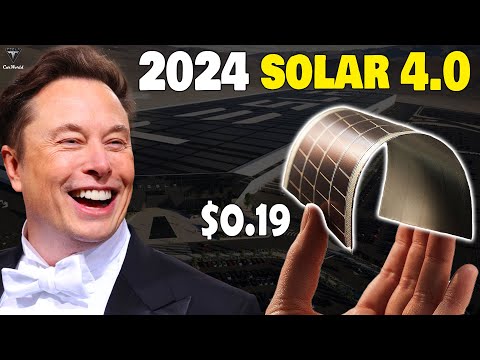
Elon Musk Revealed All New Solar Panels for 2024 Renewable Energy, Can blow your mind!
The Future of Solar Energy
In this video, the speaker discusses a new innovation in solar energy technology that could revolutionize the industry. The new technology involves using Ferroelectric Crystal cells to create photovoltaic cells that are lighter, simpler to manufacture, and less expensive than traditional silicon-based solar panels.
Introduction to Ferroelectric Crystal Cells
- Ferroelectric Crystal cells are thin enough to power a house and can be manufactured at a lower cost than traditional silicon-based solar panels.
- These cells use materials like barium titanate instead of polysilicon, which significantly reduces costs.
- Unlike conventional silicon cells, ferroelectric crystals do not require a PN Junction to create the PV effect. This makes them easier and cheaper to produce.
Advantages of Ferroelectric Crystal Cells
- They are lighter and simpler to manufacture than traditional silicon-based solar panels.
- They can be produced using raw materials with a crystalline structure, reducing the need for mining from the earth.
- They cost up to 10 times less per watt than modern commercial silicon solar panels.
How Ferroelectric Crystal Cells Work
- Researchers created crystalline layers of barium titanate strontium titanates and calcium of titanate which they placed alternatively on top of one another separating the positive and negative charges in the same photovoltaic device.
- Combining extremely thin layers of different materials significantly increases the solar energy yield by experimenting with different material combinations this was achieved by vaporizing the crystals with a high power laser and redepositing them on Carrier substrates this produced a material made of 500 layers that are about 200 nanometers thick in comparison with pure barium titanate the new photoelectric material irradiated with laser light had a current flow one thousand times stronger and more efficient even with a reduction action.
Conclusion
- Elon Musk said Tesla's new cell will change the game because it can generate more energy than ever.
- The US installed 3.9 gigawatts of solar PV capacity in the first quarter of 2022 to reach 126.1 gigawatts direct current of total installed capacity enough to power 22 million American Homes.
- By using Ferroelectric Crystal cells, we can expect to see an increase in electrical energy production and a decrease in costs for solar panels.
Tesla's Ferroelectric Solar Cells
This section discusses Tesla's ferroelectric solar cells and their potential to revolutionize the renewable energy market. It also covers the challenges associated with thin films and high temperatures.
Ferroelectric Cell Development Plan
- Tesla's ferroelectric cell development plan is a big step forward for the renewable energy market.
- The cell has the potential to produce 1.5 million kilowatt hours per week, fulfilling Elon Musk's ambition to provide electricity for the entire United States.
- Solo will be at least plurality of power in less than 20 years.
Challenges for Ferroelectric Solar Cells
- High temperatures shorten lifespan for thin films, which is a common problem.
- Silicon crystal holds the best position so far, but Tesla is working on creating a thin film that can withstand extreme temperatures.
- The ferroelectric cell is relatively new and needs time to be studied in the lab.
Thin Film Solar Technology
This section discusses thin film solar technology and its potential as an alternative to traditional silicon-based solar panels.
Copper Indium Gallium Selenide (CIGS)
- CIGS is one of the most developed materials among various materials for thin film solar cells.
- It has achieved efficiencies rivaling those of crystalline silicon.
- Bouge RV recently released its new CIGS thin film solar panel that has been gaining praise from users and experts alike.
Benefits of Thin Film Solar Cells
- Thin film solar cells are more stable, flexible, durable, and easier to install than silicon-based solar cells.
- They are able to generate three times more electricity than your average solar panel in low sunlight conditions.
- If one cell gets blocked by shade, it will still be able to produce power from any other areas left in the sun.
Flexible Solar Panels
This section discusses flexible solar panels and their potential as an alternative to traditional rectangular glass panels.
Bouge RV's Flexible Solar Panel
- Bouge RV's new flexible solar cell is a thin film photovoltaic device that absorbs sunlight and converts it into electricity.
- It is created with CIGS and cadmium sulfide for the absorber, generating power by absorbing photons from incoming sunlight.
- The cells within this solar panel are connected using a combination of series and parallel connections, making it more stable than traditional solar panels in low sunlight conditions.
Benefits of Flexible Solar Panels
- They are able to produce 400 watts of power in the shade, which is three times more than your average solar panel.
- They are more stable, durable, and easier to install than traditional silicon-based solar panels.
- They can provide higher stability for off-grid photovoltaic systems.
Tesla Solar Panel Lifespan and Benefits
This section discusses the lifespan and benefits of Tesla's solar panels, as well as the advantages of flexible solar panels.
Lifespan and Benefits of Tesla's Solar Panels
- The lifespan of Tesla's solar panels is about 25 to 30 years.
- The lifespan is constantly improving as solar technology evolves globally.
- Bouge RV says that their flexible solar panels can last for 30 years when it has to work continuously and can last up to 250 years if they are not in use.
- Bouge RV's flexible solar panels are tough and rigorously tested through a high pressure flushing test, penetrating damage test, and rolling limit test of automobile tires.
- Tesla's solar panels come in 100 or 200 watt 12 volts with pre-drilled holes.
Advantages of Flexible Solar Panels
- Flexible solar panels are more adaptable to curved surfaces than rigid ones.
- Copper indium gallium selenide flexible solar panel is an upgrade from ordinary flexible solar panel. It can be bent up to 360 degrees, even curved into a roll, and adhere to any uneven surface.
- Flexible panels provide stable efficiency per space compared to rigid ones.
- They are faster to install than rigid ones since many come with adhesive backing and plug-and-play components.
Cost Comparison: Flexible vs Rigid Solar Panels
This section compares the cost between flexible and rigid solar panels.
Cost Comparison
- With a deal from Bouge RV, you can get yourself a 100 watt flexible solar panel for just $199.99 by using promo code AFF50. This means you can save fifty dollars compared to Tesla's price which starts at $66 for their pre-drilled holes model.
- Although the price may be three times as expensive as the Tesla solar panel, it won't cost as much to install it.
- The cost of labor for rigid panels is expensive whereas a flexible panel can be installed with only a tube of psychoflex glue.
Thermophotovoltaics: A New Solution by Researchers at MIT
This section discusses thermophotovoltaics and its potential advantages in energy storage.
Thermophotovoltaics
- More than 90% of the world's electricity comes from sources of heat such as coal, natural gas, nuclear energy, and concentrated solar energy.
- Steam turbines have been the industry standard for converting such heat sources into electricity on average steam turbines reliably convert about 35 percent of a heat source into electricity with about 60 percent representing the highest efficiency.
- Researchers at MIT have developed a new solution called thermophotovoltaics that has the potential to blow your mind.
- Thermophotovoltaics technology requires fewer materials and less energy to produce.
Heat Engine with No Moving Parts
Engineers at MIT and the National Renewable Energy Laboratory have designed a heat engine with no moving parts that converts heat to electricity with over 40% efficiency. The engine is a thermo-photovoltaic (TPV) cell that captures high-energy photons from a white-hot heat source and converts them into electricity.
How it Works
- The TPV cell is similar to a solar panel's photovoltaic cells, but it passively captures high-energy photons from a white-hot heat source.
- The cell is fabricated from three main regions: a high band gap alloy, which sits over a slightly lower band gap alloy, and underneath which is a mirror-like layer of gold.
- The first layer captures the highest energy photons and converts them into electricity while lower energy photons that pass through the first layer are captured by the second and converted to add to the generated voltage.
- Any photons that pass through this second layer are then reflected by the mirror back to the heat source rather than being absorbed as wasted heat.
- The team's design can generate electricity from a heat source of between 1900 to 2400 degrees Celsius or up to about 4,300 degrees Fahrenheit.
Cost Comparison
- After considerable research, Henry and his team estimate that this system could store energy at around $10 per kilowatt hour of capacity while nuclear power costs $1300 times more expensive capital costs for nuclear power plants range between $7,800 to $12,800 US dollars per kilowatt.
- A one square meter cell could generate around 100 kilowatts for comparison; an array of 30 by 30 modules about 900 square feet will have total capacity close to 100 megawatts.
Advantages
- TPV cells can deliver energy instantly like traditional solar cells, making them ideal for grid-scale applications in a grid-scale thermal battery.
- The experimental cell was just a square centimeter, so the team would have to ramp that up to about 10,000 square feet for grid-level power.
- TPVs take little space to implement but are as efficient as nuclear power.
Challenges
- Moving heat requires very advanced complex pumps and systems to cope with all that heat.
- The system is very expensive to invest in and is still under development in the lab.
- Blasting TPV cells with such intense heat and light is another new challenge engineers haven't faced before.
Nuclear Power Plants and Renewable Energy
This section discusses the environmental impact of nuclear power plants, the need for renewable energy sources, and Tesla's solar energy solutions.
Environmental Impact of Nuclear Power Plants
- Nuclear power plant construction and demolition release CO2 emissions.
- A nuclear power plant accident can expose people to high levels of radiation.
- The 2011 Fukushima disaster is one of the worst nuclear disasters in history.
Need for Renewable Energy Sources
- Civilization needs to find ways to produce energy in a renewable manner.
- Texas has been experiencing a heat wave that has put pressure on its electricity grid.
- Elon Musk has developed a low-cost renewable energy source that may end the Texas emergency.
Tesla's Solar Energy Solutions
- Tesla's solar deployments increased by 25% YoY in Q2 2021 to 106 MW.
- Energy generation and storage revenue amounted to $866 million, equivalent to around 5.1% of Tesla's total revenue in the quarter.
- Tesla introduced a cheap solar power system tailored for Texas that is already cheaper than grid electricity costs.
- Solar costs are higher in winter but drop down to seven cents per kilowatt hour during summer months in Texas.
Tesla's Solar Roof
- Tesla's new solar roof tiles generate electricity while looking like normal roofing shingles.
- The cost ranges from $39,800-$48,700 with potential buyers wondering how long it might take for resulting energy savings to break even.
- A 6.13 kW roof can provide 9,265 kWh of power each year at an installed cost of $43,300 including removal of old roof.
- Federal and local tax incentives will lower the cost by $13,600 for this example.
- Austin Energy's value of solar tariff pays homeowners under 10 cents for every kilowatt hour their solar panels can generate.
- The total cost of the investment is recovered in 297 months, which is 24 years and 9 months.
Overall, this section highlights the environmental impact of nuclear power plants and the need for renewable energy sources. Tesla's solar energy solutions are presented as a viable option to address these issues, with a focus on their low-cost solar power system tailored for Texas and their new solar roof tiles that generate electricity while looking like normal roofing shingles.
Tesla's Solar Panels and the Solar Roof Race
This section discusses Tesla's efforts to manufacture solar panels with Hanwa, the challenges of recycling solar panels, and other companies competing in the solar roof market.
Manufacturing Solar Panels with Hanwa
- Tesla is working with Hanwa to manufacture its solar panels.
- There has been skepticism since the panels are shipped from China.
Recycling Challenges for Solar Panels
- The useful life of a solar panel is about 20 years.
- Most discarded panels end up in dumps or landfills due to lack of commercially viable recycling processes.
- Raw materials can be recovered from recycled panels, but it is difficult to reclaim Silicon without using an expensive and energy-intensive process.
Competitors in the Solar Roof Market
- GAF Energy is building a $100 million facility in Texas to increase domestic production capacity.
- A professionally installed Sun Run solar PV system costs around $22,000-$33,000 and comes with a 10-year warranty.
- Tesla's energy roof has a high aesthetic value but is more expensive than competitors.
Conclusion
Tesla faces challenges in manufacturing and recycling its solar panels while competing against other companies in the growing solar roof market.
Turn any video into a summary like this
YouTube links, meetings, lectures. With transcripts, search, and chat.