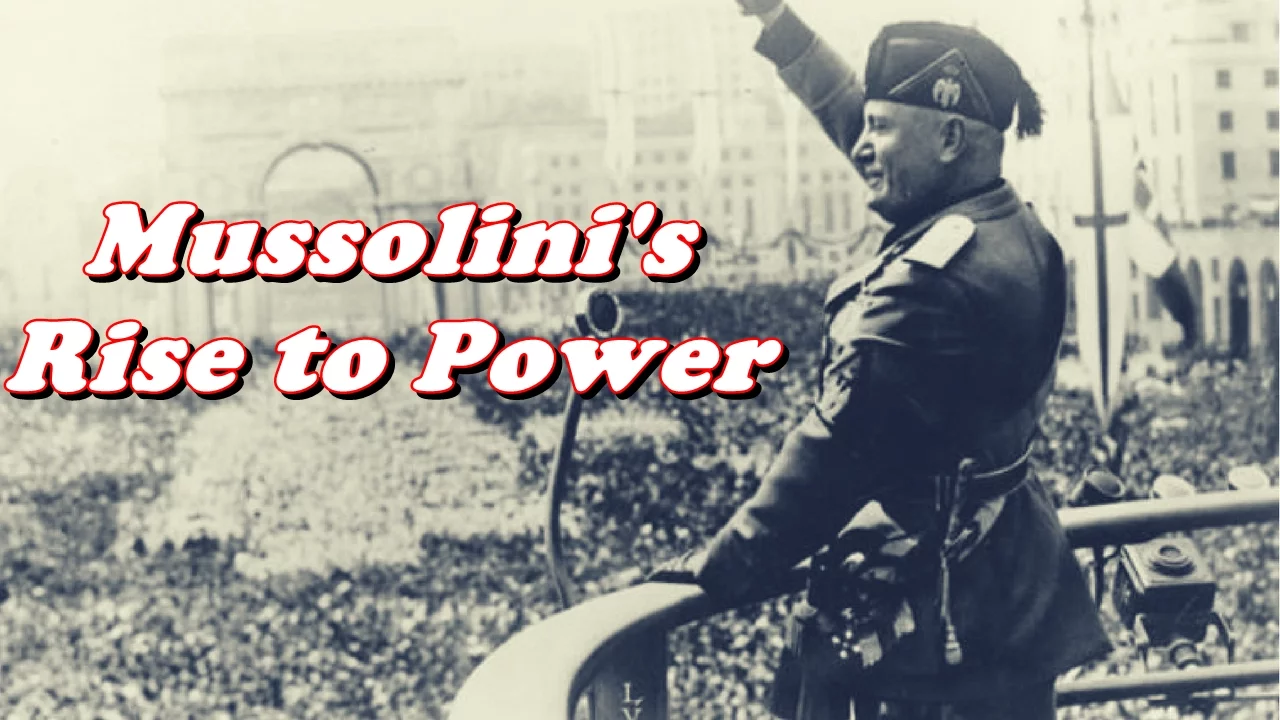
Mussolini established a totalitarian regime in Italy during the 1920s, capitalizing on public dissatisfaction with economic issues and fear of communist influence.
He founded the Fascist Party in 1921, promoting extreme nationalism and prioritizing national interests over individual rights.
Mussolini led the "March on Rome" in 1922 with his followers, gaining control after being appointed by the Italian king as the leader of the government.
New Section
This section contrasts Mussolini's approach to governance with Stalin's methods, highlighting how Mussolini sought public support while establishing a dictatorship.
Contrasting Leadership Styles
Unlike Stalin's harsh methods, Mussolini aimed to win public support by praising Italians and adopting Roman imagery.
Under fascist rule, Italy experienced economic improvements but at the cost of silencing opposition through disbanding political parties and controlling media with propaganda.
New Section
This section delves into Mussolini's expansionist ambitions, focusing on his invasion of Ethiopia and international response.
Expansionist Ambitions
In 1935, Mussolini targeted Ethiopia for conquest as part of his vision for Italy's global role.
Turn any video into a summary like this
YouTube links, meetings, lectures. With transcripts, search, and chat.
This video gives a brief description of Benito Mussolini's rise to power in Italy. Teachers, follow our store on TpT: http://bit.ly/2fSXb3V
***
Follow us on Facebook: https://www.facebook.com/ReadingThroughHistory/
****
Follow us on Twitter: https://twitter.com/bigmarshdawg77
In this video:
As Stalin established firm control over the Soviet Union, another dictator rose to power in Europe. Who was Benito Mussolini? What type of government did he implement?
During the 1920s, Benito Mussolini established a totalitarian regime in Italy. A powerful and persuasive speaker, Mussolini played on public dissatisfaction with high unemployment, inflation, and frequent labor strikes, as well as fear of communist influence in politics.
Mussolini took advantage of the unstable situation by appealing to Italy’s wounded national pride. He won the support of many Italians by promising to address the economic suffering and the threats posed by communism. In 1921, Mussolini established the Fascist Party. Fascism is a political ideology that stresses extreme nationalism and places the interest of the nation above that of the individual. Fascism also emphasizes the need for a strong leader with the power necessary to address and eliminate the nation’s problems.
In October of 1922, Mussolini led 30,000 of his followers, known as “Black Shirts,” in an event known as the March on Rome. When many of the police, military, and government officials refused to stop the movement, the Italian king appointed Mussolini to lead the government.
Rather than going by the title of prime minister, Mussolini referred to himself as “Il Duce,” meaning “the leader.” Mussolini was granted “emergency powers” that were to last for only one year, but in doing so, the Italian parliament unknowingly established a dictatorship that would last for the next20 years.
Unlike Stalin, who used harsh methods to maintain control over his people, Mussolini sought to win public support. Mussolini praised the Italian people and their past, stirring up emotions by adopting much of the imagery of the Roman Empire. Mussolini glorified the nation’s workers and the middle class while promising to restore Italy to its former position as a world power.
Under fascist rule, Italy had a balanced budget, inflation was eliminated, and the railway system was modernized. However, much of the success stemmed from the fact that Mussolini silenced his opposition. Opposing political parties were disbanded, while the press, radio, and film were used to distribute a ceaseless flow of propaganda. Over time, the fascist extended their control to every aspect of Italian life. The school system was used to indoctrinate children into the fascist ideology. Students wore black uniforms and the concepts of discipline, duty, and obedience were emphasized.
Mussolini also hoped to enhance Italy’s role on the world stage and preached that it was natural for strong nations to conquer weaker ones. Ethiopia, one of the few remaining independent nations in Africa, became his first target.
Haile Selassie, the Emperor of Ethiopia, pleaded with the League of Nations for support as thousands of Italian soldiers prepared to invade in 1935. The League of Nations responded with a modest economic boycott of Italy and offered no military assistance as Selassie was forced to flee. Ethiopia was conquered and officially annexed by Mussolini in May of 1936.