Протокол RIP | Компьютерные сети. Продвинутые темы
Introduction to RIP Routing Protocol
Overview of Routing Protocols
- Routing protocols enable routers to automatically create a network map and routing table without administrator intervention.
- RIP stands for Routing Information Protocol, the first routing protocol used in networks.
Historical Context
- The original version of RIP was developed for ARPANET, with its first implementation appearing in 1982.
- The initial standard for RIP was released in 1988 (RFC 1058), followed by version 2 in 1994 (RFC 2453). Version RIPng was defined in RFC 2080 in 1997.
Technical Aspects of RIP
Distance Vector Protocol
- RIP is a distance vector protocol that uses the Bellman-Ford algorithm for data transmission.
- It operates on the principle of distance vectors, which are one-dimensional arrays containing known network addresses and their distances from the router.
Metrics and Limitations
- In RIP, the metric is simply the number of intermediate routers (hops) needed to reach a destination network. A maximum route length of 16 hops indicates an unreachable network, preventing loops in large networks.
Routing Table Construction
Initial Setup
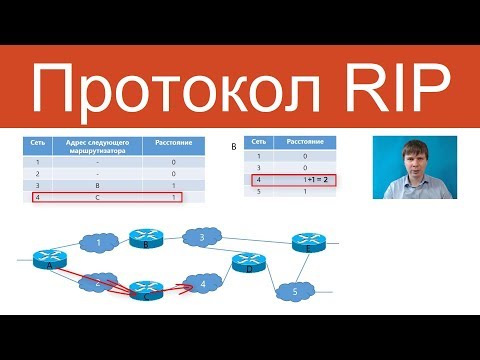
- At startup, Router A knows only about directly connected networks (e.g., Networks 1 and 2) with a distance of zero since no other routers are involved initially.
Iterative Process
- Routers exchange information about known networks through distance vectors; this process continues iteratively as they learn new routes from neighbors. Each router updates its routing table based on received information from adjacent routers.
Example Scenario: Router Communication
Initial Communication
- Initially, Router A communicates with neighboring Router B, which has knowledge only about Networks 1 and 3; then it receives similar messages from Router C regarding Networks 2 and 4. This initiates updates to Router A's routing table based on new information received from both neighbors.
Updating Routing Tables
- When receiving updates:
- If a route already exists with a shorter distance, it is retained.
- New routes are added if they provide better paths or if they are unknown previously.
- For example, Router A learns about Network 3 through Router B and adds it to its table since it's not previously known with any cost associated with it being greater than zero.
Subsequent Iterations
Continued Information Exchange
- During subsequent iterations, routers continue sharing updated distance vectors that include newly learned routes from their neighbors.
- This ongoing communication allows all routers within the network to gradually build comprehensive routing tables reflecting current network topology changes over time as more information becomes available through these exchanges.
Routing Protocols and Their Limitations
Overview of Routing Updates
- The distance to network 4 is evaluated, revealing that the route through router C (distance 1) is shorter than through routers B and D (distance 2). Thus, the routing table remains unchanged.
- Router A learns about a new route to network 5 with a distance of 1. It records this in its table as it currently lacks knowledge of any routes to network 10.
Completion of RIP Process
- The RIP protocol for router C concludes as it establishes paths to all subnets. However, routers continue exchanging distance vectors to detect changes in the network.
- Notably, RIP does not add backup routes; if router B fails, router A will take time to discover an alternative route via routers C and D.
Limitations of RIP
- One major limitation is that RIP only considers the number of hops without accounting for link speed. This can lead to inefficient routing decisions.
- Another issue is slow failure detection; routers send their distance vectors every 30 seconds. If a neighbor's vector isn't received, it may take up to 180 seconds before it's deemed unavailable.
Count-to-Infinity Problem
- During this delay, neighboring routers remain unaware of issues, potentially leading to routing loops.
- An example illustrates how a failure in connectivity between routers can cause incorrect routing information propagation among them.
Propagation of Incorrect Routes
- When router C detects an issue with network access but takes time to inform others, it may inadvertently propagate outdated routes from router B.
- Router C updates its routing table based on received information from router B but does so without realizing that the original path has failed.
Infinite Looping Scenario
- As updates circulate among routers regarding distances increasing due to failures, they may continuously increment until reaching an infinite count (16).
- This leads to packets circulating endlessly between routers until they are dropped once their Time To Live (TTL) expires.
Solutions Implemented in V-RIP
- To mitigate these issues, V-RIP introduced features like split horizon which prevents sending route information back on the interface it was received from.
Routing Protocols and Their Challenges
Understanding Route Poisoning and Hold Down Mechanisms
- The concept of route poisoning is introduced, where a router informs its neighbors that a route to a specific network (network 3) is no longer available. This is done by setting the distance metric to 16, indicating an unreachable state.
- The hold down mechanism is explained as a delay period after detecting an unavailable route. During this time, if new routing information arrives, the router will ignore it to prevent instability in the routing table.
Overview of RIP Routing Protocol
- The Routing Information Protocol (RIP) is discussed as one of the earliest routing protocols designed for TCP/IP networks. It operates as a distance vector protocol, measuring routes based on hop count.
- A critical limitation of RIP is highlighted: its maximum hop count of 16 signifies infinity, which restricts scalability in modern networks. This leads to slow convergence times and potential routing loops due to routers taking time to recognize network changes or failures.