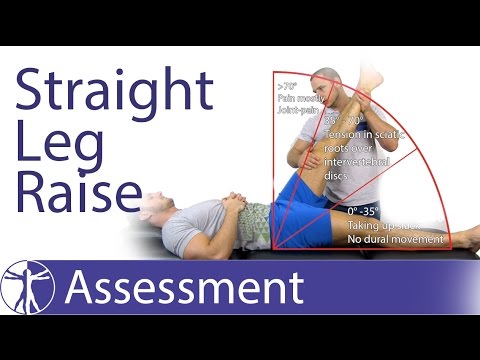
Straight Leg Raise or Lasègue's Test for Lumbar Radiculopathy
Straight Leg Raise Test for Lumbar Radiculopathy
Overview of the Straight Leg Raise Test
- The video introduces the Straight Leg Raise (SLR) test, also known as Laségue's Test, which is crucial in assessing lumbar radiculopathy symptoms often linked to disc herniations.
- Common symptoms of lumbar radiculopathy include radiating pain down the leg, loss of muscle strength, and numbness or tingling in one or both legs.
Sensitivity and Specificity
- The SLR test has a reported sensitivity of 91% and specificity of 26%, according to a systematic review by Deville et al. (2000).
Conducting the Test
- To perform the SLR test, position the patient supine and assess the unaffected leg first before flexing the affected leg at the hip while keeping the knee extended.
- Symptoms are expected to occur between 35-70 degrees of hip flexion; pain beyond this range may indicate issues from either the lumbar spine or sacroiliac joint.
Further Assessment Techniques
- If symptoms arise during testing, further neurological assessment can be conducted by dorsiflexing the ankle (Bragard's Sign) or asking for maximal neck flexion (Neri's Sign).
- Pain elicited during these maneuvers suggests potential stretching in dura mater or lesions within spinal cord due to disc herniations or tumors.
Confirmatory Diagnosis