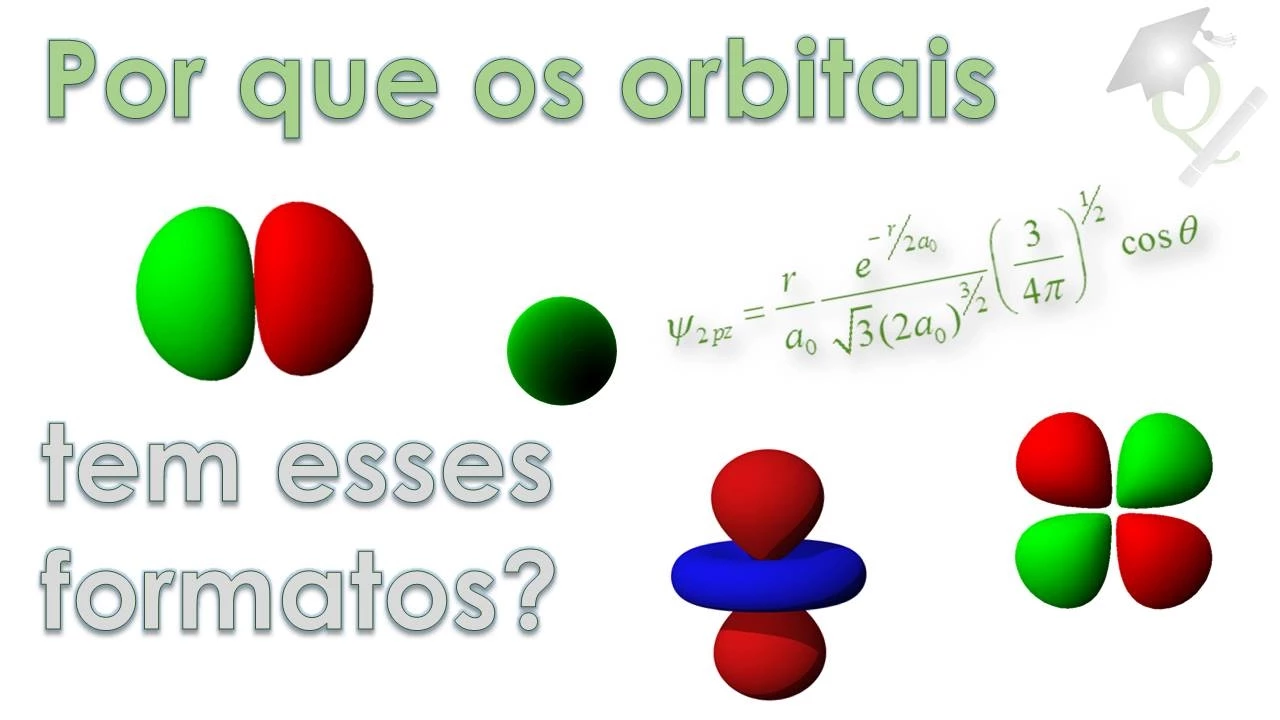
Episódio 12 - Modelando os Elétrons #1 (Por que os orbitais tem esses formatos? #1)
Modeling Electrons in Chemistry
In this episode, the focus is on delving deeper into the concept of wave function, particularly in spherical coordinates. The discussion emphasizes the two components of wave functions and their roles in understanding electron behavior.
Understanding Wave Functions
- Wave functions are easier to work with when expressed in spherical coordinates rather than Cartesian coordinates.
- Wave functions can be seen as a product of two independent functions: radial part (dependent on r) and angular part (dependent on angles like theta).
- The radial part provides information about the extension or energy levels of orbitals, while the angular part (spherical harmonics) determines the shape of orbitals.
- Variations in energy levels among orbitals are attributed to differences in radial parts of wave functions.
Significance of Angular Part
- Angular parts influence orbital shapes; focusing on this aspect helps understand how different orbitals take distinct forms.
- Defining orbitals correctly as spatial wave functions clarifies their role beyond just regions with high electron probability.
Defining Orbitals and Their Representations
This segment explores the accurate definition of orbitals as spatial wave functions, emphasizing their mathematical nature and representations through graphs.
Orbital Definition
- Orbitals are best defined as spatial wave functions depending on xyz coordinates for electrons.
- Contrary to popular belief, an orbital is not solely a region with high electron probability but a spatial function representing electron density.
Graphical Representation
- Orbitals can be visualized graphically as mathematical functions showing electron density distribution around nuclei.
New Section
In this section, the speaker discusses angles and wave functions related to spherical harmonics.
Understanding Angles and Wave Functions
- The angle theta (θ) can range from 0 to 180 degrees, representing the angle formed by a point with the origin and the z-axis. On the other hand, the angle phi (ϕ) ranges from 0 to 360 degrees.
- Spherical harmonics do not have internal dependencies, allowing them to take on all values of theta (θ) from 0 to 180 and phi (ϕ) from 0 to 360.
- Spherical harmonics are spherical in shape due to their lack of restrictions on theta values. In contrast, orbital wave functions like p orbitals have specific shapes based on their dependence on angles around the z-axis.
New Section
This part delves into cosine functions and their relationship with angles in wave functions.
Cosine Functions in Wave Functions
- The cosine function varies between maximum and minimum values as the angle changes. At an angle of 90 degrees, the cosine is zero, indicating a nodal region where the function crosses zero.
- Understanding these nodal regions is crucial for visualizing wave function behavior. A projection of a two-dimensional plane helps illustrate how values change with varying angles.
New Section
Here, the discussion centers around angular dependencies in spherical harmonics and their implications for wave functions.
Angular Dependencies in Spherical Harmonics
- Spherical harmonics exhibit no dependency on phi (ϕ), allowing them to cover all values from 0 to 360 degrees. This property influences their geometric representation when rotating around the z-axis.
- The concept of nodal planes or regions where wave functions cross zero plays a significant role in understanding angular restrictions within wave functions.
New Section
This segment explores different types of orbitals based on solutions derived from wave functions.
Types of Orbitals Based on Solutions
- P orbitals like pz involve complex mathematical solutions yielding real numbers or imaginary numbers depending on their nature.
- Combining linear combinations of solutions results in new functions that maintain real number properties. This process leads to distinct orbital types such as px and py with unique characteristics.
New Section
The focus here shifts towards discussing specific characteristics of certain orbitals within quantum mechanics.
Characteristics of Specific Orbitals
- Zeroth-order spherical harmonic orbitals possess distinct features compared to other orbitals due to their unique properties termed "si bambolê."
Defining Hospital Information
In this section, the speaker discusses defining information about hospitals and their structure in a two-dimensional system.
Hospitals Structure
- Four hospitals are presented with an angular origin in a spherical harmonic form.
- Hospitals have two nodal planes, one vertical and one horizontal, characterizing them based on angular origin.
- Hospitals with zero or two nodal planes have a slightly different format in a bidimensional system resembling four lobes.
- The hospital's shape changes diagonally as it moves through regions, characterized by two nodal regions.
- The hospital's shape is directly related to spherical harmonics expressed in spherical coordinates.
Angular Origin of Orbitals
This section delves into the significance of the angular part responsible for shaping orbitals.
Angular Part of Orbitals
- The orbital shape is directly influenced by the spherical harmonic expressing angular coordinates.
- Spherical harmonics with zero angular regions can assume any theta and phi values, forming a sphere.
- Orbitals are characterized by modal regions passing between lobes, presenting two angular origin regions.
- Different types of orbitals present varying numbers of nodal regions based on their characteristics.
Conclusion and Next Steps
Concluding remarks on how the spherical harmonic shapes orbitals and hints at exploring energy levels in the next episode.
Conclusion
- Orbital shapes are defined by spherical harmonics, while radial parts determine energy levels.