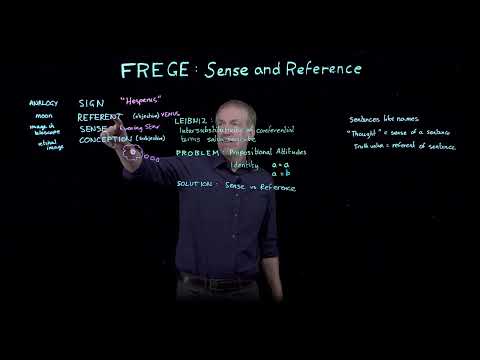
Frege: Sense, Reference and "The Thought"
Introduction to 20th Century Philosophy
Overview of Analytic and Continental Philosophy
- The discussion begins with Gottlob Frege, a foundational figure in analytic philosophy, which emerged as a significant trend in the 20th century.
- A schism exists between two philosophical traditions: analytic philosophy, prevalent in English-speaking countries (e.g., England, Australia, Canada), and Continental philosophy.
- While the U.S. has some schools leaning towards Continental philosophy (e.g., Marquette University), analytic philosophy dominates the English-speaking world.
Key Characteristics of Analytic vs. Continental Philosophy
- Analytic philosophy focuses on analyzing concepts and ideas into their component parts with clarity being a major goal.
- In contrast, Continental philosophy often employs complex jargon and dense writing styles that can be difficult for outsiders to understand.
- The distinction is highlighted by Frege's contributions to logic and language compared to his contemporaries in the Continental tradition.
Frege's Contributions to Logic
Development of Predicate Logic
- Frege is credited with inventing modern predicate logic, allowing for more sophisticated logical expressions than previously possible.
- He introduced formal symbolism for categorical propositions (e.g., "All men are mortal"), enabling combinations with other logical statements like conditionals.
Influence on Philosophy of Language
- Frege’s work significantly impacted the philosophy of language; his articles "Sense and Reference" and "The Thought" are pivotal texts published in respected journals.
Understanding Propositions
Distinction Between Sentences and Thoughts
- The term "thought," as used by Frege, refers to what we typically call a proposition—distinct from sentences that exist physically in our world.
- A sentence can be written or spoken, while its meaning transcends physical form; this distinction is crucial for understanding translation across languages.
Philosophy of Language and Meaning
The Nature of Translation
- Discussion begins with the complexity of translating sentences between English and French, highlighting that despite differences in structure, they can convey the same meaning.
Philosophy of Language
- The speaker notes that the philosophy of language became a central focus in 20th-century philosophy, emphasizing its significance in understanding meaning.
Meaning and Ideas
- A key topic is the nature of meaning; traditional views suggest meanings are ideas in our heads, but this notion is challenged due to the private nature of thoughts.
Rejection of Private Meanings
- Fraga argues against the idea that meanings are merely private ideas because communication relies on shared understanding. If meanings were private, effective communication would be impossible.
Sensations vs. Ideas
- Fraga distinguishes between sensations (which can be perceived through senses) and ideas (which exist only in minds). He asserts that while we experience sensations, ideas themselves cannot be directly sensed.
Skepticism and Perception
Arguments Against Skepticism
- The discussion references Descartes' skepticism about reality based solely on inner experiences. Fraga attempts to counter this by asserting that we perceive things outside our minds.
The Role of Bearers for Ideas
- Ideas require a "bearer," meaning they exist only within individuals' minds. Each person's perception is unique even when observing the same object.
Public vs. Private Meanings
Distinctiveness of Ideas
- Every idea is distinctive to an individual; even if two people observe the same tree, their impressions differ due to personal perspectives and contexts.
Implications for Communication
- Since meanings must be public for effective communication, they cannot simply be private ideas held by individuals. This leads to questioning what constitutes true meaning.
Propositions as Meanings
Transition from Ideas to Propositions
- Fraga posits that meanings are better understood as propositions rather than mere ideas. Propositions serve as a bridge between subjective thoughts and objective realities.
Sense and Reference Analogy
- An analogy involving "Hesperus" illustrates how signs (written words or symbols) relate to their meanings—highlighting distinctions crucial for understanding language's function in conveying thought.
Understanding Hesperus and Phosphorus
The Greek Names for Venus
- Hesperus is identified as the evening star, the first star visible at dusk due to its brightness.
- Phosphorus refers to the morning star, which is the last star to disappear when dawn breaks.
- Both Hesperus and Phosphorus are actually names for the planet Venus, a fact unknown to the Greeks.
The Denotative Theory of Meaning
- A sign (like "Hesperus") has a referent, meaning it points to something in reality.
- The denotative theory of meaning posits that a word's meaning is directly linked to what it refers to; this idea is sometimes referred to dismissively as the "Fido theory."
- According to this theory, one can literally interact with meanings by referring directly to their real-world counterparts.
Challenges with Denotative Theory
- Philosopher Leibniz proposed that if denotation holds true, substituting co-referential terms should not change a sentence's truth value.
- For example, replacing "Hesperus" with "Phosphorus" in a true statement about Venus should yield another true statement.
Propositional Attitudes and Their Implications
- Not all contexts allow for such substitutions; propositional attitudes (like beliefs or desires about propositions) complicate this principle.
- An example: Socrates may believe "Hesperus is Venus," but he might not know that "Phosphorus" also refers to Venus. Thus, substituting could lead to falsehood.
Conclusion on Reference and Meaning
- Frager attempts to reconcile these issues by suggesting that in certain contexts, the referents of terms can shift based on knowledge or belief states.
Understanding Referential Opacity and Transparency
The Nature of Referential Contexts
- In normal contexts, the referent of "Hesperus" is Venus itself. However, in propositional attitude contexts (e.g., believes, hopes), the referent can change, leading to what is termed as "referentially opaque."
- Referentially transparent contexts allow clear reference to objects, while referentially opaque contexts complicate this clarity. This distinction originates from philosopher Quine's work.
Fraga's Contribution to Reference Theory
- Philosopher Fraga argues that in certain contexts, terms like "Hesperus" and "Phosphorus," or "Superman" and "Clark Kent," are not co-referential due to changes in their referents.
- Fraga introduces the concept of 'sense' to explain how names can shift from their usual referents to a different meaning based on context.
Challenges with Denotative Theory of Meaning
- The 20th-century philosophical focus on meaning often centers around proper names. A significant issue arises with denotative theories when language fails to clearly indicate a specific referent.
- For example, while we know what Venus refers to (the planet), abstract concepts like “red” pose challenges for direct reference without alternative theories explaining their meanings.
Extensional vs. Intentional Concepts
- Fraga aims to reconcile logic with extensionality—where references ground statements in reality—versus intentionality, which deals with sense or meaning beyond mere reference.
- An example provided contrasts the extension (all dogs as a set) versus intention (the essence of 'dogginess'), highlighting how logic seeks clarity through extensional definitions.
Implications for Propositional Attitudes
- In propositional attitudes like “Lois Lane believes Superman is sexy,” substituting terms may alter truth values due to changes in reference within these specific contexts according to Fraga’s rules.
Understanding the Referent of Superman
The Concept of Sense vs. Reference
- The referent of "Superman" in certain contexts is identified as its sense rather than its reference, meaning it pertains to the meaning or concept associated with Superman rather than the physical entity itself.
- Lois Lane's belief that "Superman is sexy" is based on her conception of Superman (the sense), not directly on the actual character, highlighting how beliefs can be influenced by personal interpretations.
Identity Statements and Epistemological Distinctions
- The discussion introduces identity statements, which assert that two entities are one and the same, raising questions about their epistemological implications.
- Key epistemological distinctions include a priori (knowledge independent of experience) versus a posteriori (knowledge dependent on experience).
- A priori truths, such as mathematical equations like "2 + 2 = 4," can be known without sensory experience, while a posteriori knowledge requires empirical observation.
Analytic vs. Synthetic Truths
- The distinction between analytic truths (true by virtue of meanings and definitions alone) and synthetic truths (true based on how they relate to the world) is introduced.
- An example illustrates that analytic truths can be determined through analysis of language, whereas synthetic truths require additional information beyond mere definitions.
Necessary vs. Contingent Truths
- Necessary truths must always be true and cannot be false; for instance, mathematical statements like "1 + 1 = 2."
- In contrast, contingent truths may vary over time or circumstances; an example given is "Today is Monday," which could change from week to week.
Implications for Proper Names
- The statement "Hesperus is Hesperus" exemplifies an a priori analytic necessary truth due to its self-referential nature.
- However, "Hesperus is Phosphorus" appears different despite both referring to Venus; this raises questions about how reference alone fails to capture deeper meanings in statements.
- Fraga argues that understanding names requires considering both their referents and senses; proper names encompass both aspects for full comprehension.
Understanding Sense in Language
- Fraga suggests that sense involves information enabling identification of referents; it's not merely about what something refers to but also includes conceptual understanding.
- Later interpretations propose that sense consists of a set of descriptions sufficient for identifying the referent effectively.
Understanding Hesperus and the Nature of Meaning
The Concept of Hesperus
- The term "Hesperus" refers to a unique individual, specifically not just any heavenly body. It is closely associated with the evening star, which is the first light seen as night falls.
Fraga's Theory on Names and Sentences
- Fraga posits that proper names possess a sense, similar to how sentences function as complex proper names. Both have referents that allow identification.
- The sense of a name provides information for identifying its referent, while the sense of a sentence conveys what it refers to—essentially its proposition or thought.
Truth Values and Abstract Entities
- According to Fraga, the referent of a sentence is its truth value; every true sentence points to an abstract entity known as "the true."
- Meanings and senses are objective realities but exist in an abstract form rather than as physical objects. They cannot be subjective since they must be shared among individuals.
Accessing Abstract Thoughts
- Humans can access abstract thoughts despite their non-physical nature. Fraga emphasizes that we apprehend thoughts rather than perceive them like physical objects.
- When discussing Hesperus, one can differentiate between the sign (word), referent (planet Venus), sense (first visible star), and personal conception (subjective idea).
Reality of Propositions
- Propositions exist independently from human consciousness; they remain unchanged regardless of whether humans exist or think about them.
- For example, mathematical truths like Pythagoras's Theorem would still hold true even without sentient beings because they represent independent thoughts.
Ontological Perspectives: Quine vs. Fraga
- Quine critiques the existence of abstract objects, advocating for a pared-down ontology focused on measurable entities necessary for scientific theories.
- He argues against accepting abstract concepts unless required by theory, viewing them as unnecessary complications in understanding reality.
Mathematics and Abstract Existence
- Fraga counters Quine’s view by asserting that mathematics is not merely a human construct but an eternal truth discovered rather than created by humans.
- Numbers like "two" have an existence independent of human thought; they are timeless entities unaffected by our perception or acknowledgment.
Understanding Abstract Objects and Analytic Philosophy
The Nature of Abstract Objects
- Discussion on abstract objects, emphasizing their existence outside the physical universe. The number two is presented as an example of such an object, distinct from tangible entities.
- Fraga's commitment to the existence of meanings as apprehensible entities suggests a dilution of the denotative theory of meaning, which posits that words refer directly to physical world objects.
Propositions and Meanings
- Clarification that while sentences exist physically (e.g., measurable letters), their meanings reside in an abstract realm. This distinction highlights the complexity between language and its reference.
- Fraga's perspective on propositions indicates that different expressions can convey the same thought, exemplified by "snow is white" and "Najee Blanche."
Contributions to Analytic Philosophy
- Fraga is recognized as a pivotal figure in analytic philosophy due to his logical contributions. Bertrand Russell expanded on this by critiquing natural language for its vagueness when expressing truths about the universe.
- The need for clarity in philosophical discourse is emphasized; natural language's ambiguity can hinder precise communication of ideas.
Goals of Analytic Philosophy
- Aiming for clarity involves striving for a pure language devoid of natural ambiguities. Logic serves as a tool to articulate truths clearly, addressing issues inherent in everyday language.
- Early 20th-century analytic philosophers sought to eliminate metaphysical concepts deemed meaningless, focusing instead on factual discourse.
Distinctions Between Philosophical Approaches
- A contrast is drawn between analytic philosophy (aligned with science and clarity) and Continental philosophy (which embraces ambiguity). This divergence shapes differing philosophical methodologies.
- Fraga’s work illustrates key distinctions between sense (the meaning contained within names) and reference (the actual entity referred to), setting up discussions around naming theories.
Critique of John Stuart Mill
- Fraga critiques Mill’s psychologistic view that logic stems from human constructs, asserting instead that logic exists independently from our cognitive processes.
- He also challenges Mill’s theory regarding names being mere labels without intrinsic meaning, advocating for a more nuanced understanding of how names function semantically.