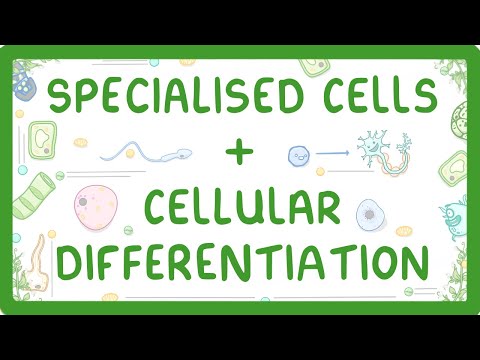
GCSE Biology - Differentiation and Specialised Cells
What Are Specialized Cells and How Do They Differentiate?
Understanding Specialized Cells
- The video introduces two key concepts: specialized cells and the process of differentiation.
- Specialized cells are distinct types of cells in complex organisms, such as humans and plants. Examples include sperm cells, muscle cells, nerve cells, root hair cells, and xylem cells.
- A sperm cell's primary role is to deliver genetic material to an egg cell for fertilization. It has adaptations like a streamlined shape and a tail (flagellum) for swimming.
Adaptations of Sperm Cells
- Sperm cells contain half the genetic material of normal adult cells to combine with the egg's genetic material during fertilization.
- They have numerous mitochondria that provide energy necessary for movement towards the egg.
- Digestive enzymes at the front of sperm help penetrate the egg cell upon contact.
Differentiation Process
- Differentiation is defined as the process by which unspecialized cells become specialized for specific functions.
- In humans, life begins as a zygote that divides through mitosis into identical cells before undergoing differentiation into various specialized types like muscle or nerve cells.
Stem Cells
- Stem cells are unique because they can repeatedly divide by mitosis and differentiate into various specialized cell types.
Turn any video into a summary like this
YouTube links, meetings, lectures. With transcripts, search, and chat.