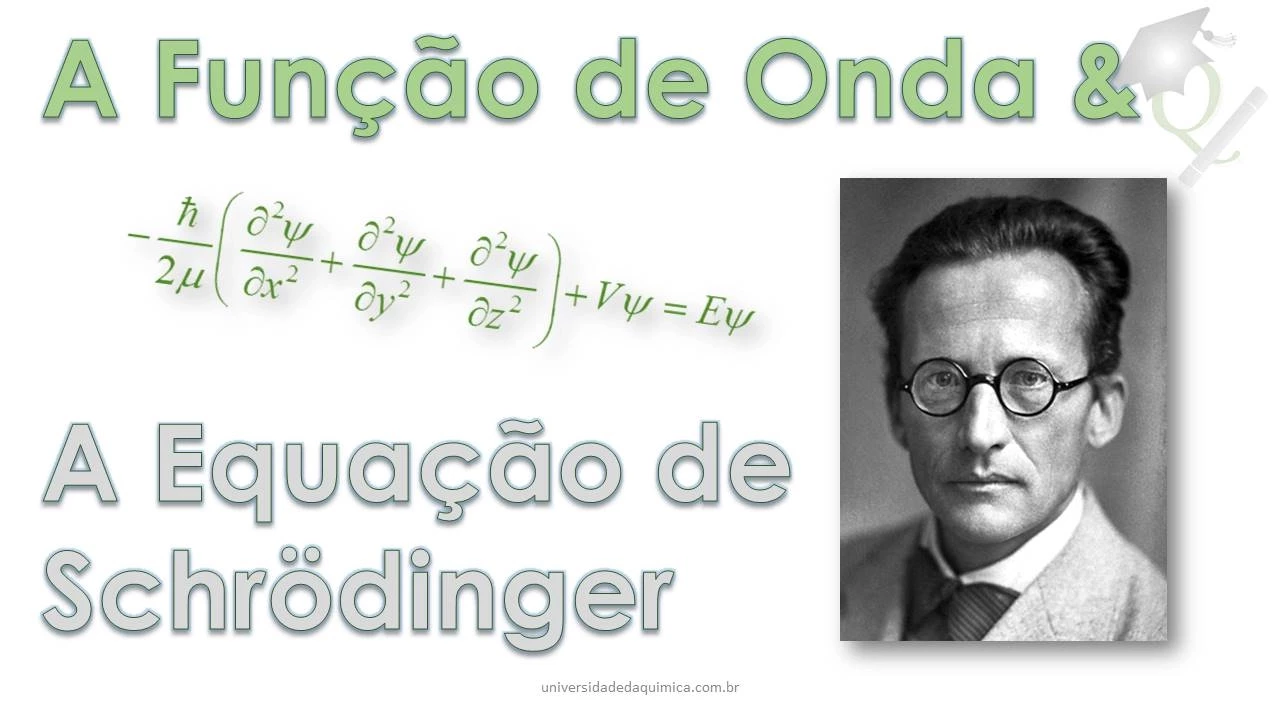
Episódio 11 - Precisamos dar uma função para o elétron! (Função de onda/Equação de Schrödinger)
Introduction to Electron Function
The introduction discusses the importance of assigning a function to the electron and introduces the physicist Eduard Schrödinger as the individual responsible for this concept.
Eduard Schrödinger's Contribution
- Physicist Eduard Schrödinger introduced mathematical foundations in 1926 to describe the behavior of electrons.
- He proposed a mathematical function known as the wave function to define how electrons behave both as particles and waves.
- Werner Heisenberg, another physicist, also contributed to quantum mechanics with a different approach based on matrices.
Mathematical Foundations for Electron Behavior
This part delves into the mathematical aspects behind describing electron behavior, building upon previous hypotheses by de Broglie regarding particle-wave duality.
De Broglie's Hypothesis and Mathematical Descriptions
- De Broglie proposed that electrons exhibit characteristics of both particles and waves.
- Waves can be mathematically described using functions like cosine, leading to the concept of wave functions for electrons.
- Werner Heisenberg and Eduard Schrödinger presented complementary theories based on quantum mechanics but differing in their mathematical approaches.
Contrasting Approaches: Heisenberg vs. Schrödinger
A comparison is drawn between Heisenberg's matrix-based quantum mechanics and Schrödinger's wave function theory.
Quantum Mechanics Approaches
- Heisenberg developed matrix mechanics while Schrödinger focused on wave mechanics.
- Both theories yield similar results, but Heisenberg's approach is considered more powerful yet challenging due to its complexity.
Significance of Wave Functions in Quantum Mechanics
The importance of wave functions in quantum mechanics is highlighted, emphasizing their role in achieving consistent results despite varying theoretical approaches.
Role of Wave Functions
- Wave functions play a crucial role in quantum mechanics by providing consistent outcomes across different theoretical frameworks.
- Despite differences in methodologies, both Heisenberg's matrix-based approach and Schrödinger's wave function theory converge on similar conclusions.
Historical Context: Schrödinger's Contributions
Explores how Schrödinger laid down foundational work through his series of articles published in 1926.
Schrödinger’s Articles
- In 1926, Schrödinger published a series of four articles introducing quantization as a significant problem involving high values equations.
Mathematical Representation of Electrons
In this section, the discussion revolves around the mathematical representation of electrons in quantum mechanics, focusing on the concept of wave functions and their physical interpretations.
Wave Function Characteristics
- The wave function in quantum mechanics carries all information about the system, representing the electron with specific characteristics.
Physical Interpretation by Max Born
- The physical significance of the wave function was provided by Max Born through his interpretation.
- The square of the wave function indicates the probability of finding an electron at a certain distance from the nucleus.
- This interpretation is crucial for understanding electron positions and probabilities.
- Max Born's Nobel Prize-winning work in statistical understanding of wave functions is highlighted.
Probability Density and Nodal Points
- Understanding probability density involves squaring the wave function to obtain positive values that indicate maximum probability regions.
- Nodal points represent regions where the wave function changes sign but do not relate to charge properties.
- The squared wave function provides insights into electron distribution and density probabilities near the nucleus.
Interpreting Electron Position through Wave Functions
This section delves deeper into interpreting electron positions using wave functions, emphasizing how squared functions reveal probability densities.
Significance of Squared Wave Functions
- Squaring the wave function transforms negative values into positive ones, aiding in determining probability densities effectively.
- Peaks and amplitudes in squared functions signify varying probabilities of finding electrons at specific distances from the nucleus.
- Understanding these peaks helps visualize electron distributions within atomic radii representations.
Quantum Model Contrasts
- Contrasting quantum probabilistic models with deterministic models like Bohr's reveals distinct approaches to understanding electron behavior.
- Quantum models focus on probabilistic maxima rather than precise determinations, reflecting a different conceptual framework for electron analysis.
- Notable differences lie in interpreting nodal points where probabilities drop to zero, influencing electronic reorganization within atoms significantly.
Quantifying Electron Properties through Operators
This segment explores quantifying electron properties using mathematical operators within quantum mechanics.
Role of Mathematical Operators
- Operators like Hamiltonian (H) play a pivotal role in manipulating wave functions to extract essential properties such as energy levels efficiently.
- Hamiltonian acts as a mathematical entity interacting with wave functions to yield corresponding values or energies.
- Observables like energy levels can be derived by applying specific operators to relevant equations.
- These operators emulate instruments providing real values for various electron attributes.
Operator Applications
- Utilizing operators tailored for specific properties like angular momentum enables precise quantification within quantum frameworks.
- Each operator corresponds to a distinct property measurement tool, facilitating comprehensive analysis across different aspects of electrons' behavior.
- Operators serve as mathematical tools mimicking physical instruments for measuring diverse electron characteristics effectively.
Quantum Mechanics and Wave Functions
In this section, the speaker delves into quantum mechanics, discussing how it provides physical properties of electrons within an atom through mathematical operations. The focus is on wave functions and operators related to kinetic and potential energy.
Quantum Mechanics Fundamentals
- The mathematics simplifies the understanding of electron properties within atoms by introducing operators like the kinetic energy operator.
- Mathematical operations involving partial derivatives with respect to x, y, and z help determine kinetic and potential energies within a system.
- Wave functions play a crucial role in quantum mechanics, with distinct wave functions for different electron orbitals (e.g., 2p or 3d).
Coordinate Systems in Quantum Mechanics
- Spatial wave functions are described without considering time, focusing solely on spatial coordinates like x, y, and z.
- Transitioning from Cartesian to spherical coordinates simplifies calculations by restricting variables based on distance from the origin (r), angle theta (θ), and angle phi (ϕ).
Spherical Coordinates and Wave Function Representation
- In spherical coordinates, r represents distance from the origin while θ and ϕ denote angles along specific axes.
- Visualizing electrons along a sphere aids in understanding quantum models compared to traditional planar representations.
Transformations in Quantum Mechanics
- Coordinating transformations simplify electron behavior descriptions by transitioning from xyz coordinates to spherical representations.
New Section
In this section, the speaker discusses the concept of orbitals and their mathematical functions.
Understanding Orbitals
- The first function, denoted as apex 100, corresponds to an s orbital.
- The function at 210 corresponds to a p orbital.
- The function at 320 corresponds to a d orbital.
New Section
This part delves into the relationship between the form of orbitals and their functions.
Relationship Between Form and Function
- Spherical symmetry is crucial for s orbitals.
- The speaker mentions a "hula hoop" analogy to explain why certain functions have specific forms.
New Section
Here, the focus shifts towards extracting information about orbitals from their mathematical functions.
Extracting Information from Functions
- Skilled individuals can determine the shape of an orbital by examining its wave function.
- The upcoming episode will introduce the concept of orbitals in more detail.
New Section
This segment emphasizes understanding quantum mechanics by taking it step by step.
Embracing Quantum Mechanics Slowly
- Encouragement is given to revisit parts of the video slowly for better comprehension.
- Viewers are urged to stay tuned for future episodes on quantum mechanics understanding.
New Section
Concluding remarks and call-to-action from the speaker regarding further engagement with the content.
Conclusion and Engagement
- Viewers are encouraged to explore additional videos in the project for valuable information.