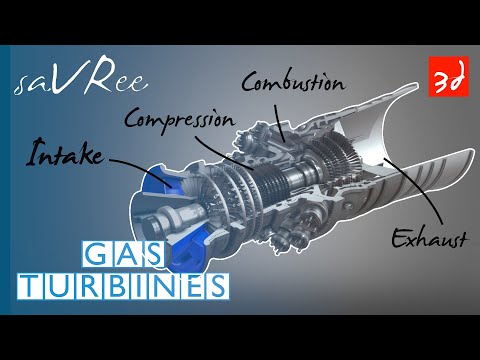
How Gas Turbines Work (Combustion Turbine Working Principle)
Gas Turbines: Understanding Their Functionality and Applications
Introduction to Gas Turbines
- John introduces the topic of gas turbines, also known as combustion turbines, outlining the main components and their assembly.
- He compares gas turbines to combustion engines using the phrase "suck squeeze bang blow," highlighting the stages of intake, compression, combustion, and exhaust.
Stages of Operation
- The exhaust stage is referred to as the expansion stage; it consists of a cold section (blue) and a hot section (yellow/orange/red).
- A brief explanation of how a combustion turbine works: igniting fuel heats air, which is why it's called a gas turbine.
Fuel Types and System Types
- Gas turbines can utilize various fuels such as natural gas, light fuel oil, or coal dust—up to 30 different types.
- Distinction between open and closed systems: this video focuses on open systems that use ambient air as the working fluid.
Process Overview
- Air is drawn in through inlets, compressed to increase pressure/density/temperature before entering the combustion zone for ignition.
- Hot gases from combustion pass over turbine blades causing rotation of the central shaft connected to both compressor and turbine.
Efficiency and Applications
- Gas turbines operate with constant combustion leading to higher efficiency (30%-40%), potentially reaching up to 55%-60% when combined with steam turbines in combined cycle plants.
- Applications include aircraft engines due to high power-to-weight ratio; modifications allow for electricity generation in power plants.
Types of Gas Turbines
- Two main designs are discussed: heavy frame (for large power generation needs exceeding 250 MW capacity) and aeroderivative (used primarily in aircraft but also for smaller power applications).
Gas Turbine Designs and Efficiency
Overview of Gas Turbine Types
- There are two main gas turbine designs: aeroderivative and heavy frame. The power output for aeroderivative turbines ranges from 30 to 60 megawatts, while heavy frame designs range from 200 to 500 megawatts.
Efficiency Comparisons
- Aeroderivative turbines have an efficiency of about 39% to 43%, whereas heavy frame designs typically range from 37% to 40%. However, the speaker suggests that heavy frame efficiency might be more realistically around 35% to 37%.
Combined Cycle Power Plants
- When combining gas turbines with steam turbines in a combined cycle power plant, overall efficiency can exceed 50%, representing a significant improvement over standalone systems.
Components of a Gas Turbine
Physical Structure and Cooling Systems
- A gas turbine is often housed within a box that varies in size. It may utilize air cooling or water cooling depending on its design. A control oil system is typically installed nearby for valve actuation.
Air Intake and Compression Process
- Air enters the turbine through an intake, flowing past compressor blades which increase both pressure and temperature as it moves through multiple stages. Heavy frame designs achieve compression ratios between 15:1 and up to 18:1, while aeroderivative engines can reach up to 30:1.
Combustion Process in Gas Turbines
Fuel Injection and Ignition
- After compression, fuel is injected into the combustion zone where it ignites, generating heat that further heats the compressed air. Initially, ignition requires a spark; however, once operational speed exceeds approximately 50%, external ignition becomes unnecessary.
Energy Generation Mechanism
- The hot air produced during combustion is discharged through stationary nozzles across turbine blades, causing them to rotate. This rotation drives the central shaft connected to a generator for electricity production.
Combined Cycle Power Plant Functionality
Integration of Thermodynamic Cycles
- A combined cycle power plant utilizes both Brayton (gas turbine) and Rankine (steam turbine) cycles for enhanced efficiency. Each cycle represents different thermodynamic processes named after their inventors.
Operational Workflow
- In this setup, the gas turbine connects via a shaft to a generator producing three-phase electrical power sent through transformers for distribution. Air intake undergoes filtration before reaching the gas turbine to prevent damage from foreign particles or moisture.
Heat Recovery Steam Generators and Combined Cycle Plants
Understanding Heat Recovery Steam Generators
- A heat recovery steam generator (HRSG) functions as a boiler, utilizing exhaust gases to transfer heat to water, converting it into steam.
- The generated steam is directed to a steam turbine, where the rotor's rotation produces electricity via a generator.
- This system exemplifies a combined cycle plant, which efficiently operates both gas and steam turbines using a single heat source.
- The efficiency of such plants can significantly increase from approximately 35% to between 50% and 60%, showcasing the benefits of this technology.
Additional Resources