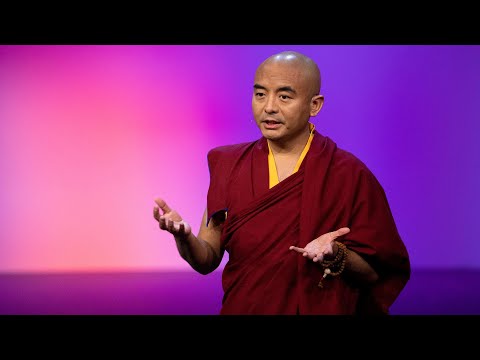
How to Tap into Your Awareness | Yongey Mingyur Rinpoche | TED
Introduction to Meditation
In this section, the speaker introduces the topic of meditation and addresses two common misunderstandings about it.
What is Meditation?
- Meditation is about awareness and knowing what you are thinking, feeling, doing, seeing, and hearing. It is simple but often perceived as difficult.
- Many people mistakenly believe that meditation means stopping thoughts or concentrating on nothing.
- Trying to stop thinking actually leads to more thoughts.
- The goal of meditation is not to bliss out or seek peace and relaxation.
Connecting with Awareness
- The speaker shares his personal experience of having panic attacks as a child.
- His father taught him that instead of fighting against panic, he should connect with awareness.
- Awareness is always present and calm like the sky in the mountains, while thoughts and emotions are like passing storms.
- There are three steps to practice connecting with awareness: using an object as support, listening to sounds without getting caught up in thoughts, and letting thoughts come and go without attachment.
Experiencing Meditation through Sound
In this section, the speaker guides the audience through a simple meditation exercise using sound.
Sound Meditation Exercise
- Close your eyes and relax your muscles.
- Listen attentively to the sound (ding) without getting distracted by thoughts or trying to control them.
- Let any distractions or thoughts come and go without judgment or attachment.
- The key is to maintain awareness of the sound while allowing other experiences to arise naturally.
Overcoming Laziness in Meditation Practice
In this section, the speaker discusses his struggle with laziness when it comes to practicing meditation.
Laziness as a Challenge
- The speaker admits being lazy when it comes to practicing meditation despite liking the idea of it.
Conclusion
The transcript provides an introduction to meditation, addressing common misconceptions and emphasizing the importance of awareness. The speaker shares a personal experience and guides the audience through a sound meditation exercise. Laziness in practicing meditation is acknowledged as a challenge.
New Section
The speaker shares their experience of joining a retreat and dealing with laziness and panic. They explain how they learned to live with panic through meditation and the benefits it brought.
Living with Panic
- The speaker joined a retreat but started experiencing laziness and panic after the first month.
- They felt embarrassed to leave because they had told their friends about it, so they decided to learn how to live with panic.
- Meditation can be done anywhere, anytime, with anything, including panic.
- By observing panic without getting caught up in it, awareness becomes stronger than panic.
- This practice brings benefits such as acceptance, love, compassion, and wisdom.
- Panic is not a solid entity but made up of various sensations, images, voices, and beliefs.
- By removing one element from the experience of panic, it loses its power.
- Through this practice, panic becomes like shaving foam - appearing solid but full of bubbles.
New Section
The speaker explains how their relationship with panic transformed over time. They share their journey of becoming friends with panic and how it became their teacher.
Panic as Teacher
- The speaker's relationship with panic improved through meditation practice until eventually the panic disappeared.
- They finished their retreat successfully and went on to teach meditation and write books on the subject.
- However, they noticed a new ego emerging within them due to their success.
- To counteract this egoic tendency, they embarked on a wandering retreat where they left everything behind and lived on the streets.
- During this challenging period, they experienced food poisoning and thought they were going to die.
New Section
The speaker describes their experience during an open awareness meditation practice where they focused solely on being present. They also share the transformative effects of this practice.
Open Awareness Meditation
- The speaker practiced open awareness meditation, where they simply focused on being aware without any external support.
- Their body deteriorated during the practice, but their mind became incredibly present and free.
- They experienced a state of deep presence for several hours before returning to their normal state.
- Afterward, everything around them felt like home, and even ordinary things like trees and wind became sources of love and joy.
New Section
The speaker expresses the difficulty in explaining open awareness meditation but emphasizes its simplicity and freedom.
Explaining Open Awareness Meditation
- Open awareness meditation does not require any specific actions or techniques; it is about simply being present.
- The sense of presence brings a feeling of freedom and liberation.
Turn any video into a summary like this
YouTube links, meetings, lectures. With transcripts, search, and chat.