aminoacidos metabolismo
Overview of Amino Acids and Metabolism
This section provides a brief review of amino acids and their metabolism. It discusses the structure of amino acids, the division of amino acid metabolism into two parts (amino group and carbon chain), and the different pathways that amino acids can follow.
Structure of Amino Acids
- Amino acids have a carbon alpha (α) atom to which an amino group, a carboxyl group, a hydrogen atom, and a variable side chain are attached.
- The structure of amino acids varies depending on the specific side chain.
Division of Amino Acid Metabolism
- Amino acid metabolism is divided into two main parts:
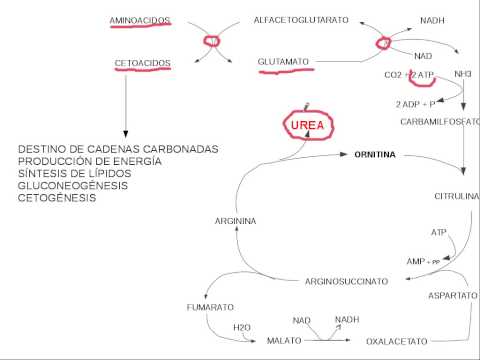
- Amino Group Metabolism: Involves transamination, oxidative deamination, and the urea cycle.
- Carbon Chain Metabolism: Involves energy production or lipid synthesis.
Fate of Carbon Chains
- Carbon chains from amino acids can be directed towards energy production through the Krebs cycle with reduced enzymes and ATP.
- Excess amino acids in the presence of excess energy can be used for lipid synthesis.
- During fasting or protein catabolism, carbon chains can be utilized for gluconeogenesis or ketogenesis.
Transamination Process
This section explains the process of transamination in amino acid metabolism.
- Transamination is carried out by enzymes called transaminases.
- Transaminases transfer the nitrogen from an amino group to α-ketoglutarate, forming glutamate.
- Glutamate then undergoes further reactions to generate α-ketoacids and ammonia.
- The removal of the amino group during transamination converts it into an α-ketoacid.
Urea Cycle and Ammonia Detoxification
This section discusses the urea cycle and the detoxification of ammonia.
- Ammonia, generated during transamination, is toxic to cells and can cause metabolic disturbances.
- The urea cycle is a metabolic pathway that converts ammonia into urea, a non-toxic molecule.
- The urea cycle involves the incorporation of one nitrogen atom from ammonia and another from aspartate to form urea.
- Urea is highly soluble and non-toxic compared to ammonia.
Fate of Carbon Chains
This section explains the different pathways that carbon chains from amino acids can follow.
Production of Energy or Lipid Synthesis
- When there is a high intake of amino acids along with carbohydrates and lipids, carbon chains can be directed towards energy production or lipid synthesis.
Gluconeogenesis and Ketogenesis
- During fasting or when proteins are derived from endogenous sources, carbon chains are utilized for gluconeogenesis (formation of glucose) or ketogenesis (formation of ketone bodies).
Enzymes Involved in Amino Acid Metabolism
This section describes the enzymes involved in amino acid metabolism.
- Transamination process is carried out by transaminases, which use pyridoxal phosphate as a prosthetic group.
- Oxidative deamination is catalyzed by glutamate dehydrogenase, which generates ammonia and reduced enzymes.
- Formation of carbamoyl phosphate is catalyzed by carbamoyl phosphate synthetase 1 (CPS1).
- CPS1 requires ATP hydrolysis to incorporate nitrogen into carbamoyl phosphate.
- Various other enzymes such as argininosuccinate synthetase, argininosuccinate lyase, and arginase are involved in the urea cycle.
Relationship with Krebs Cycle
This section explains the relationship between amino acid metabolism and the Krebs cycle.
- The urea cycle is closely related to the Krebs cycle.
- One of the intermediates of the Krebs cycle, fumarate, is generated during the urea cycle.
- Fumarate is converted back to malate, then to oxaloacetate, and finally enters the Krebs cycle again.
- This connection allows for efficient utilization of carbon chains from amino acids in energy production.
Timestamps have been associated with relevant bullet points as requested.
Incorporation of Amino Acids in Gluconeogenesis
This section discusses the amino acids that can be incorporated into the process of gluconeogenesis and the compounds they can generate.
Amino Acids for Glucose Production
- Isoleucine, phenylalanine, tyrosine, and tryptophan can generate compounds such as acetate and acetyl-CoA.
- Acetate and acetyl-CoA cannot form glucose but can contribute to the production of ketone bodies.
Ketone Body Formation from Certain Amino Acids
This section explains how certain amino acids can generate ketone bodies due to their carbon chains.
Amino Acid Metabolism for Ketone Body Formation
- Lysine and leucine, during their catabolism, can only generate acetoacetate and acetic acid.
- In situations where there is no intake of carbohydrates or proteins, and endogenous proteins are being utilized, these amino acids' carbon chains will primarily produce acetoacetate.
- The liver produces ketone bodies that can be used mainly by muscles.
Extra Pathway for Amino Acid Catabolism
This section introduces an additional minor pathway for amino acid catabolism.
Alternative Pathway for Amino Acid Catabolism
- Some amino acids undergo transamination to produce specific acids, while their nitrogen generates urea.
- The carbon chains mentioned earlier have the potential to generate compounds that can produce glucose or ketone bodies.