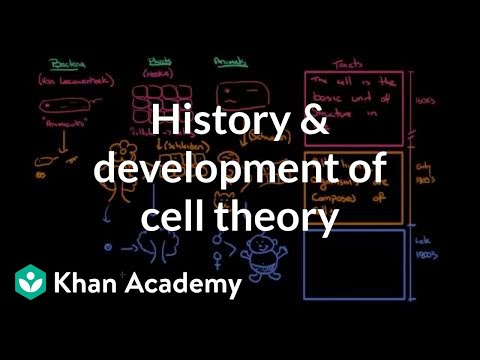
History and development of cell theory | Cells | MCAT | Khan Academy
The Development of Cell Theory
Introduction to Cell Theory
- The narrative of cell theory's development spans from the 1600s to the late 1800s, highlighting three major tenets that will be discussed.
- Examples from bacteria, plants, and animals will illustrate key points throughout the discussion.
Anton van Leeuwenhoek's Discoveries
- In the 1600s, Anton van Leeuwenhoek used a microscope he invented to observe dental scrapings, discovering "Animacules," which we now recognize as bacteria.
- Van Leeuwenhoek is often called the father of modern microbiology due to his pioneering observations.
Robert Hooke and the Naming of Cells
- Robert Hooke also utilized a microscope and famously examined cork, leading him to identify cell remnants resembling monk dormitories.
- He coined the term "cells" from the Latin word "cellula," marking a significant moment in biological terminology.
Establishing the First Tenet of Cell Theory
- Observations across various organisms led scientists to conclude that cells are the basic unit of structure in all living things.
- Different shapes of bacteria were identified (rod-shaped, spiral-shaped, spherical), but they all shared this fundamental cellular structure.
Contributions by Matthias Schleiden and Theodor Schwann
- In the 1830s, botanist Matthias Schleiden discovered that all plants share a common microscopic structure—cells—regardless of species.
- Concurrently, Theodor Schwann found similar cellular structures in different animal tissues. Their discussions led them to propose that all living organisms are composed of cells in 1838.
Understanding Origins: Abiogenesis Theory
- While it was accepted that all living things were made up of cells, questions remained about their origins.
- It was generally understood that animals came from other animals and plants from seeds; however, bacterial origins were less clear.
- The prevailing theory at this time was "Abiogenesis," an ancient concept dating back to Aristotle regarding how life originated.
The Evolution of Cell Theory
The Concept of Spontaneous Generation
- Scientists once believed that life could arise from non-living materials, such as rocks, through a process called spontaneous generation.
- This theory suggested an unknown substance in the air combined with non-living matter to produce life.
Rudolph Virchow's Contributions
- German physician Rudolph Virchow observed bacteria dividing and forming identical cells, leading to the concept of binary fission.
- He famously stated "Omnis cellula e cellula," meaning "Every cell originates from a cell like it," challenging the idea of spontaneous generation.
- Although credited for this theory, the phrase was coined by François-Vincent Raspail, and the concept was likely influenced by Robert Remak.
Criticism and Abiogenesis Debate
- Virchow faced criticism from proponents of abiogenesis who argued that his findings did not disprove their theory; both mechanisms could coexist.
- This debate set the stage for Louis Pasteur's experiments in the 1860s, which aimed to provide clarity on the origin of life.
Louis Pasteur's Swan-Neck Bottle Experiment
- Pasteur conducted a pivotal experiment using a swan-neck bottle to test whether microorganisms in the air caused bacterial growth in sterilized broth.
- Proponents of abiogenesis claimed that bacteria formed spontaneously when broth was left exposed after boiling; Pasteur sought to refute this claim.
- His design allowed air exposure while preventing airborne microorganisms from contaminating the broth, resulting in no bacterial growth over time.
Establishing Cell Theory
- Pasteur's findings effectively debunked abiogenesis and reinforced that all cells come from preexisting cells, solidifying one of the three major tenets of cell theory.
- The development of these ideas over 200 years laid foundational principles for modern biology regarding cellular reproduction and life origins.