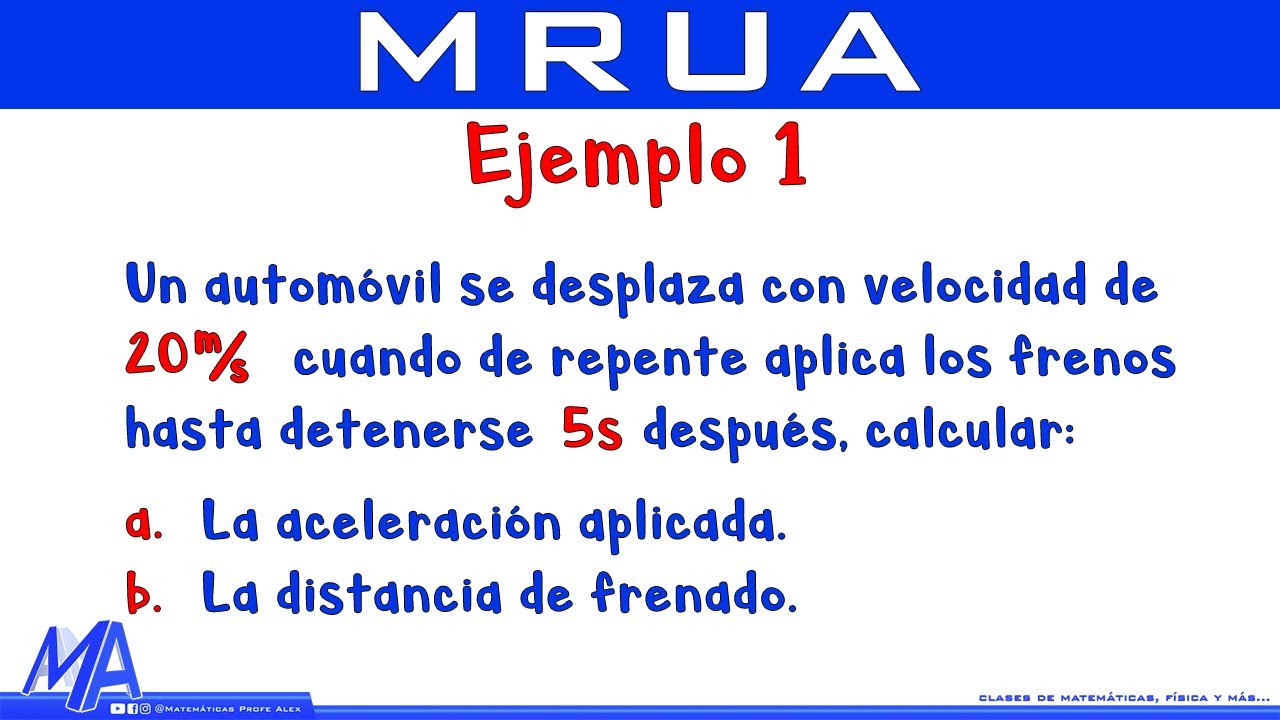
Movimiento Rectilíneo Uniformemente Acelerado o Variado MRUA MRUV | Ejemplo 1
New Section
In this section, the speaker introduces the topic of solving problems related to uniformly accelerated rectilinear motion and provides recommendations for approaching exercises.
Introduction to Problem Solving in Uniformly Accelerated Motion
- The importance of pausing the video to attempt problem-solving independently if familiar with previous course videos.
- Emphasizing the significance of understanding key concepts such as differentiating between data types like time, space, velocity, initial velocity, and acceleration.
- Highlighting the necessity of recognizing which formulas to apply for problem resolution by referencing prior instructional videos.
New Section
This part focuses on identifying and interpreting data provided in a problem scenario to facilitate problem-solving in uniformly accelerated motion.
Data Interpretation for Problem Solving
- Illustrating how to extract essential information from a given scenario, emphasizing the identification of three known data points.
- Explaining how implicit details like stopping imply specific values (e.g., final velocity being zero).
- Discussing the importance of recognizing units (e.g., seconds for time), aiding in determining missing variables like acceleration and distance.
New Section
This segment delves into selecting appropriate formulas based on known variables and preparing for calculations in uniformly accelerated motion problems.
Formula Selection and Preparation for Calculations
- Demonstrating the process of choosing a formula without the unknown variable (space in this case) to simplify calculations.
- Deciding which formula to use based on whether acceleration or another variable needs determination.
Aquí se mide en metros
In this section, the speaker discusses the importance of measuring in meters and seconds for calculations. They emphasize the need to ensure consistency in units for accurate results.
Importance of Unit Consistency
- Conversion of Units: Emphasizes converting all values to seconds or meters for uniformity before calculations.
- Unit Replacement: Explains replacing units systematically without needing to write them repeatedly.
- Calculation Example: Demonstrates a calculation involving acceleration using consistent units of meters and seconds.
- Understanding Units: Highlights the significance of understanding unit measurements, such as meters per second squared for acceleration.
- Interpretation of Negative Acceleration: Discusses negative acceleration indicating deceleration or slowing down.
Distance Calculation and Formulas
This section delves into calculating distance using known variables and selecting appropriate formulas with space already isolated.
Calculating Distance
- Formula Selection: Advises choosing a formula with space isolated among known variables for distance calculation.
- Formula Evaluation: Identifies available formulas with space isolated, simplifying selection based on existing data.
- Formula Versatility: Discusses flexibility in formula choice when all necessary data is available for accurate calculations.
- Formula Preference: Recommends simpler formulas if possible but acknowledges the validity of more complex ones based on data availability.
- Data Replacement: Stresses verifying units before substituting values into formulas for precise outcomes.
Final Calculations and Conclusions
The final segment covers executing calculations accurately by ensuring unit consistency and providing answers in a clear format.
Concluding Calculations
- Operational Efficiency: Demonstrates step-by-step calculation efficiency by ensuring correct unit conversions and systematic computation process.
- Result Presentation: Emphasizes presenting final answers clearly with appropriate units for comprehensive understanding.
Estimation of Initial Velocity and Acceleration Calculation
In this section, the speaker discusses how to estimate the initial velocity and calculate acceleration in a physics problem scenario.
Estimating Initial Velocity
- The initial velocity is estimated to be 0 meters per second since the object is stationary initially.
- The final velocity is determined to be 25 meters per second, indicating the acceleration process until reaching this speed.
Calculating Acceleration
- To calculate acceleration, a formula without distance is sought.
- Units are checked for consistency before substituting values into the acceleration formula.
- Acceleration calculation: (Final velocity - Initial velocity) / Time = 3.125 m/s^2.
Determining Distance Traveled
- With acceleration known, the next step is to find the distance traveled.
- Choosing a formula with distance included for distance calculation.
- Distance calculation: (Final velocity - Initial velocity)/2 * Time = 100 meters.
Invitation to Explore More Physics Problems
The speaker invites viewers to explore more physics problems and courses for further learning and understanding.
Encouragement for Further Exploration
- Viewers are encouraged to explore additional physics problems and courses for comprehensive learning.
Turn any video into a summary like this
YouTube links, meetings, lectures — with transcripts, search, and chat.