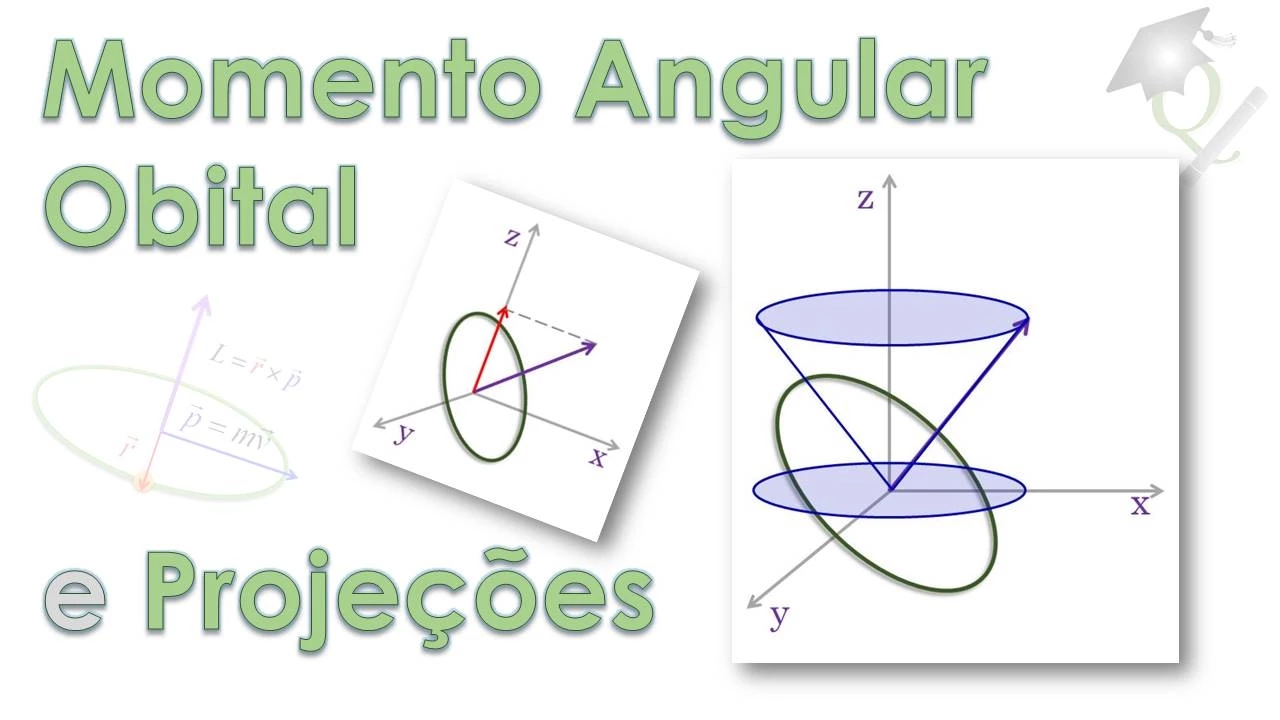
Episódio 15 - Apontando para (quase) todas as direções (Momento Angular Orbital)
New Section
The discussion in this section introduces the topic of angular momentum in atomic systems from a quantum perspective, highlighting its significance and properties.
Angular Momentum in Atomic Systems
- The importance of angular momentum is emphasized, with different orbitals possessing varying angular momenta.
- Describes the acquisition of angular momentum by a moving body in circular motion, emphasizing the role of the position vector and velocity vector.
- Defines the relationship between velocity and linear momentum, leading to the concept of angular momentum as a cross product between position and linear momentum vectors.
- Discusses the perpendicular nature of angular momentum to position and linear momentum vectors, indicating its direction relative to particle trajectory.
- Introduces the quantification of angular momentum through operators in quantum mechanics, linking it to measurable values represented by quantum numbers.
Exploring Quantum Angular Momentum
This segment delves deeper into the quantification and measurement of angular momentum in quantum systems, elucidating its association with quantum numbers.
Quantification of Angular Momentum
- Explores operators for measuring angular momentum in quantum mechanics, highlighting their role in determining observable values.
- Discusses how different quantum numbers correspond to distinct angular momenta, influencing the behavior of electrons in various energy states.
- Relates Planck's constant squared to angular momentum units, underscoring its significance as a reference point for quantifying angular momentum values.
Quantum Interpretation Challenges
This section addresses challenges in interpreting quantum concepts like angular momentum due to their departure from classical physics frameworks.
Interpreting Quantum Angular Momentum
- Highlights difficulties transitioning classical notions to quantum interpretations due to wave-like behaviors at atomic scales.
- Emphasizes that absolute values of angular momentum are determined by substituting Planck's constant into equations rather than direct visualization.
Angular Momentum and Projections
In this section, the speaker delves into the concept of angular momentum in quantum mechanics, emphasizing the significance of projections in understanding this fundamental property.
Angular Momentum Representation
- The classical representation of angular momentum using the right-hand rule is distinct from its quantum mechanical interpretation.
- Angular momentum vector's projection on the z-axis is crucial, showcasing how projections influence the magnitude compared to the actual vector.
Quantum Numbers and Projections
- The projection of angular momentum along a specific axis relates to the secondary quantum number l, indicating quantized spatial orientations.
- Exploring projections further, different ml values correspond to varied spatial orientations due to their role as eigenvalues of an operator projecting onto the z-axis.
Significance of Projections
- ML values represent possible projections along the z-axis for an angular momentum vector with implications for spatial quantization.
- Understanding projections aids in discerning specific spatial directions that angular momentum can assume based on quantum numbers and operators.
Operator Commutation and Measurement
This segment elucidates operator commutation in quantum mechanics and its implications on simultaneous measurements within a system.
Operator Commutation Relations
- Operators representing different observables must commute for simultaneous measurement feasibility, highlighting their interplay in determining measurement outcomes.
- The inability to measure all three components of angular momentum simultaneously stems from non-commutativity between corresponding operators.
Limitations on Simultaneous Measurements
- Due to non-commuting properties, precise determination of multiple angular momentum components concurrently is unattainable within quantum systems.
Projections and Angular Momentum
In this section, the speaker discusses projections of x and y, emphasizing the mathematical nature of these projections. The concept of angular momentum is introduced as a vector unique to each particle, with a focus on measuring its projection.
Projections and Angular Momentum
- The discussion revolves around the projection of x and y, highlighting their distinct mathematical forms.
- Introduces spatial continuation through angular momentum, distinguishing it from orbital angular momentum associated with electron movement.