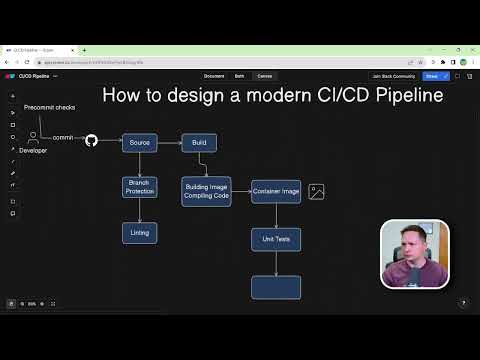
How to design a modern CI/CD Pipeline
Designing a Modern CI/CD Pipeline
Introduction to CI/CD Pipelines
- The video introduces the concept of designing a modern Continuous Integration/Continuous Deployment (CI/CD) pipeline, aimed at software and DevOps engineers.
- Emphasizes that the principles discussed are applicable across various industries and types of applications.
Source Stage
- The source stage begins with retrieving code from repositories like GitHub or Bitbucket.
- Importance of implementing branch protection rules to ensure code reviews via pull requests (PR) before merging into the main branch.
- Linting is introduced as a method for checking syntax errors in code, which can be integrated into the CI/CD pipeline using tools available for different programming languages.
- A pre-commit hook is recommended to run linting checks locally on developers' machines before they commit their code to GitHub.
Build Stage
- After passing the source stage, the process moves to the build stage where an artifact is created for testing and release.
- Discusses compiling code and building container images, particularly using Docker; personal preference on order: build image first then compile code within it.
- Unit tests are crucial during this stage; they validate basic functionalities of new code submissions by developers.
Code Coverage Checks
- Code coverage checks are implemented post-unit tests to ensure adequate testing coverage (80%-90% recommended).
- If coverage falls below a set threshold, it triggers a failure in the pipeline.
Testing Stage
- Transitioning from build to test stage where more comprehensive testing occurs beyond unit tests.
Understanding the CI/CD Pipeline: Testing and Release Stages
Integrated Testing Environment
- Running integrated tests can be time-consuming, especially when dealing with microservices that have multiple dependencies, including other microservices and databases.
- It's crucial to establish an integrated testing environment. Tools like Docker Compose can facilitate this, but a full Kubernetes cluster may also be utilized depending on organizational needs and application types.
Release Stage of CI/CD Pipeline
- The release stage focuses on deploying your application so that servers can utilize it effectively. This involves shipping the built image to a registry.
- Once the image is available in the registry (e.g., ECR), various environments such as QA, pre-production (staging), and production can pull the image for further testing or deployment.
Overview of Continuous Integration and Delivery
- The entire process discussed constitutes a continuous integration and continuous delivery (CI/CD) pipeline. This framework ensures that code changes are automatically tested and prepared for release.
Next Steps: Continuous Deployment
- Future discussions will cover how to transition from CI/CD pipelines to continuous deployment pipelines, potentially integrating GitOps practices.