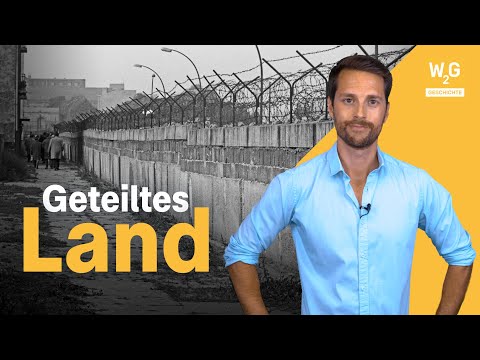
Die deutsche Teilung: Das müsst ihr wissen
The Construction of the Berlin Wall: A Historical Overview
Introduction to the Division of Germany
- The construction of the Berlin Wall began on August 13, 1961, marking a significant historical event nearly 60 years ago.
- This video discusses key facts about the division of Germany, its origins, and its lasting impact.
Post-World War II Context
- Following Germany's unconditional surrender in May 1945, there was uncertainty regarding the country's future after its role in World War II.
- Plans were made by the USA, Soviet Union, and Britain to divide Germany into up to five independent states to prevent it from becoming a military threat again.
Emergence of Two German States
- By mid-1945, tensions rose between former allies as Stalin's troops advanced into Europe, leading to a split between Western liberalism and Eastern communism.
- At the Potsdam Conference in July 1945, Allied leaders agreed to divide Germany into four occupation zones controlled by the USA, UK, France, and USSR.
Economic and Political Divisions
- The Soviet Union implemented communism in its zone while Western Allies supported democracy through initiatives like the Marshall Plan.
- Currency reforms led to economic divisions: West Germany adopted the Deutsche Mark while East Germany introduced the Ostmark.
Formation of Separate German States
- In West Germany (Federal Republic), democratic institutions emerged with growing political participation; they referred to their constitution as "Grundgesetz" (Basic Law).
- On October 7, 1949, East Germany (German Democratic Republic or DDR) was established under communist influence.
Ideological Conflict and Military Alliances
- The two German states became ideologically opposed: West aligned with free democracies while East joined socialist blocs.
- Military alliances formed during this period included NATO for West Germany and Warsaw Pact for East Germany amid rising tensions known as the Cold War.
Key Events Leading Up to Division
- The Cold War intensified with ideological conflicts manifesting militarily; both superpowers sought allies within their respective spheres.
- A critical moment occurred in 1948 when Soviets blockaded all routes into West Berlin.
Response to Blockade: The Berlin Airlift
- In response to Stalin's blockade aimed at forcing Western powers out of Berlin, an airlift operation commenced supplying essential goods over eleven months.
Consequences of Division
The Division of Germany and the Berlin Wall
The Mass Exodus from East Germany
- Over 2.5 million people flee East Germany (DDR), with an average of 570 individuals leaving daily, equating to a city like Kassel or Rostock emptying each year.
- The DDR leadership aims to seal the border permanently, leading to the construction of the Berlin Wall on August 13, 1961, referred to internally as the "antifascist protective wall."
Perception vs. Reality of the Wall
- While presented as a barrier against Western fascists, most recognize it as a prison wall designed to confine citizens rather than protect them.
- The division is not just in Berlin; a barbed wire fence splits all of Germany into two ideologically opposed sides.
Military Tensions and Nuclear Threats
- Both sides are heavily armed, with thousands of nuclear warheads at their disposal; plans existed for strategic nuclear strikes on Western Europe by the Warsaw Pact.
- The Cold War's balance of terror relies on mutual destruction threats, which paradoxically serve as a peace guarantee during this period.
Attempts at Reconciliation
- Under Chancellor Willy Brandt (SPD), efforts are made to engage with communist neighbors despite ongoing fatalities at the border due to escape attempts.
- Some regulations allow family visits across borders, fostering limited economic and political interactions amidst stark ideological differences.
Cultural Divergence and Rivalry
- A cultural divide emerges: West Germans enjoy consumerism while East Germans face shortages but have more freedom in local leisure activities like nudism (FKK).
- In sports, notable rivalries develop; for instance, East Germany's national football team defeats West Germany in the 1974 World Cup group stage.
The Prelude to Change: Protests and Reforms
Growing Discontent in East Germany
- By 1989, reforms sweep through Eastern Bloc countries; Gorbachev’s policies embolden East Germans who grow increasingly dissatisfied with their living conditions.
- Public outrage peaks when SED leaders claim overwhelming electoral support (98.85%), prompting protests against government lies.
Escalation of Protests
- Thousands begin fleeing through Hungary and foreign embassies; Monday demonstrations start gaining momentum with attendance swelling from hundreds to tens of thousands demanding freedom from oppression.
Peaceful Revolution and Fall of the Wall
- Unlike previous uprisings, Soviet tanks do not intervene this time; peaceful protests culminate in one of history's happiest moments—the fall of the Berlin Wall on November 9, 1989.
Reunification Challenges
Transitioning Towards Unity
- Following reunification on October 3, 1990—marked by significant geopolitical changes—the process reveals deep-seated issues between former East and West Germans.
Identity Crisis Post-Reunification
- Many in former East German states feel marginalized post-reunification amid capitalist influxes that lead to job losses and identity crises due to rapid economic changes.
Cultural Legacy
Reflections on Historical Narratives
Perspectives on Storytelling
- The speaker questions the quality of narratives surrounding historical events, pondering whether they are overly negative or excessively sanitized.
- An invitation is extended to the audience to share their thoughts in the comments, encouraging engagement and discussion about these narratives.
- The speaker references additional resources, including a video about youth experiences in divided Germany and another from "Terra X" regarding the Berlin Wall's construction.
- Emphasis is placed on the educational value of these videos, suggesting that viewers can gain significant insights by watching them.