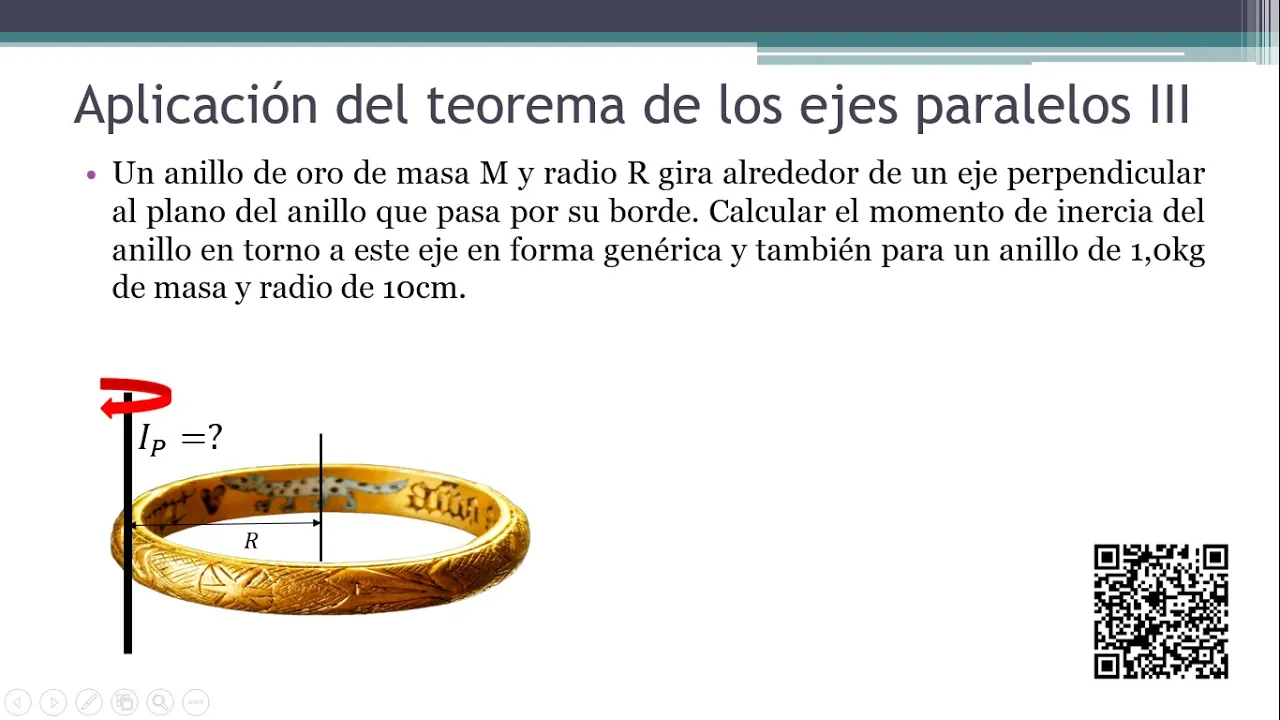
TEOREMA DE STEINER o de los ejes paralelos EJERCICIO RESUELTO N°3 Momento de inercia, aplicación.
Teorema de los Ejes Paralelos - Ejercicio Resuelto
In this section, the video discusses the application of the theorem of parallel axes or Steiner's theorem to solve a specific exercise involving calculating the moment of inertia of a gold ring rotating around an axis perpendicular to its plane.
Calculating Moment of Inertia for a Gold Ring
- The gold ring with a mass of gm and a radius xerez is rotated around an axis passing through its side.
- Data includes mass (gm), radius (xerez), and the need to calculate moment of inertia for two cases: one generic and another for a one-kilogram ring with a 10-centimeter radius.
- Applying Steiner's theorem, the equation for moment of inertia around an axis P is derived as mass times radius squared plus mass times distance between parallel axes squared.
- The moment of inertia for a thin-walled cylinder is discussed using formulas related to mass and radius.
- A generic equation for moment of inertia when rotating around an axis passing through its edge is derived as twice the mass times radius squared.
Solving for Specific Values
- Calculating the moment of inertia for a one-kilogram ring with a 10-centimeter radius yields 0.02 kilogram-meter squared.
- The solved exercise demonstrates that rotating the ring by its outer wall doubles the moment of inertia compared to rotation around its center.