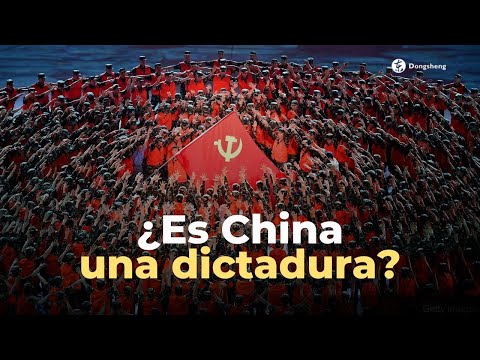
¿Cómo funciona el sistema político de China? | Explicando
Understanding China's Political System
Overview of the Chinese Communist Party and State Structure
- The 20th Congress of the Communist Party of China is currently being held, highlighting China's central role in global geopolitics and economics.
- To understand China's political system, one must recognize two main structures: the state and the party. The Communist Party took control after the establishment of the People's Republic of China on October 1, 1949.
- At the top of the state structure is the presidency, followed by the National People's Congress (NPC) and the Chinese People's Political Consultative Conference (CPPCC), which form the legislative power.
- The judicial power is represented by the Supreme People's Court and the People's Procuratorate, while executive power includes the Central Military Commission and State Council led by a Prime Minister.
- Although there are no opposition parties in China, it operates under a multi-party cooperation system where eight other political parties participate alongside accepting leadership from the Communist Party.
Legislative Functions and Elections
- The NPC is considered China's highest state authority; local people's congresses also exist with four primary functions: legislation, appointment of officials, decision-making, and supervision.
- Direct elections occur at county and municipal levels where representatives are elected directly by citizens; higher-level representatives are chosen by lower-level assemblies.
- In 2016-2017, approximately 900 million voters participated in local elections—this was noted as one of the largest community elections globally.
Structure of the Communist Party
- The Communist Party has its own extensive structure with an organization department often referred to as "the world's largest human resources department," overseeing civil service sectors among others.
- With nearly 97 million members, if it were a country, it would rank as one of the most populous nations. Recruitment prioritizes university graduates based on academic performance starting from lower levels within party ranks.
Meritocracy within Leadership
- Members can ascend through various levels over decades; for instance, current leaders may have started from grassroots positions before reaching high bureaucratic roles managing vast populations or significant enterprises.
- This meritocratic process involves annual evaluations that assess performance through peer reviews and public opinion surveys to promote capable individuals up to senior positions.
Decision-Making Bodies
- The Central Committee consists of only 360 members; from this group emerges a smaller Politburo Standing Committee comprising seven key figures including both President and Prime Minister.
- Major decisions are made during national congresses held every five years. Current discussions revolve around whether China can be classified as a dictatorship or not.
Conceptualizing Democracy in China
- A white paper titled "Democracy That Works" emphasizes "whole-process people's democracy," integrating electoral democracy with consultative democracy rooted in Chinese culture and traditions.
Understanding China's Unique Democratic System
The Nature of Chinese Democracy
- China has developed a unique system of governance that incorporates direct elections at the grassroots level, alongside higher-level consultations with various sectors of society.
- This new system aims to represent and respond effectively to the needs and desires of the Chinese populace, suggesting an alternative model to Western democracy.
- The speaker emphasizes that while China's democratic approach is not perfect, it is tailored specifically to the realities faced by the Chinese people.
- It is highlighted that this model should not be viewed as a universal template for other nations, indicating a respect for diverse political systems.