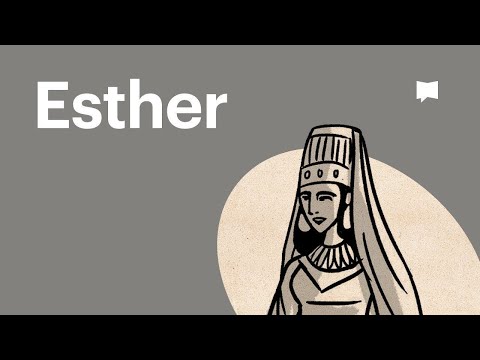
Book of Esther Summary: A Complete Animated Overview
The Book of Esther: An Exciting and Curious Story
This section provides an introduction to the book of Esther, highlighting its setting, main characters, and the absence of direct mention of God.
Introduction to the Book of Esther
- The book is set over 100 years after the Babylonian exile of the Israelites.
- It focuses on a Jewish community living in Susa, the capital city of the ancient Persian Empire.
- The main characters are Mordecai and his niece Esther, who are Jews.
- The king of Persia is portrayed as a drunken pushover in this story.
- The Persian official Haman serves as the cunning villain.
Absence of Direct Mention of God
- Unlike other books in the Bible, God is never mentioned in the book of Esther.
- This absence invites readers to look for signs of God's activity throughout the story.
- The story is filled with coincidences and ironic reversals that reveal God's purpose at work behind the scenes.
The Banquets and Decrees
This section explores the opening events in the book, including extravagant banquets thrown by the king, Queen Vashti's refusal to appear before him, and Esther's rise to become queen.
Elaborate Banquets and Queen Vashti's Refusal
- The king throws two elaborate banquet feasts lasting 187 days to display his greatness and splendor.
- Queen Vashti refuses to appear at the party when summoned by a drunken king. As a result, she is deposed from her position as queen.
Esther's Rise to Power
- Esther, hiding her Jewish identity, enters a beauty pageant and wins, becoming the new queen of Persia.
- Mordecai overhears a plot to murder the king and informs Esther, who then informs the king. Mordecai is credited with saving the king's life.
Haman's Plot and Mordecai's Rise
This section focuses on Haman's plot to destroy all Jews and Mordecai's rise in power.
Haman's Plot
- Haman, an Agagite descendant of the Canaanites, is elevated to a high position in the kingdom. He demands that everyone kneel before him.
- Mordecai refuses to kneel before Haman, which fills Haman with rage. When he discovers that Mordecai is Jewish, he successfully persuades the king to enact a decree to annihilate all Jews.
Mordecai's Rise
- The date for the Jews' annihilation is determined by rolling dice called "Pur" in Hebrew. It is set for eleven months later on the thirteenth of Adar.
- Meanwhile, Mordecai saves the king from an assassination plot, but God is not explicitly mentioned in these events.
Esther's Brave Plan
This section highlights Esther and Mordecai's plan to reverse the decree and save their people.
A Risky Plan
- Esther decides to reveal her Jewish identity to the king and ask him to reverse the decree despite knowing that approaching him without a royal request could result in death according to Persian law.
- Mordecai expresses confidence that deliverance for the Jews will come from another place if Esther remains silent. He suggests that perhaps she became queen for this very moment.
The Ironic Reversal
This section describes the ironic reversal of Haman's evil plans and the downfall of Haman himself.
Esther's Banquet and Haman's Rage
- Esther hosts a banquet for the king and Haman, where she reveals her Jewish identity and informs them about Haman's decree to murder her, Mordecai, and all Jews.
- After leaving the banquet drunk, Haman sees Mordecai in the street and orders a tall stake to be built for his execution. The situation seems dire for the Jews.
The King's Sleepless Night
- That night, the king cannot sleep and has the royal chronicles read to him. He learns about how Mordecai had saved his life but was never rewarded.
- In the morning, when Haman enters to request Mordecai's execution, the king orders him to honor Mordecai publicly instead. This marks a turning point in favor of Mordecai and against Haman.
Esther's Second Banquet
This section focuses on Esther's second banquet with the king and reveals how their actions lead to a plan to reverse the decree.
Esther Reveals Everything
- At her second banquet with the king, Esther discloses her Jewish identity again and exposes Haman as an enemy plotting against her people.
- The king becomes enraged upon hearing this news while heavily intoxicated and orders that Haman be impaled on the stake he had prepared for Mordecai.
Reversing the Decree
- Although Haman's execution does not solve the problem of the decree to kill all Jews, Esther and Mordecai devise a plan to reverse it.
- They discover that the king cannot revoke a decree he has already made, so instead, Mordecai is commissioned to issue a counter decree allowing Jews to defend themselves against any who plot their destruction.
- The Jews celebrate this new decree with banquets and feasts.
New Section
This section provides an overview of the book of Esther, including the establishment of the feast of Purim and Mordecai's elevation to second in command in the kingdom.
The Story of Esther
- The story revolves around the rescue of the Jews from annihilation, resulting in joy and celebration throughout the kingdom.
- Esther and Mordecai establish a two-day feast called Purim to commemorate their deliverance from destruction. The name "Purim" comes from Haman's dice.
- Mordecai is elevated to second in command in the kingdom, and the Jews thrive in exile.
New Section
This section discusses how the story of Esther is designed as a series of ironic reversals, with moments mirroring each other.
Ironic Reversals
- The entire story is structured as ironic reversal, with moments mirroring each other. For example, King's splendor and feasts are mirrored by Mordecai's splendor and feasts at the end.
- Esther and Mordecai first save the king, but in the end, they save all of the Jews. Haman's elevation and edicts are reversed by Mordecai's elevation and edict.
- At the center of it all are Esther and Mordecai's planning scenes and two banquets that frame Haman's humiliation and Mordecai's exaltation - a significant moment of reversal in the story.
New Section
This section explores the moral ambiguity of characters in the book of Esther.
Moral Ambiguity
- Characters in the book of Esther, including Mordecai and Esther, exhibit moral ambiguity. They engage in drinking, anger, sex, and murder, violating commands in the Torah.
- The story does not present Mordecai and Esther as moral examples or endorse their behavior. However, they are portrayed as models of trust and hope during difficult times.
New Section
This section addresses the absence of God's mention in the book of Esther and its message about God's providence.
Absence of God
- The book of Esther raises the question of why God is not mentioned. It suggests that even when God seems absent and His people are unfaithful to the Torah, He can still work in human history's mess and moral ambiguity.
- Morally compromised individuals like Mordecai and Esther can be used by God to accomplish His purposes. The book invites trust in God's providence even when it may not be visible and emphasizes His commitment to redeeming His world.