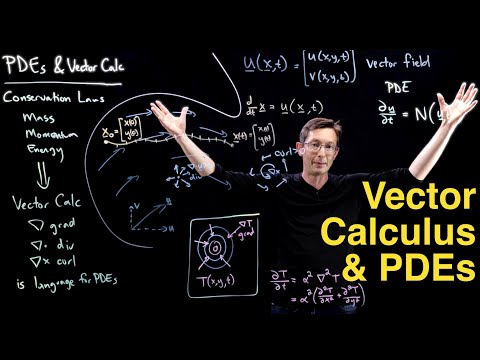
Vector Calculus and Partial Differential Equations: Big Picture Overview
Introduction to Vector Calculus and Partial Differential Equations
In this lecture series, the focus is on vector calculus and its application in deriving and solving partial differential equations (PDEs). PDEs express conservation laws such as mass, momentum, and energy. Vector calculus serves as the language for describing these conservation laws.
The Language of PDEs
- PDEs express conservation laws in physics, such as mass, momentum, and energy.
- Vector calculus is the language used to translate physical laws into differential equations that can be solved and analyzed.
- Concepts like gradient, divergence, and curl are essential in vector calculus for describing conservation laws.
Intuition for Div, Grad, and Curl
- Div (divergence), grad (gradient), and curl are fundamental operations in vector calculus.
- These operations help describe the behavior of vector fields associated with conservation laws.
Manipulations with Stokes's Theorem and Gauss's Theorem
- Stokes's theorem and Gauss's theorem provide tools for manipulating vector fields in the context of PDEs.
- These theorems allow us to write down conservation laws as PDEs.
Deriving Heat Equation, Laplace's Equation, Mass Continuity Equation
- Heat equation, Laplace's equation, mass continuity equation (Navier-Stokes), etc., are derived from scratch using vector calculus.
- Assumptions made during derivations are clarified along the way.
Expressing Physical Phenomena Using Vector Calculus
- Physical phenomena like shock waves or energy input can be expressed using vector calculus.
- Understanding these phenomena helps build intuition about how they work.
Fluid Flow Example: Gulf of Mexico
- A fluid flow example is used to illustrate a vector field representing fluid velocity at different points in space over time.
- The solution of a PDE represents this vector field, which changes in time due to various dynamics.
General Framework of Vector Fields and PDEs
- Vector fields represent solutions of PDEs.
- The dynamics of the vector field can change over time, influenced by factors like heating variations.
This summary provides an overview of the topics covered in the transcript. For a more detailed understanding, refer to the specific sections and timestamps provided.
Understanding Temperature Distribution in a Metal Plate
In this section, the speaker introduces the concept of solving for temperature distribution in a metal plate using partial differential equations. The heat equation is derived to describe the conservation of heat energy in the plate.
Deriving the Heat Equation
- The temperature distribution in the metal plate is represented as a function of x, y, and time (T).
- The heat equation is written as ∂T/∂t = α^2 (∂^2T/∂x^2 + ∂^2T/∂y^2), where α is a positive constant.
- This equation represents the conservation of heat energy and can be solved using partial differential equations.
Applications of Partial Differential Equations
In this section, the speaker discusses various applications of partial differential equations in physics phenomena such as heat distributions, airplane wing lift generation, and fluid flow fields.
Predicting Trajectories and Flow Fields
- A vector field solution of a partial differential equation can be used to predict the trajectory of particles dropped into it.
- The flow field induced by the partial differential equation sets up a dynamical system for particle movement.
- Numerical integration can be used to track particles through the flow field, which has practical applications like predicting oil spill movements or search and rescue operations.
Understanding Gradient, Divergence, and Curl
In this section, the speaker explains gradient, divergence, and curl in vector calculus and their significance in understanding flow fields.
Gradient, Divergence, and Curl
- The divergence of a flow field measures the local flow away from or into a point.
- Positive divergence indicates flow moving away, while negative divergence indicates flow converging.
- Sink points have negative divergence, while sources have positive divergence.
- The curl of a flow field represents the rotation or circulation at a point.
- The gradient takes a scalar field (e.g., temperature distribution) and returns a vector field indicating the direction of fastest increase.
Following Temperature Gradients
In this section, the speaker explains how following temperature gradients can lead to reaching hot spots faster.
Using Gradient for Temperature Increase
- The gradient of a temperature distribution provides information on the direction of fastest temperature increase.
- By following the gradient direction, one can reach hot spots in the temperature distribution more quickly.
This summary covers key points from the transcript and is not an exhaustive representation of the entire video.
Gradients and Vector Calculus
In this section, the speaker introduces the concept of gradients in million-dimensional spaces and their relevance to machine learning models. The speaker also mentions the importance of physical intuition, such as partial differential equations and conservation laws, in understanding vector calculus.
Gradients in Million-Dimensional Spaces
- Gradients extend to million-dimensional spaces where machine learning models are trained.
- These spaces involve concepts from physical intuition, such as partial differential equations and conservation laws.
- Vector calculus plays a crucial role in understanding these concepts.
Learning Vector Calculus
- The speaker plans to start with explaining the meaning of vector calculus terms.
- Concepts like Gauss's theorem, Stokes's theorem, and Gauss's divergence theorem will be covered.
- These theorems encode physical ideas related to conservation of mass, momentum, and energy.
- They are used to derive partial differential equations for real physical systems like Navier-Stokes equation, heat equation, and mass continuity.
Watch Video
Turn any video into a summary like this
YouTube links, meetings, lectures — with transcripts, search, and chat.