Logística.- 5.3 VOP Volumen óptimo de pedido
What is the Optimal Order Volume?
Understanding Optimal Order Volume
- The optimal order volume (BOP) is defined as the quantity to be ordered at each time unit to minimize total costs, including management and storage costs.
- The Wilson model analyzes the relationship between ordering costs and holding costs, highlighting that increased order quantities raise ordering costs while reducing storage costs.
Cost Analysis for Orders
- To calculate BOP, consider acquisition cost (purchase price times annual demand), management cost (cost per order times annual demand divided by order volume), and storage cost (holding cost per unit times average stock).
- The formula for calculating the optimal order volume is:
[
BOP = sqrtfrac2 times textAnnual Demand times textManagement CosttextStorage Cost
]
Calculating Optimal Order Volume Example
Case Study: Company Demand and Costs
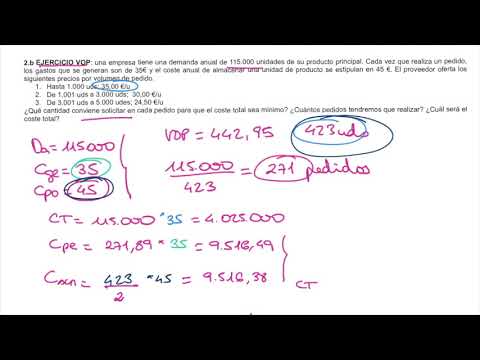
- A company has an annual demand of 115,000 units with a management cost of €35 per order and a storage cost of €45 per unit.
- The goal is to determine how many units should be ordered each time to minimize total costs.
Step-by-Step Calculation
- Using the BOP formula:
- BOP = sqrt2 times 115000 times 35/45 = 423
- Thus, the optimal order quantity is approximately 423 units.
Total Cost Calculation
Breakdown of Total Costs
- To find total costs:
- Calculate purchase cost: 115000 / 423 orders annually results in about 271 orders.
- Purchase cost totals €4,025,000 based on higher pricing from previous calculations.
Additional Costs Incurred
- Management costs are calculated as:
- 271 times €35 = €9,516.49
- Storage costs are derived from average stock levels:
- Average stock when ordering 423 units leads to a similar calculation yielding around €9,516.38.
Comparing Offers for Cost Efficiency
Evaluating Alternative Pricing Options
- Analyzing alternative offers can lead to different purchasing strategies; for instance, if a lower price of €24.50 is available.
Conclusion on Best Practices
Cost Calculation and Order Optimization
Understanding Order Costs
- To calculate the cost of an order, it's essential to know the number of orders placed annually. Given that each order consists of 3,001 units, dividing 115,000 by 3,001 results in approximately 38.32 orders per year.
- The acquisition cost for these orders is calculated by multiplying the number of annual orders (38) by the cost per order (€35), leading to a total acquisition cost of €1,341.22.
Storage Costs Analysis
- The storage cost is determined by taking the average stock (3,001 units divided by 2) and multiplying it by the storage cost per unit (€45). This results in a total storage cost of €67,500.50.
- The overall total cost combines acquisition and storage costs along with any additional expenses, culminating in a total of €286,363.72. This new offer significantly outperforms previous options due to reduced prices from suppliers based on volume incentives.
Conclusion on Ordering Strategy