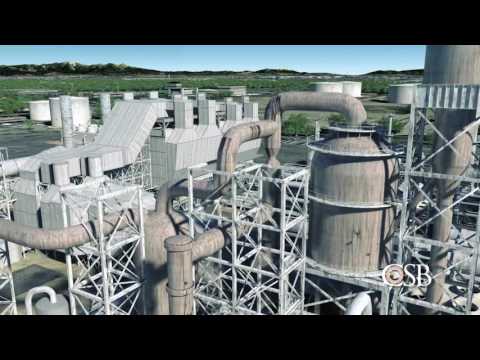
Animation of 2015 Explosion at ExxonMobil Refinery in Torrance, CA
Explosion at the Torrance Refinery: Understanding the FCC Unit Process
Overview of the Torrance Refinery and FCC Unit
- The Torrance Refinery spans 750 acres near Los Angeles, California, and was owned by ExxonMobil during the explosion incident.
- A critical component of refining occurs in the Fluid Catalytic Cracker (FCC) Unit, where heavy hydrocarbons from crude oil are converted into lighter hydrocarbons suitable for gasoline and fuel products.
Operation of the FCC Unit
- Heavy hydrocarbons enter a reactor where they mix with a catalyst to produce lighter hydrocarbon vapors that ascend through the reactor.
- At the top of the reactor, lighter vapors are separated from the catalyst, which then moves to a regenerator to remove carbon deposits known as "coke."
Regeneration Process
- In the regenerator, air is introduced to burn off coke from the catalyst; this process generates flue gas that must be filtered through various equipment.
- The final filtration step involves an Electrostatic Precipitator (ESP), which uses static electricity to eliminate small catalyst particles but also poses ignition risks due to sparks generated during operation.
Sequence Leading Up to Explosion
- On February 16th, 2015, vibrations in an expander caused automatic safety measures to engage, transitioning the FCC Unit into "safe park" mode—halting hydrocarbon flow into reactors and closing slide valves.
- Despite these precautions, one slide valve had eroded over time and failed to maintain a proper barrier between equipment sections. Within minutes of entering safe park mode, all catalyst fell into the regenerator creating a direct pathway for hydrocarbons.
Attempts at Repair and Consequences
- Operators attempted multiple restarts on February 17th but suspected accumulated catalyst inside prevented success; discussions led them to utilize a previously approved variance allowing deviations from standard procedures for repairs.
- On February 18th, maintenance efforts were hindered by escaping steam through an open flange; attempts were made to reduce steam flow without assessing its sufficiency against potential hydrocarbon backflow risks from other units.
Critical Alarm Signals and Final Incident
- By 8:07 AM on February 18th, alarms indicated leaking hydrocarbons near workers; evacuation occurred shortly after multiple alarms sounded around 8:40 AM as flammable mixtures moved toward ignition sources within ESP systems.
- An increase in steam flow was ordered too late as explosive conditions had already developed leading up to a violent explosion within the facility.