ICT Mentorship Core Content - Month 10 - Bond Trading - Split Session Rules
Introduction
This video is a discussion on commodities, specifically as a paper trade only. The mentorship focuses on teaching how to trade with ICT Concepts Forex and commodities.
ICT Bond Trading Lesson 2 Split Session Rules
This section discusses the split session rules for trading bonds.
Time of Day Element for Commodities
- Commodities have a unique time of day element that differs slightly from Forex.
- Overnight sessions will have an impact, traditionally seen as the London session.
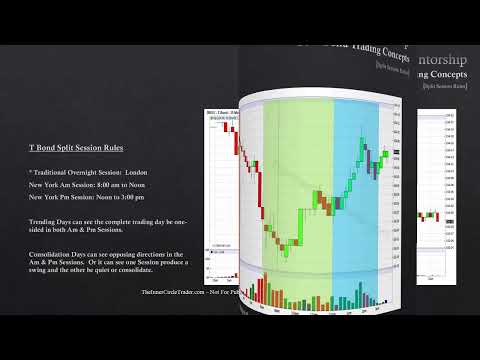
- New York AM session is defined by 8 A.M New York time to noon New York time.
- New York PM session is defined by noon New York time to 3 P.M New York time.
Focus on Trading the New York Session Hours
- Analysis concepts should be focused primarily on the New York session hours.
- Overnight or London sessions can also be traded but use information seen during overnight trading during the London session to look for stops liquidity voids fair value gaps those types of things.
- The largest volume for bond futures is seen between 8 AM and 9:30 AM NY time.
AM and PM Sessions
- The AM session generally forms the higher low of the NY session or total range of true day for treasury bonds.
- The PM session generally has a continuation or reversal and consolidation.
- Focusing primarily on 8:20 in the morning to 11 o'clock in the morning was like my Killzone when I was doing Commodities only as an asset class.
Trading Days
- Trending days can see the complete trading day be one-sided in both the AM and PM sessions.
- Training days can start with one of the sessions being for instance the PM session.
Conclusion
This video provides an overview of split session rules for bond trading, focusing primarily on New York session hours. It also discusses time of day elements for commodities and how to trade during overnight or London sessions. The AM and PM sessions are explained, as well as trading days that can be one-sided in both sessions.
Understanding Split Session Rules for Bond Trading
In this section, the speaker explains how to use split session rules for bond trading. The speaker defines the morning and afternoon sessions and provides insights on how to use this information to make informed trading decisions.
Morning Session (8 AM - Noon)
- The morning trend is defined by 8 AM to noon.
- European and UK traders close up shop around 11 AM, leading to a reduction in volume.
- New York lunch occurs around 11 o'clock to one o'clock in the afternoon.
- If the lines portion of the day has been fulfilled by the am session, it's best to avoid trading during the PM session.
Afternoon Session (Noon - 3 PM)
- The New York PM session is from 12 noon New York time to 3 P.M New York time.
- Generally, if there's a large degree of the average daily range seen in the AM session, then the PM session will be rather abbreviated.
- If you have made profits during the morning session, it's best not to trade during the PM session.
Examples of Split Session Rules for Bond Trading
In this section, we look at two examples of split session rules for bond trading.
Example One
- Between two o'clock and five o'clock in the morning is known as traditional London open trade.
- Price rallies up into the 11 o'clock hour London and European Traders go home they Square positions retracement takes place right down into noon so that begins the PM session.
- Price makes the high today ahead of two o'clock in the afternoon and then goes into retracement and consolidation at 3 pm.
Example Two
- No bullet points with timestamps available.
Bond Market Trading Strategies
In this transcript, the speaker discusses bond market trading strategies and how to apply them in Forex trading. The speaker covers topics such as opening range concepts, fair value gaps, bullish order blocks, and turtle soup.
AM Session Trading
- Trades down below London session lows creating a failure swing.
- Split session rules see the AM session going higher than the PM session going lower.
- During the AM session, price has a large opening range. Look for retracement ideas or fair value gaps to be a buyer or seller.
PM Session Trading
- A bullish order block is created at 15402 level during the AM session.
- Price trades down into fills the fair value gap at 15403 into 15402 ahead of the 10 o'clock hour during equities open.
- Take profits in position when fair value gap closes between highs at 15410 during AM session and last up close candle during eight o'clock hour.
Applying Concepts to Price Action
- By applying these concepts and thinking about how it dovetails nicely with foreign exchange, you'll start to see there's a synergy that takes place between asset classes.
- Keep a journal of bond market trading day by day basis to appreciate how bonds influence other markets.
Conclusion
In this section, the speaker concludes the video and wishes good luck to the viewers.
- The speaker mentions that there is a large range available for trading.
- The speaker wishes good luck and good trading to the viewers.
Turn any video into a summary like this
YouTube links, meetings, lectures. With transcripts, search, and chat.