Public Key Infrastructure - What is a PKI? - Cryptography - Practical TLS

Public Key Infrastructure - What is a PKI? - Cryptography - Practical TLS

New Section

In this section, the importance of Public Key Infrastructure (PKI) in ensuring confidentiality, integrity, and authentication in communication systems is discussed.

The Role of Entities in PKI

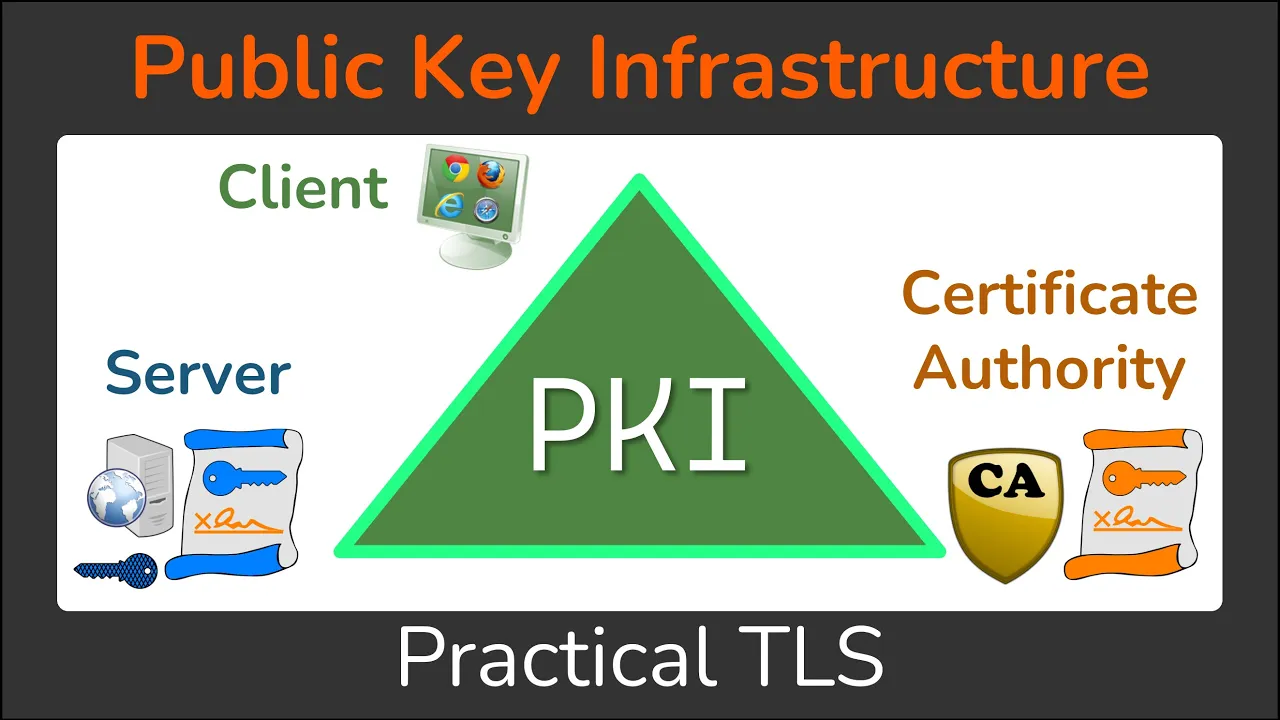
  • PKI involves three key entities: client, server, and certificate authority (CA).
  • The client needs secure connections or identity verification, the server proves its identity, and the CA verifies identities and generates certificates.
  • In the web PKI scenario, clients are browsers like Chrome or Firefox, servers are websites like Google.com, and CAs are public web certificate authorities.

Different Types of PKIs

  • Apart from web PKIs, there exist other types like code signing PKIs for software verification.
  • Code signing PKIs involve entities such as operating systems as clients verifying software identities with specific CAs.

Corporate Internal PKIs

  • Many corporations have internal corporate PKIs for securing internal resources without relying on public CAs.
  • Corporations establish their own internal CAs to sign certificates for internal resources accessed by employees.

Understanding a PKI

This section emphasizes comprehending the components that constitute a Public Key Infrastructure (PKI).

Importance of a PKI

  • A PKI comprises clients, servers, and CAs essential for establishing secure communication channels.
Video description

Throughout this course, we've been discussing three key players: Client, Server, and Certificate Authority. These three identities create what's known as a PKI, or a Public Key Infrastructure. Each element of a PKI serves a specific purpose: - Servers - Need to prove their Identity - Clients - Need to validate an Identity - Certificate Authority - Governs the whole process by issuing identities (in the form of Certificates) to Servers. Most of us are familiar with the public web PKI, these are the Client/Server/CAs that secure every HTTPS website on the Internet. But there are other PKIs that exist, like Code signing PKIs, or even Internal website PKIs. This lesson is a free sample lesson from the the greatest TLS and SSL training course ever created. No instructor rambling on about pointless stories. No slides with massive walls of text. No time wasting. Only simple, effective, and precise explanations. Complimented with practical illustrations and visuals. 🔐 More details about the course: https://classes.pracnet.net/courses/practical-tls 🏢 Do you configure or troubleshoot TLS/SSL for work? If so, I'm willing to bet your employer would happily pay for this SSL training. Reach out if you'd like to coordinate an introduction for a bulk license purchase with your company. I'm happy to provide a generous referral bonus =) 💬 Join Practical Networking Discord https://discord.com/invite/yrexngJ 🖧 Want to learn how how data moves through a network? https://www.youtube.com/playlist?list=PLIFyRwBY_4bRLmKfP1KnZA6rZbRHtxmXi 0:00 - Intro 0:34 - Confidentiality, Integrity, Authentication 1:12 - Hashing - Fingerprints, Message Authentication Codes (MACs) 1:46 - Symmetric Encryption - Encryption 2:05 - Asymmetric Encryption - Key Exchange, Signatures, Encryption 2:38 - Bulk Data vs Limited Data 3:04 - How SSL/TLS uses Cryptographic Tools to secure Data 6:32 - PKI - Public Key Infrastructure 7:25 - Outro Since you've made it to the bottom of the Description, here's a $100 off coupon code you can use on the full course =) YT100