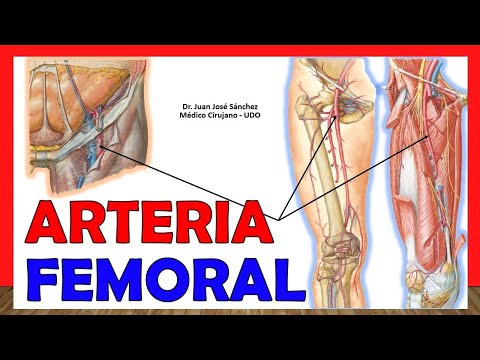
🥇 ARTERIA FEMORAL, Anatomía. ¡Explicación Fácil y Sencilla!
Introduction to the Femoral Artery
In this section, the speaker introduces the topic of the femoral artery and its importance in lower limb irrigation. The femoral artery is discussed as a continuation of the external iliac artery.
The Femoral Artery as a Continuation of the External Iliac Artery
- The femoral artery is not a branch but rather a continuation of the external iliac artery.
- It passes through the femoral canal and changes its name from external iliac artery to femoral artery at this point.
Course and Anatomy of the Femoral Artery
This section focuses on discussing the course, anatomical relationships, branches, and termination of the femoral artery.
Course and Relationships
- The femoral artery starts at the midpoint inguinal ligament after passing through it.
- It continues its course in an anterior direction within the thigh.
- In its superior third, it is relatively superficial.
- As it progresses towards the middle and inferior thirds of the thigh, it becomes deeper.
Termination
- The femoral artery terminates in a unique manner in comparison to other arteries.
- Its termination occurs when it reaches the inferior third of the thigh where it becomes deeper.
Understanding that Femoral Artery is a Continuation
This section emphasizes that understanding that the femoral artery is not a branch but rather a continuation is crucial for studying its anatomy.
Continuation vs. Branching
- The femoral artery should be understood as a continuation of the external iliac artery rather than being considered as a branch.
- Similar to how subclavian arteries become axillary arteries before changing names again, this is a common occurrence in arterial anatomy.
Superficial and Deep Regions of the Femoral Artery
This section discusses the superficial and deep regions of the femoral artery within the anterior thigh.
Superficial Region
- The superior third of the femoral artery is relatively superficial.
- It is located in the anterior region of the thigh, specifically within the femoral triangle.
Deep Region
- As the femoral artery progresses towards the middle and inferior thirds of the thigh, it becomes deeper and more medial.
- It passes through a well-known canal called the adductor canal or canal of Hunter.
Anatomy Surrounding Femoral Artery
This section provides an overview of anatomical structures surrounding the femoral artery, including muscles and ligaments.
Anatomical Structures
- The femoral artery is surrounded by various structures as it courses through different regions.
- In its course through the inguinal region, it passes below or behind (posterior to) the inguinal ligament.
- The iliac external artery gives rise to inferior epigastric arteries before passing beneath or behind (posterior to) the inguinal ligament.
Unique Arrangement with Femoral Vein and Nerve
This section explains how the femoral vein and nerve are arranged in relation to each other and to the femoral artery.
Arrangement with Femoral Vein and Nerve
- Within the femoral triangle, where it becomes deeper, the femoral artery is accompanied by both the femoral vein and nerve.
- The arrangement can be remembered using a mnemonic device:
- "VAN" - Vein (medial), Artery (middle or lateral), Nerve (lateral).
Femoral Artery in the Adductor Canal
This section discusses the femoral artery's location within the adductor canal and its relationship with other structures.
Location in the Adductor Canal
- As the femoral artery progresses deeper and more medial, it passes through the adductor canal.
- Within this canal, it is accompanied by the femoral vein and branches of the femoral nerve.
These notes provide a comprehensive overview of the transcript, highlighting key points about the anatomy and course of the femoral artery. The timestamps provided allow for easy reference to specific parts of the video for further study.
Anatomy of the Femoral Artery
This section provides an overview of the anatomy of the femoral artery and its branches.
Structure and Limitations of the Femoral Artery
- The femoral artery is limited by the vastus medialis muscle.
- It is commonly referred to as the first author and abs, with some theories suggesting it may also be referred to as the third author.
- The femoral artery runs superficially in the anterolateral region of the femur.
Course of the Femoral Artery
- The femoral artery passes through the famous ring of the third adductor muscle, known as the "anillo del tercer aductor."
- After crossing this ring, it ceases to be called the femoral artery and becomes known as the popliteal artery.
- The popliteal artery continues posteriorly and is accompanied by the femoral vein.
Branches of the Femoral Artery
This section discusses various branches that arise from the femoral artery.
Subcutaneous Abdominal Artery (Epigastric Superficial Artery)
- The subcutaneous abdominal artery arises immediately after leaving the femoral region.
- It crosses obliquely in an upward direction, passing over structures such as inguinal ligament or spermatic cord.
- It perforates through fascia lata to reach anterior part of hypogastric region where it terminates by anastomosing with inferior epigastric arteries.
Circumflex Iliac Arteries (External Iliac Circumflex Arteries)
- The circumflex iliac arteries are also known as external iliac circumflex arteries or superficial iliac circumflex arteries.
- They perforate the fascia lata and run superficially to the superior anterior iliac spine.
- They anastomose with deep circumflex iliac arteries.
Pudendal Arteries
- There are two groups of pudendal arteries: superficial and deep.
- The superficial pudendal artery runs medially, while the deep pudendal artery also takes a medial course.
- These arteries do not perforate the fascia lata and exit through the opening of the great saphenous vein.
- They supply blood to inguinal region, crossing structures such as spermatic cord in males or round ligament in females.
Functions of the Femoral Artery
This section highlights the functions of the femoral artery.
- The femoral artery not only supplies blood to the femoral region but also plays a role in irrigating the anterior abdominal wall and external genitalia.
New Section
This section discusses the anatomy of the femoral artery and its branches.
Anatomy of the Femoral Artery
- The femoral artery gives rise to several branches, including the superficial epigastric artery, superficial circumflex iliac artery, and deep external pudendal artery.
- The deep femoral artery, also known as the profunda femoris artery, is a prominent branch that runs posteriorly to the main femoral artery. It supplies blood to the muscles in the anterior and medial regions of the thigh and gives rise to perforating arteries.
- The perforating arteries pass through openings between muscles in the thigh and provide blood supply to these muscles. There are four perforating arteries, with three being called "perforating" and one considered a continuation of the deep femoral artery.
- The first three perforating arteries contribute to an anastomosis called "cruciform anastomosis" along with other arteries such as the inferior gluteal artery. These arteries also give off nutrient branches that supply blood to the femur bone.
- Two important branches of the deep femoral artery are the circumflex arteries: lateral and medial. They resemble similar branches in the upper limb (brachial artery). The lateral circumflex artery passes behind nerve branches while giving off ascending, transverse, and descending branches. The medial circumflex artery passes between muscles and gives off an acetabular branch that connects with other vessels like those from obturator artery.
- Both circumflex arteries have external branches that penetrate into joint capsules to reach the head of the femur for blood supply. Additionally, they may give rise to internal branches that irrigate structures within or around the hip joint.
New Section
This section continues discussing the branches of the deep femoral artery, specifically focusing on the superficial external arteries and their relationship with the head of the femur.
Superficial External Arteries and Their Branches
- The medial circumflex artery gives off superficial external arteries that perforate the joint capsule to reach the head of the femur. These arteries can be divided into anterior and posterior branches.
- The anterior branch of the medial circumflex artery contributes to anastomosis with other vessels, such as those from obturator artery, in supplying blood to the head of the femur.
- The posterior branch of the medial circumflex artery may give rise to an internal branch that also supplies blood to structures within or around the hip joint.
Timestamps are provided for each section based on available information in order to create a clear and concise summary using bullet points.
New Section
This section discusses the anatomy of the femoral artery and its branches.
Anatomy of the Femoral Artery
- The femoral artery is a deep artery located in the thigh.
- Its last branch is the descending branch, also known as the great anastomotic artery or arteria anastomosis magna.
- The descending branch divides into two main branches:
- One branch accompanies the internal saphenous nerve and is called the saphenous branch.
- The other branch is an articular branch that supplies blood directly to the knee joint.
New Section
This section explains the branching pattern of the descending branch of the femoral artery.
Branching Pattern of Descending Branch
- The descending branch immediately divides into two branches:
- One branch accompanies the internal saphenous nerve.
- The other branch is an articular branch that goes directly to the knee joint.
- The saphenous branch has an anastomosis at knee level and connects with the inferior medial genicular artery, which is a branch of the popliteal artery.
New Section
This section describes additional connections and anastomoses involving the descending branch of the femoral artery.
Additional Connections and Anastomoses
- The articular branches from both sides (superior lateral and inferior medial) connect with each other, forming a complex network of anastomoses in front of the knee joint.
- The lateral circumflex femoral artery descends towards the knee joint, connecting with superior lateral genicular arteries.
- The descending branch also connects with superior lateral genicular arteries through these anastomoses.
New Section
This section concludes the discussion on the descending branch of the femoral artery.
Conclusion of Descending Branch
- The descending branch of the femoral artery gives rise to various branches, including the saphenous branch and articular branches.
- The saphenous branch accompanies the internal saphenous nerve and has an anastomosis at knee level.
- The articular branches connect with the inferior medial genicular artery and supply blood to the knee joint.
New Section
This section provides a summary of the entire video and invites viewers to watch related videos on popliteal artery and leg arteries.
Summary and Conclusion
- The video discussed the anatomy of the femoral artery, focusing on its descending branch.
- Viewers are encouraged to subscribe, like, follow on Instagram, and watch other videos related to popliteal artery and leg arteries.
Timestamps may not be accurate due to limitations in processing audio. Please refer to the original transcript for precise timestamps.