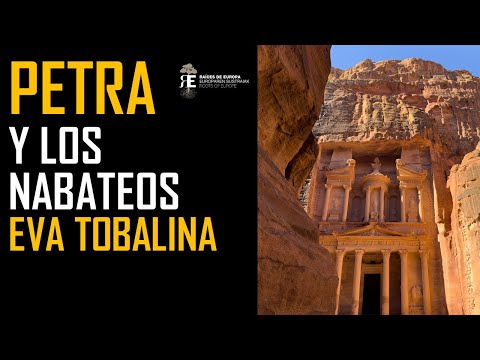
Petra y los Nabateos. Eva Tobalina
The Nabateans: Culture, Trade, and Decline
Lifestyle and Burial Practices of the Nabateans
- The Nabateans were primarily nomadic traders focused on luxury goods and livestock, with their main activities shifting after camel domestication opened new trade routes.
- They lived in tents rather than permanent settlements, as they were not primarily agricultural people.
- A notable custom involved burial practices; wealthy Nabateans preferred to construct mausoleums in one of four sacred cities instead of being buried near their settlements.
- These sacred cities held significant religious importance, serving as burial sites for kings and places for annual pilgrimages where rituals honored the deceased.
- Agra (modern Madain Saleh), another funerary city similar to Petra, was rediscovered later but shared architectural features with Petra.
Economic Prosperity and Decline
- The peak of Nabatean prosperity occurred between the 2nd and 1st centuries BCE, coinciding with the establishment of trade routes like the Silk Road.
- However, this period of splendor ended around 30 BCE when Rome took control over Egypt following Cleopatra VII's death.
- Romans became major consumers of luxury goods from Asia but faced high tariffs imposed by the Parthian Empire controlling Mesopotamia.
- After seizing Egypt, Romans sought direct access to Asian goods without relying on Parthian intermediaries.
- This led to Roman expeditions via Red Sea ports that had been previously closed during Ptolemaic rule, establishing a more efficient maritime trade route.
Impact of Roman Trade Routes on Nabatean Commerce
- Roman efforts included sending fleets directly to India for spices and silk while also reaching out to China for direct trade relations during the imperial era.
The Decline of the Nabataean Kingdom
Economic Challenges and Roman Conquest
- The Nabataeans, from major Syrian cities like Damascus and Palmyra, began to face economic decline by the end of the 1st century AD due to reduced demand for their products along trade routes with India.
- Roman attempts to conquer the Nabataean kingdom were made multiple times, notably by Pompey in the late 60s BC. Despite efforts, they faced strong resistance as the Nabataeans were at their peak power.
- By the early 2nd century AD, competition from Romans diminished the Nabataeans' commercial significance, leading to a loss of income sources and minimal resistance against Emperor Trajan's conquests.
- Trajan successfully annexed much of Nabataean territory, including Petra, transforming it into a Roman province called Arabia Petraea and marking a significant decline in Nabataean influence.
Natural Disasters and Cultural Shifts
- In the 4th century AD, Petra was devastated by a massive earthquake that destroyed many structures not carved into rock. A second earthquake in the 6th century further contributed to its abandonment.
- By the 6th century AD, with Christianity spreading through the region followed by Islam in the 7th century, traditional ceremonies honoring deceased individuals ceased as Petra fell into obscurity.
Rediscovery of Petra
- Johann Ludwig Burckhardt was born in Lausanne, Switzerland in the late 18th century. He came from a wealthy merchant family involved in trade similar to that of the Nabataeans.
- Burckhardt moved to England seeking adventure; he aimed to join an expedition across Africa around 1806 to explore sources of rivers like Niger.
Exploration Challenges
- The Niger River is one of Africa's largest rivers but remained largely unexplored despite being known since antiquity. Its source was unknown until modern exploration efforts began.
- By late 18th century knowledge about Niger was limited; explorers knew it flowed into Guinea Gulf but lacked information on its upper course or origins near Timbuktu—historically significant for gold trade before European discovery of America.
Expedition Preparations
- In late 18th-century explorations for Niger’s source faced violent encounters with indigenous populations which deterred many explorers from proceeding further inland.
- In response to these challenges, an expedition organized in London aimed at traversing sub-Saharan Africa towards Timbuktu and exploring upstream along Niger River for its mysterious sources.
Búrja's Journey to Syria and Beyond
Búrja's Initial Experience in Syria
- Búrja decided to move to Syria, specifically Aleppo, where he spent several years immersing himself in the local culture and language.
- He disguised himself as a local Syrian to avoid detection as a Western outsider while learning Arabic and Islamic faith fundamentals.
- In 1812, he prepared for an expedition from Cairo to Timbuktu, having gained sufficient knowledge of the language and religion.
The Dangerous Journey Begins
- The journey from Aleppo to Aqaba was perilous; Búrja faced multiple thefts and deceptions along the way.
- After being abandoned by a local guide in the desert, he managed to reach a village where he connected with locals for further assistance.
Exploration of Historical Sites
- Near his destination at Aqaba, Búrja sought out a legendary site known as Guadir Musa, believed by Muslims to be linked to Moses.
- This area featured a spring called "Moses' Spring," which locals believed had been opened by Moses during the Exodus.
Cultural Significance of Guadir Musa
- Jordan's geography is rich with references to the Exodus narrative; it includes sites like Mount Nebo where Moses supposedly viewed the Promised Land.
- Locals were hesitant to reveal hidden ruins due to beliefs that foreigners sought treasures within them.
Gaining Trust Among Locals
- To gain access to these ruins, Búrja pretended to be a devout Muslim wanting to honor Aaron by sacrificing a goat at his tomb.
- With minimal resources left after giving away valuables for assistance, he secured help from locals who guided him toward Aaron’s tomb.
Discoveries Along the Way
- As they followed the stream formed by Moses' Spring towards Aaron's tomb, they encountered ancient structures that intrigued Búrja.
Exploring the Sik and Its Historical Significance
The Journey Through the Sik
- The speaker describes following the course of the Guadimusa stream, leading to a narrow gorge that initially appeared closed but revealed a geological fault upon closer inspection.
- Today, the Sik is significantly altered from Burjar's original observations; he noted ancient canalization remnants in its walls, which were likely used for rainwater management.
- Since mid-20th century tourism began in Petra, over 40 floods have occurred in the Sik, resulting in tragic fatalities due to sudden water surges during storms.
- It wasn't until late in the 20th century that old Nabatean canalizations were restored and a dam was built outside Petra to mitigate flood risks for tourists.
- Burjar recognized ancient Nabatean canalizations over two millennia old that ensured orderly water flow through the Sik.
Discoveries Within the Sik
- After walking for half an hour through this unique gorge, Burjar encountered statues of mysterious deities and various water conduits, some of which have since disappeared.
- He described a mysterious arch with niches for statues at the entrance of the Sik; locals claimed no one had ever successfully climbed it, attributing its construction to "evil geniuses."
- Following his exploration of the Sik, Burjar discovered an extraordinary mausoleum carved into rock—its design aimed to impress travelers with its beauty and precision.
Architectural Marvels and Cultural Insights
- This mausoleum is among antiquity's most significant remains; locals refer to it as "the Pharaoh's castle," believing it served as a prince's residence rather than merely a tomb.
- As Burjar explored further inside this tomb complex, he was astonished by its well-preserved state despite being devoid of archaeological artifacts due to past looting.
- He marveled at intricate chambers and vibrant colors within these rock-cut mausoleums while feeling compelled to touch their surfaces—a testament to their craftsmanship.
The Theater and Its Importance
- Among his findings was an enormous theater surrounded by tomb structures; this discovery would later be crucial in understanding Nabatean civilization beyond its Greek-Roman facade.
- Burjar eventually reached what was once a lush valley nourished by the Guadimusa River—now much drier than during Nabatean times when gardens and trees thrived along its banks.
Final Observations on Structures
Exploration of Ancient Ruins and Bedouin Beliefs
Discovering the Temple
- The protagonist, Burjarnos, speculates that the well-preserved structure he is examining might be a temple or significant public building rather than a tomb, hoping to find inscriptions or statues for clues about its purpose.
- A Bedouin accompanying Burjarnos becomes suspicious of his intentions after observing him examine the site. He accuses Burjarnos of lying about his true purpose, suggesting he seeks hidden treasures instead of performing a sacrificial ritual.
Beliefs About Hidden Treasures
- There exists a common belief among Bedouins that foreigners are descendants of those who built ancient structures and possess knowledge about hidden treasures within them, which they do not share with locals.
- The Bedouins believe that these foreigners have magical abilities to locate treasures guarded by genies. This belief leads them to think that simply measuring columns could be interpreted as instructions given to these supernatural beings.
Challenges Faced by Burjarnos
- Due to the suspicions raised by the Bedouin, Burjarnos has to abandon his exploration efforts and repeatedly assure him that he is only interested in visiting Aaron's tomb for sacrificial purposes.
- Burjarnos expresses concern over losing his diary filled with valuable notes and sketches if discovered by the Bedouins, fearing they would mistake it for a magical book.
Ritual at Aaron's Tomb
- Ultimately, Burjarnos must give up on further exploring Petra. He describes the urgency of performing a ritual sacrifice at Aaron's tomb while being cautious not to attract attention from other Bedouins.
- After completing the sacrifice, he reflects on how tourists inadvertently create rock piles similar to those he made during his ritual above the sheep’s blood at Aaron’s tomb.
Historical Significance and Further Travels
- The absence of similarly sized cities in the region convinces Burjarnos that he has discovered Petra—the legendary capital of Arabia Petria—based on historical accounts linking it to Aaron's burial site.
The Journey of Exploration and Discovery in Petra
Early Challenges and Discoveries
- The speaker recounts the struggles faced by an explorer suffering from dysentery while traveling to Mecca in 1817, highlighting the difficulties of exploration during that era.
- The explorer kept a secret diary filled with notes, maps, and observations about his travels, which he later sent to Europe. This diary became crucial for future expeditions.
The First Scientific Expedition to Petra
- In 1829, a French-led expedition created the first map of Petra, detailing routes through significant landmarks like the Siq and the Tomb of the Treasure.
- This expedition produced early illustrations of Petra that were published in Europe, marking a pivotal moment in its historical documentation.
European Fascination with Nabatean Culture
- Upon seeing engravings from this expedition, Europeans were captivated by Nabatean tombs that combined Greek and Egyptian architectural elements.
- Initial explorations were influenced by biblical accounts and classical authors; however, these sources provided limited information about the Nabateans.
Unraveling the Mysteries of Nabateans
- Questions arose regarding who built these tombs and why they constructed cities amidst their burial sites. The remaining structures primarily consisted of mausoleums and temples.
- Early photographs taken around 1860 showcased Petra's challenging accessibility due to nomadic tribes inhabiting the area.
Archaeological Challenges in Petra
- Accessing Petra was difficult due to local beliefs about outsiders stealing treasures; travelers often required armed escorts for safety.
- Significant archaeological excavations did not occur until after World War I when British control allowed for more organized scientific efforts.
Resurgence of Interest Post-War
- Following World War I, archaeological expeditions began uncovering Nabatean artifacts such as pottery and inscriptions that revealed aspects of their culture.
- The 1920s marked a peak period for exploration in Petra as Victorian travelers documented their experiences, bringing renewed attention to this ancient city.
Turn any video into a summary like this
YouTube links, meetings, lectures — with transcripts, search, and chat.