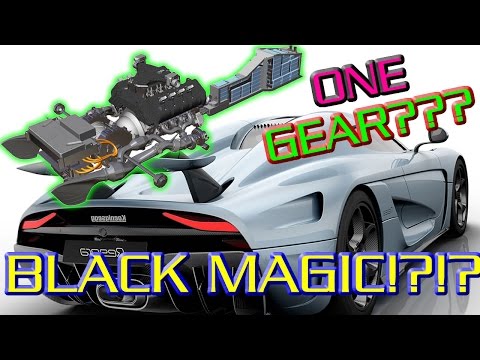
Explained: How does the Koenigsegg Regera work with only ONE GEAR???
Introduction to the Koenigsegg Regera
Overview of the Regera
- The Koenigsegg Regera is a newly launched hybrid car, marking a shift from the company's previous stance against hybrid technology.
- A key feature of the Regera is its lack of a traditional gearbox; it operates with a fixed gear ratio, which has caused some confusion among potential buyers.
Drivetrain and Torque Vectoring
- The Regera features a drivetrain that converts engine power from longitudinal to lateral direction without switchable gears.
- It includes one electric motor on the crankshaft and two additional motors for rear wheels, allowing for individual wheel torque vectoring, enhancing handling performance.
Hydraulic Coupling Mechanism
Understanding Torque Multiplication
- The connection between the engine and rear differential utilizes a hydraulic coupling instead of a clutch, enabling torque multiplication across different RPM ranges.
- This system can achieve torque multiplication through fluid dynamics rather than mechanical gears, differentiating it from traditional systems like those in automatic cars.
Comparison with Agera R
- In contrast to the Agera R's seven-speed gearbox with specific ratios, the Regera’s design simplifies gear management while still achieving effective performance metrics.
Torque Converter Dynamics
Functionality Explained
- A torque converter functions by using fluid dynamics to multiply input torque at varying RPM levels; this is crucial for understanding how the Regera achieves its performance.
- Typical reduction ratios range from 2.5:1 in cars to 5:1 in heavy machinery, balancing efficiency and weight considerations in design.
Calculating Effective Ratios
- By analyzing gear ratios from both models (Regera vs. Agera R), we can derive necessary multipliers for effective speed management under different driving conditions.
Performance Metrics and Speed Ratios
Analyzing Top Speeds
- The effective first gear ratio for the Agera R is noted as 11.4:1; calculations show that achieving similar performance metrics in the Regera requires an effective torque production ratio of 4:1.
Implications on Engine Performance
- Despite having lower top speeds compared to Agera R (250 mph vs. 273 mph), calculations indicate that maintaining these speeds requires only marginally higher engine rev rates due to efficient gearing strategies.
Low-Speed Operation Considerations
Internal Combustion Engagement
Power and Performance of Hybrid Vehicles
Overview of Electric Motors
- The vehicle features two rear electric motors and one front motor, with each rear motor rated at 180 kW, totaling 360 kW of power. This level of power contributes to rapid acceleration.
Weight and Grip Calculations
- The car weighs approximately 1.6 tons, with an assumption that 70% of this weight is on the axle, resulting in about 11 kN of grip available under ideal conditions.
Power Dynamics and Traction
- Using the formula P = F × v (power equals force times velocity), the speaker discusses how to calculate traction limits based on power output and grip levels.
- Acknowledges that while this calculation is simplistic, it provides a conservative estimate for speed before losing traction; calculated speed is around 32 m/s or roughly 57 km/h.
Engine Engagement Strategy
- The petrol engine kicks in at around 30 mph (approximately 48 km/h), strategically designed to engage when electric motors can no longer maintain traction alone.
Torque Management
- Discusses the importance of having a powerful front electric motor to mitigate turbo lag during acceleration phases, ensuring smooth transitions between electric and petrol power sources.
Efficiency Considerations
- Highlights how the integration of electric motors helps maintain a flat torque curve during acceleration, enhancing overall performance by filling gaps in power delivery.
Transmission Mechanics
Gearbox Design Insights
- The discussion includes potential confusion regarding whether quoted torque figures are at the wheels or crank due to final drive considerations; marketing often skews clarity for impact.
Losses in Transmission Systems
- Mentions that while torque converters may introduce losses, these are offset by efficiency gains from removing traditional gear sets which also contribute to weight reduction.
High Power Capabilities
- With a total output figure around 1800 horsepower, there's less concern over low first gear ratios since high-powered vehicles can utilize electric motors effectively for initial acceleration.
Future Prospects and Conclusion
Anticipation for Performance Testing
- Expresses excitement about testing the vehicle's performance against other hypercars given its impressive specifications—weight and power ratio being particularly noteworthy.
Viewer Engagement