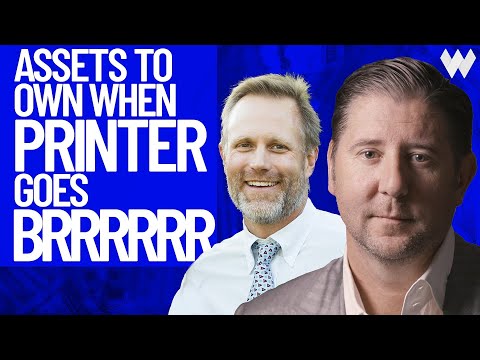
'Everybody Will Have To Print' When The Next Crisis Hits - So Own These Assets | Brent Johnson
Introduction
In this video, Wealthion Founder Adam Taggart interviews Brent Johnson, a US dollar expert. Brent shares his thoughts on the recent headlines about de-dollarization risk and how he is allocating his portfolio for the second half of the year.
Investment Themes
Brent discusses how he is allocating capital in his portfolio.
Allocating Capital
- Brent's clients own equities that they have owned for years.
- At times, they hedge them and at times they don't.
- Currently, they have them hedged which has been frustrating as markets are up.
- Brent believes there was a lot of risk involved in getting returns this year.
- He thinks the easy money in risk assets has been made this year.
U.S Equities
- When Brent says equities, he means mostly U.S equities.
- He doesn't think you need to go overseas or invest in emerging markets as the additional risk isn't worth it.
Attributes of Equities
- Because of where we are and because we're going to face a recession, Brent wants to be in big battleship companies that pay nice dividends such as John Deere, Coca-Cola, Philip Morris and Lockheed Martin.
- These companies yield anywhere from 3% to 5%.
Portfolio Allocation
- If you put 10 or 20% gold in your portfolio and 40 or 50% equities in your portfolio of big blue-chip type names that yield anywhere from three to five percent and then put the rest of your money into T-bills that yield four and a half or five percent, it's not too bad of a portfolio right now.
Assets to Go to War With
Brent discusses the assets he would go to war with.
US Equities, Gold and Treasuries
- Brent's three main assets are US equities, gold and treasuries.
- He believes everyone should own real estate but not have all their money in it as it's not portable and easily taxed.
Conclusion
Brent concludes by stringing together a couple of recent expert opinions.
Real Estate Investment
- Brent thinks history shows that owning land is actually a pretty good investment if you can keep it.
The Narrative of De-Dollarization
In this section, the speaker discusses the narrative of de-dollarization and how it is being sold to people. He talks about the need for the world to be comfortable with retiring in China and storing money in Moscow, but also highlights concerns around past regimes that have confiscated land and lack of property protection.
Concerns Around De-Dollarization
- Past regimes have a history of confiscating land and lack property protection.
- Leaders in other countries do everything they can to get their wealth outside those countries.
- Wealthy people in the world don't hold rubles or other currencies.
- Chinese hold dollars instead of other currencies.
Capital Flight from China
In this section, the speaker talks about capital flight from China and how it has led to wealthy Chinese investing in real estate in places like San Francisco Bay Area.
Real Estate Investment by Wealthy Chinese
- Realtors were flying Chinese over to invest in real estate.
- Houses are used as a store of value rather than being lived in.
- There are no corresponding plane loads of American investors going into Shanghai or Beijing.
The Dollar Falling Allows the System to Continue Running
In this section, the speaker discusses how a falling dollar allows the system to continue running. He explains that it's not the dollar falling that causes problems but rather it's the dollar rising that causes problems.
Impact of Dollar Falling on System
- The dollar falling allows the system to continue running.
- The rest of the world will continue to issue debt and trade in US dollars even if they talk about de-dollarizing.
The Dollar Milkshake Theory
Brent Johnson discusses the Dollar Milkshake Theory and how it explains the strength of the US dollar in the early post-pandemic months.
The Strength of the US Dollar
- The rest of the world was sicker than the US, causing capital to flow into US markets.
- The theory has helped Johnson make sense of market movements over the last four years.
- Johnson believes that until a sovereign debt crisis occurs, his framework will remain valid.
Thoughts on Central Bank Policy
Brent Johnson shares his thoughts on Federal Reserve policy and whether he expects a pivot in response to economic weakness.
Federal Reserve Policy
- Johnson expects economic weakness in the second half of 2021.
- Central bankers exist to be lenders of last resort and will pivot if necessary.
- However, Johnson does not believe Powell will pivot as quickly as some expect.
Economic Slowdown and Dollar Strength
In this section, the speaker discusses the possibility of an economic slowdown in the second half of the year, a potential recession, and how it could affect the strength of the US dollar.
Possibility of Global Recession
- The speaker believes that there is a good likelihood of an economic slowdown in the second half of this year, possibly leading to a recession.
- As other countries print more money and inject it into their markets, it will eventually find its way into US markets and strengthen the US dollar.
- If there is a global recession, weaker countries will seek safety in the US dollar causing it to strengthen.
Central Banks' Response
- Several world central banks have already switched to pausing. Australia, New Zealand, Canada, India are among them.
- If Powell resists pivoting for as long as he can then relief may not come immediately.
- When prices start coming down due to rising dollar value that forces a pivot.
Market Outlook
- The speaker expects that we will revisit last year's lows but is unsure if we'll go lower than that.
- Markets are expected to go down with allocation hanging out.
Fed Pivot and Extreme Response
In this section, the speaker discusses what could force Powell's pivot and how extreme his response might be.
Likelihood of Pivot
- The speaker thinks Powell will resist pivoting for as long as possible but things could get bad enough where he has no choice but to pivot in a big way.
- If Powell waits for there to be a lot of pain, he can pivot without a lot of risks to himself.
Brent Johnson's Work and Contact Information
In this section, Brent Johnson shares his contact information and where people can follow him.
Brent's Contact Information
- Brent is very active on Twitter and enjoys debating with people there.
- He also co-hosts a podcast called Milkshakespod which can be found at milkshakespod.com or on Twitter.
- For those who are not familiar with all the topics that he has discussed, they can check out some of his historical interviews on Adam's Channel.
Recommended Video for Deep Dive into Dollar Milkshake Theory
In this section, Adam recommends a video for those interested in getting a deep dive into the dollar milkshake theory.
Recommended Video
- If you want to get a deep dive into the dollar milkshake theory itself and really hear Brent expound on it for the better part of an hour, Adam recommends watching this video.
- The link to the video will be provided in the edited version of this discussion.
Santiago Capital Management Services
In this section, Brent Johnson talks about Santiago Capital Management services.
Santiago Capital Management Services
- Santiago Capital manages capital for accredited investors.
- Their minimum account size is bigger than typical places but anyone interested in customized separate account management can reach out to them at brent@santiagocapital.com.
- Their website is santiagocapital.com which is just a landing page with contact information.
New Harbor Financial Partners' Reactions to Brent's Commentary
In this section, John Lodra and Mike Preston from New Harbor Financial Partners react to Brent's commentary and provide updates on the markets.
Reactions to Brent's Commentary
- Brent is notorious for his milkshake theory which is quite substantive in terms of his framework for looking at the US dollar and its role in the world.
- The unseating of the US dollar isn't going to be an overnight or easy thing, and Brent provides a credible picture as to why.
- The Global Financial system is very complicated, and our powers that be aren't going to let the dollar just be pushed aside.
- One of the complicating factors is just the sheer size of the Euro.
Market Updates
- John Lodra and Mike Preston from New Harbor Financial Partners will provide market updates.
US Dollar Strength in Sovereign Debt Crisis
The US dollar will see strength in a sovereign debt crisis due to its dominance, according to Brent Johnson.
Key Points:
- In times of crisis, parties globally will flee to the US dollar.
- The US dollar is a very good place to be during a crisis.
- Gold is also seen as a constructive place during these times.
Unlikelihood of Currency Union for BRIC Countries
Brent Johnson makes a credible case for why forming their own currency union is not going to happen anytime soon for BRIC countries.
Key Points:
- It's tempting to look at headlines about BRIC countries talking about forming their own currency union.
- Brent makes a credible case as to why that's not going to happen anytime soon.
Importance of Gold in Prudent Positioning
Gold is an important part of prudent positioning for the current environment, according to Brent Johnson and the speaker.
Key Points:
- Gold is a very important part of prudent positioning for the kind of environment we're in.
- There can be too much of a good thing with gold, but it's still an important part of positioning.
- A portfolio with 10-20% gold, 40% Blue Chip equities, and the rest in T-bills is seen as no-brainer by Brent Johnson.
Differences in Portfolio Positioning
There are some key differences between the speaker's take and Brent Johnson's take on portfolio positioning.
Key Points:
- The only part where there might be some difference with Brent Johnson is on having 40% Blue Chip equities.
- US stocks are dramatically overvalued still, and we're just starting to see some of the kinds of erosion in earnings and margins that can be reasons for a dramatic re-rating downward of valuations.
- Global investments, especially Emerging Markets equities, are far better valuations and far better risk reward right now than the US market.
Extreme Capital Allocation Decisions
People should avoid making extreme capital allocation decisions out of anxiety that the US dollar regime is going to end tomorrow.
Key Points:
- Brent Johnson's concern is that people are reading these dire headlines getting all agitated and then making perhaps fairly extreme Capital allocation decisions out of this anxiety that the US dollar regime you know is going to end tomorrow.
- People have made really extreme decisions about something they were so emotionally sure was going to happen imminently, but it doesn't happen.
- It can be very injurious if they kind of pushed all their chips all in on that very emotional bet.
Potential Risk to US Dollar Dominance
The potential risk to the US dollar dominance is discussed by Brent Johnson and Mike.
Key Points:
- Potentially, the US dollar system could be at risk.
- These things in history happen over large swaths of time in one human lifetime or career which is relatively short in comparison.
- Brent talks a lot about the us being a bully in the U.S dollar system and being bully-like to other countries.
Building It: The Money Printing Bubble
In this section, Brent Johnson discusses the dangers of money printing and how it can lead to conflict and war. He also talks about the current state of the markets and how they have been going sideways for the past two years.
Dangers of Money Printing
- Major central banks are all in on money printing with no other plan.
- This is a dangerous thing as it can lead to conflict and war.
- Brent Johnson is a great money manager who has been warning about these dangers for a long time.
Current State of Markets
- Markets have been violently going sideways for the past two years.
- S&P is trading at the exact same place it was two years ago.
- Two-week volatility is as low as it's been in many years, indicating very little fear in the market.
- Alf Piccatello compares summer 2023 potentially to summer 2007 when volatility was low after FED raised rates three points or so.
Hedging Strategies
- If S&P gets over 4200, puts will be cheaper, making it a good time to hedge your portfolio.
- Good time to raise cash now because valuations remain amongst the most extreme in history.
- There's no telling what could cause this market to roll over; one or two bad days could break technical indicators that were lining up bullish.
- Historically, when central banks pivot and start printing and easing, markets often fall right through there.
- Long-term bonds are the best hedge for your portfolio because they are levered to drops in interest rates.
Conclusion
- Powell will not pivot until things get really bad, which could drop S&P to around 3200.
- Brent Johnson and Alf Piccatello agree that hedging strategies should be implemented now rather than waiting for the summer.
Market Analysis and Predictions
In this section, the speaker discusses market analysis and predictions for the future. They connect dots with earlier interviews and discuss similarities between current market conditions and those of 2007. They also mention Michael Cantrowitz's interview, which provides empirical data-driven arguments for why a recession and market correction are highly likely this year.
Similarities to 2007
- The speaker mentions that Elf sees similarities between current market conditions and those of the summer of 2007.
- Elf believes that things will not hang together until the end of the year, unlike in 2007 when they did. He thinks that the wheels are likely to come off sooner this time around.
Michael Cantrowitz Interview
- The speaker mentions that Michael Cantrowitz has a price target of 3200 for the S&P by the end of this year.
- Michael Cantrowitz's interview provides empirical data-driven arguments for why a recession and market correction are highly likely this year.
- Michael Cantrowitz's "hope" framework stands for housing, orders, profits, and employment. It gives us a strong sense of what timing we should expect and lets us monitor where we are in this cycle.
- Unemployment is beginning to look wobbly, which is when Michael says that's when a new bear Market starts.
Fed Response
- The Fed will respond at some point after something big enough breaks; it'll get bad enough that they'll have to shift policy from tightening to easing.
- The swing back to easing will probably be as violent as the tightening cycle.
- Elf predicts that we will go back to zero, and markets will get caught in a pretty bad downdraft. Puts are getting really cheap right now.
Investing Strategies for the Current Market
The speakers discuss investment opportunities in the current market and provide insights on how to hedge against potential risks.
Buying Bonds Before a Recession
- Buying bonds a couple of months before the start of a recession can be a good opportunity to lock in high rates.
- If the market rolls over and the FED aggressively starts easing, bringing interest rates down, the market value of bonds can start going up.
- Analysts are increasingly saying that this is when the lights begin to flash green for certain asset classes.
- There are ways to combine different option strategies for hedging instead of just buying puts.
Hedging Strategies
- Hedging costs money, so there are thoughtful strategies that one can use to defray the cost of hedging.
- Sensible ways you can hedge your portfolio include combining different option strategies or holding 40% in good quality equities.
- New Harbor provides hands-on help with specialized situations where selling is not an option due to capital gains.
Michael Cantrow's Talk
- Michael Cantrow's talk provides an analytical and data-driven approach to investing.
- He talks about how housing peaked in terms of new construction in November 2020, ISM orders peaked in March 2021, and corporate profit margins peaked in June 2022.
- Analyst profit projections are starting to be trimmed, which is consistent with Michael's cycle framework.
- The big question is whether we will see employment take a topple this year.
The Hope Model
In this section, the speaker discusses the Hope Model and how it predicts a recession based on various data inputs.
Predicting a Recession
- The speaker explains that the Hope Model is built off of decades of data from previous recessions.
- The model predicts a recession if certain dominoes fall, such as profit margins decreasing and P/E ratios increasing.
- Various experts in different fields, such as housing and finance, are agreeing with what the Hope Model is saying.
- The speaker notes that there are many different inputs that are all saying the same thing, which increases confidence in the model's predictions.
Soft Landing vs. Hard Landing
- The speaker explains that whether or not a recession will be a soft landing or hard landing depends on certain factors.
- These factors include inflation, rapid Federal Reserve rate hikes, and tightening bank lending standards.
- Based on current economic conditions, the speaker believes that we are headed towards a hard landing.
Severity of Recession
- The severity of the upcoming recession is uncertain but could potentially send markets downwards by a material amount.
- The Federal Reserve is unlikely to ease up on its tight policies until it becomes necessary to protect its credibility.
- Once this happens, they may pivot with similar intensity to when they tightened policies previously.
Considering Recession and Market Correction
The speakers discuss the possibility of a recession and market correction, urging investors to take it into consideration when allocating their capital.
Taking Recession and Market Correction into Consideration
- Alf advises that the best time to buy bonds is three or four months before a recession.
- The odds of a recession are high based on data presented by Alf.
- Dollar cost averaging is recommended for those who do not have exposure to bonds yet.
- It's not advisable to try to pick a magical top or bet on when the recession will hit.
Gold Pullback and Portfolio Check-In
The speakers discuss gold's recent pullback and its impact on portfolios.
Checking in with Gold
- Gold has seen a little bit of a pullback this week, dropping below 2000 at one point.
- It's unclear whether gold has recovered above 2000 yet.
Bonds and TLT Trading
The speakers discuss bonds trading, particularly long-term U.S. treasury bonds (TLT).
Buying Long-Term Bonds
- Dollar cost averaging is recommended for buying long-term bonds.
- Ticker symbol TLT can be used as an easy reference for long-term U.S. treasury bond trading around 104.
- If there is a large panic moment later on, especially if we go back to zurp, all bonds could trade much higher, including TLT.
Fed Policy and Bond Trading
The speakers discuss how Fed policy affects bond trading.
Fed Policy and Bond Trading
- The Fed is stubborn and unlikely to pivot anytime soon.
- They will wait for some kind of economic accident or for the recession to actually come before going in and buying bonds.
- Bonds will react to that point.
Dollar Cost Averaging into Bonds
The speakers discuss the importance of dollar cost averaging when investing in bonds.
Investing in Bonds
- Waiting for the 10-year yield to get back up to four is not advisable.
- Dollar cost averaging is recommended instead, as it's not necessary to be perfect when investing.
- It's important to keep your eye on the big picture and not make any big bets.
Gold Futures and Pullback
The speakers discuss gold futures and its recent pullback.
Checking in with Gold Futures
- Gold futures are still looking beautiful, with a healthy pullback this week.
- Spot gold is just about 2000.
Gold Mining Stocks and the Dollar
In this section, the speakers discuss gold mining stocks and their potential to rise if gold prices continue to increase. They also talk about the recent weakness of the dollar and how it could impact gold prices.
Gold Mining Stocks Potential
- If gold clears $2100, gold mining stocks like GDX could go higher into the high 30s.
- The gap between miners and gold price needs to close for miners to perform better.
- Miners are still underperforming compared to when gold was above $2000 an ounce.
Weakness of the Dollar
- The dollar has been weak over the last few weeks and months.
- Over the last couple of days, there has been a bounce in the dollar causing a normal reaction back in gold.
- For near-term outlook, it looks like the dollar could continue its downtrend or even have another flush lower which could give us that pop in gold prices.
Investing Strategies for Downside Risk
In this section, they discuss investing strategies for downside risk as well as how to protect your capital during a recession.
Probability of Recession
- As per Michael Cantorowitz's analysis, there is a compelling empirical case for arrival of recession and lower market prices this year.
- It is important to factor in downside risk while planning investments.
Personalized Investing Plan
- Highly recommend working with a professional financial advisor who takes into account all macro issues discussed by speakers.
- Create personalized investing plan based on individual needs, goals, personal situation, risk tolerance etc.
- Financial advisor should execute plan including making changes based on changing landscape.
Free Consultation
- Schedule a free consultation with one of the financial advisors endorsed by WealthyOn to get a second opinion.
- The consultation is a free public service that they offer to help as many people as possible position themselves for success.
Tax Planning Strategies
John and Adam discuss the importance of tax planning and offer some strategies to help viewers reduce their tax footprint.
Importance of Tax Planning
- Tax planning is an important part of financial planning.
- Many investment-related decisions have tax implications.
- It's important to work with a financial advisor and accountant to develop a tax-aware plan.
Tax Planning Strategies
- Consider converting traditional IRAs into Roth IRAs while staying in a favorable tax bracket.
- Look at reported capital losses and carryover losses that can be used to offset gains in appreciated securities without incurring capital gains taxes.
- Distribute funds today at current tax rates and get them into a tax-free Roth IRA so that if taxes increase in the future, assets grow tax-free.
- Work with an accountant early in the year to determine what steps you can take throughout the year to reduce your tax footprint.
Partnering with an Accountant for Tax Planning
Adam emphasizes the importance of partnering with an accountant for effective tax planning.
Benefits of Partnering with an Accountant
- Working with an accountant early in the year allows for more proactive planning.
- An accountant can help identify deductions that might otherwise be missed.
Tom Wheelwright's Advice
- Tom Wheelwright encourages people to partner with a good accountant who can help them determine what steps they can take throughout the year to reduce their tax footprint.
Free Consultations from New Harbor Financial
Adam promotes free consultations with financial advisors at New Harbor Financial.
Benefits of Free Consultations
- The consultations are completely free and have no strings attached.
- Advisors will answer any questions about investment goals or portfolios and give their best advice based on the latest market outlook.
- New Harbor Financial cares about protecting people's wealth and has connected with many thoughtful investors over the past decade.
Investing During Challenging Times
In this section, the speaker discusses the challenges of investing during unprecedented times and recommends working with a professional financial advisor.
Working with a Professional Financial Advisor
- The speaker believes that today's investors are best served working in partnership with a conscientious professional financial advisor who understands the risks in play.
- The speaker is agnostic about which professional advisor you work with as long as they're good.
- If you don't have an advisor or are having trouble finding one you respect or trust, consider talking to John and Mike and the team at New Harbor.
- There is a business relationship between WealthyOn and New Harbor which has been put in place to make sure everything is handled according to SEC regulations. All details on this are clearly provided on the WealthyOn.com website.
- New Harbor is able to work with U.S citizens, green card holders, and those with existing assets in the USA but for regulatory reasons they aren't able to take on non-US clients.
Protecting Your Wealth
- If you'd like some insight and guidance on how to protect your wealth during this unprecedented time in the markets go to WealthyOn.com to schedule your free consultation with the good folks at New Harbor.
This transcript was entirely in English so I responded using English language only.
Turn any video into a summary like this
YouTube links, meetings, lectures. With transcripts, search, and chat.